

Boavus was an Eocene booid snake from North America. One species is known from a nearly complete skeleton on a slab. A museum cast of this missing specimen preserves evidence unavailable from isolated vertebrae.
Quick facts
| Group | Snakes, booids (Booidea) |
|---|---|
| Age | Early and Middle Eocene |
| Region | North America, United States |
| Type species | Boavus occidentalis |
| Scientific name | Boavus |
| Diet | Exact prey is unknown |
What can the fossils tell us?
Trunk vertebrae, parts of the jaw and several skull bones are known. A cast preserves one nearly complete skeleton.
Vertebral anatomy helps distinguish species, and cranial and vertebral characters together inform comparisons with other booids.
The closest relatives of Boavus within Booidea depend on the characters and methods used in the analysis.
The Wyoming fossils
Othniel Charles Marsh established the genus Boavus in 1871. The type species, B. occidentalis, comes from the Bridger deposits of Wyoming. Later work referred a lower jaw, a quadrate and additional vertebrae to that species. They extend the set of characters available for comparison with Marsh’s material.
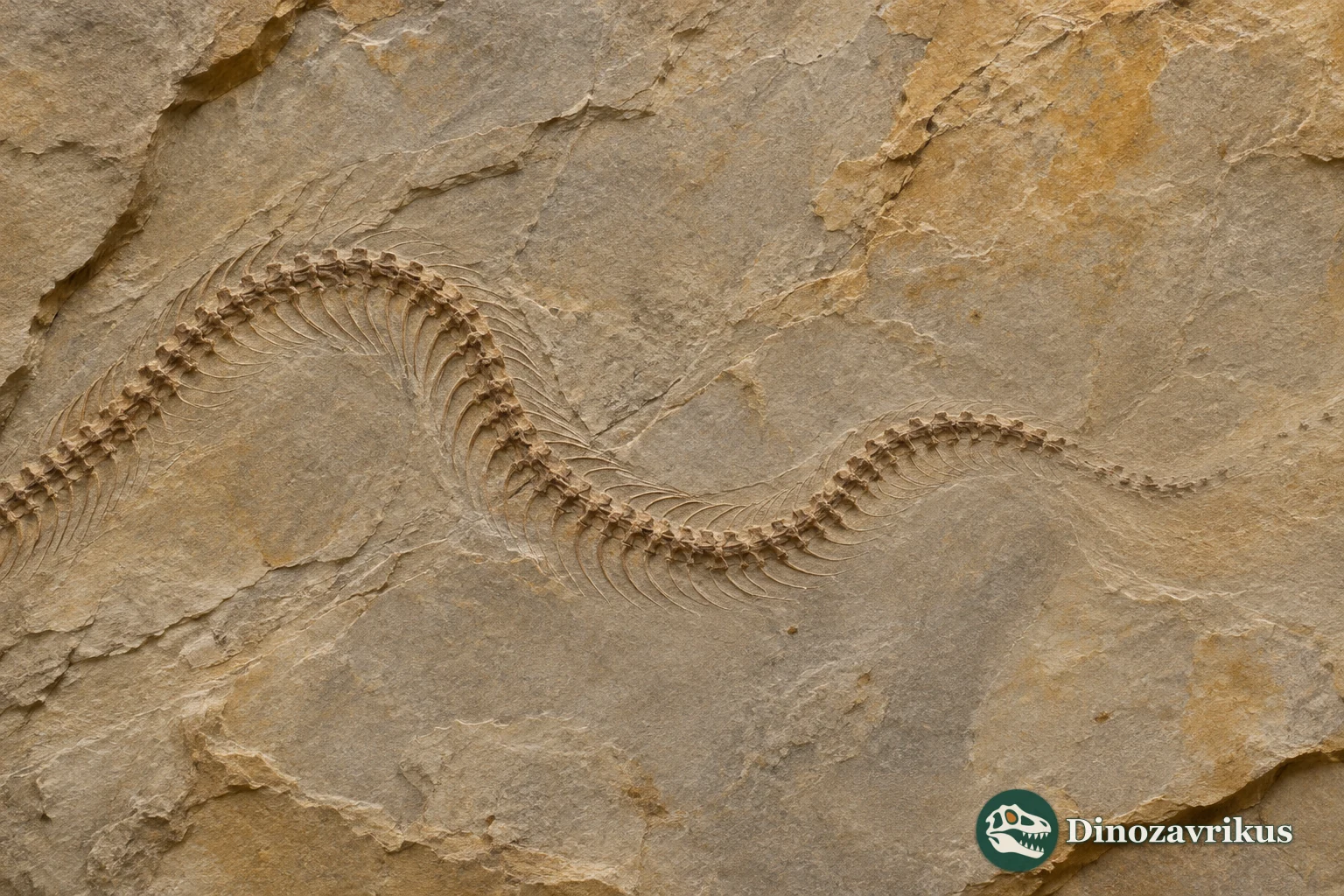
What a cast preserves
Charles Gilmore named B. idelmani in 1938. Its nearly complete skeleton was preserved on a slab from Fossil Basin, Wyoming, probably from the Eocene Green River Formation. The original specimen is missing. The American Museum of Natural History holds the plaster cast AMNH 3850, on which a long series of vertebrae and parts of the head are still visible.
Distinguishing species along the spine
Trunk vertebrae of B. occidentalis are robust, with a strongly vaulted arch. In B. brevis they are flatter and the neural spine is shorter and lower. The 2022 revision recognised the same combination in vertebrae from different trunk positions and in a young individual assigned to B. brevis. That consistency supports the distinction between the species.
Its place among the booids
Analyses based on skull and vertebral anatomy place Boavus among the booids, with results differing about its closest relatives. Some Eocene European snakes had similarly robust vertebrae. The much younger Bavarioboa offers a comparison with a later booid from Europe and Anatolia.
Frequently asked questions
Which is the type species?
Boavus occidentalis, named by Marsh from specimens in Wyoming.
Does the nearly complete Boavus skeleton still exist?
The original slab of B. idelmani is regarded as lost. The American Museum of Natural History holds its cast, AMNH 3850.
How do the vertebrae of two species differ?
The trunk vertebrae of B. occidentalis have a higher, more strongly vaulted arch than those of B. brevis.
Do fossils reveal the colour of Boavus?
Its colour and scale pattern remain unknown. They are approximate in the illustration.