

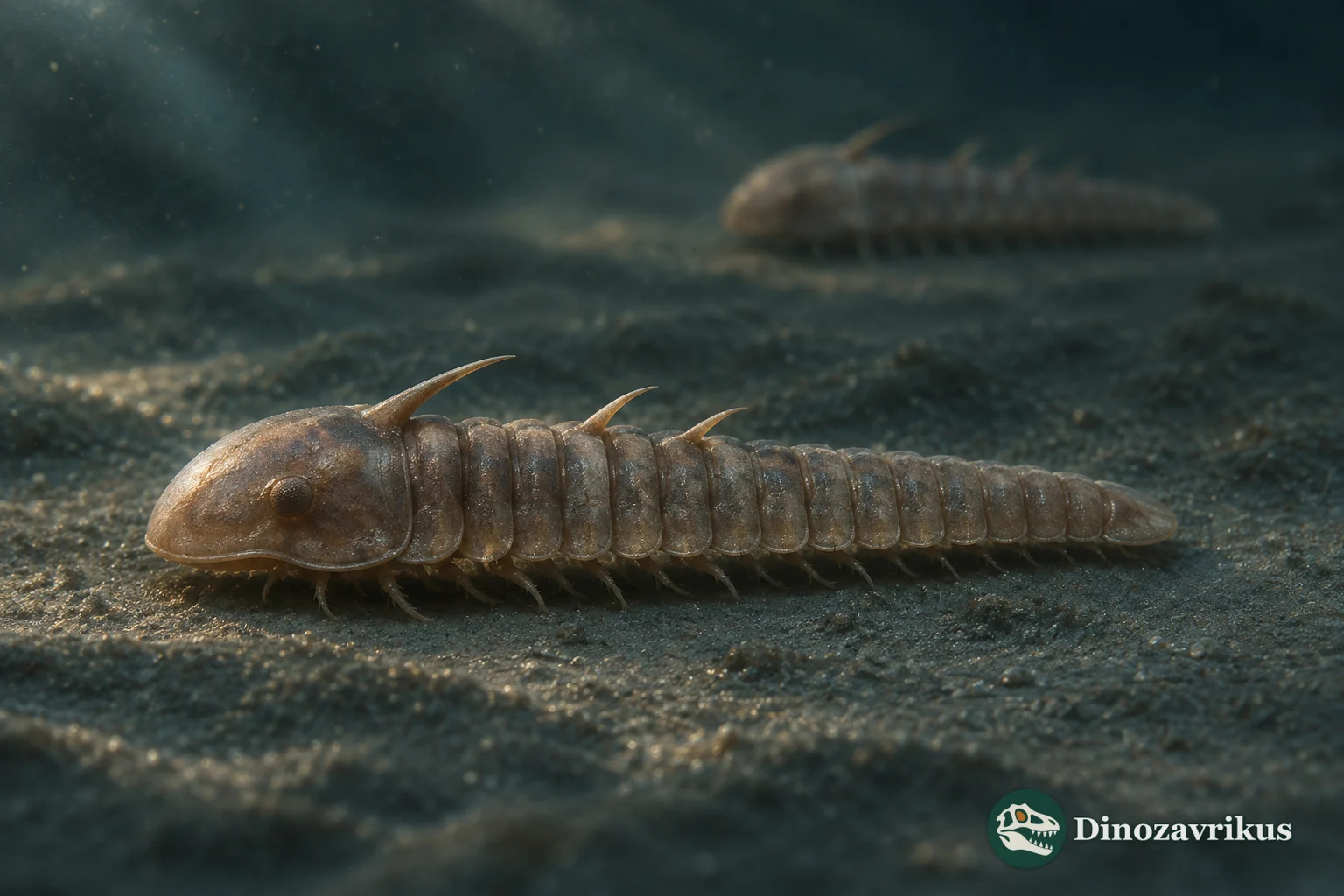
Bolaspidella was a North American trilobite genus. The type species from Utah had a spine projecting behind the head and smaller projections along the thoracic midline. The fossils include articulated adults as well as minute shells from early growth stages.
Quick facts
| Group | Trilobites |
|---|---|
| Age | Cambrian, Miaolingian |
| Region | North America (United States and Greenland) |
| Diet | Unknown |
| Type species | Bolaspidella housensis |
| Genus named by | Charles Resser, 1937 |
What can the fossils tell us?
USNM 24614 came from the Wheeler Formation. The preserved central part of its head shield is four millimetres long.
Articulated shells preserve the full series. A different species from Utah, B. reesae, had 24 thoracic segments.
Small shields from the Marjum Formation show how the armour changed before separate thoracic segments appeared.
The Wheeler Formation type
Charles Walcott described the type species as Ptychoparia housensis in 1886. The name refers to the House Range of Utah. Charles Resser made it the type of Bolaspidella in 1937. The holotype is housed at the Smithsonian National Museum of Natural History. Allison Palmer’s redescription documented a spine projecting back from the occipital ring.
Articulated Utah fossils show that B. housensis had 15 movable thoracic segments. Some have a spine at the midline. The same beds yield Elrathia kingii. The two have different segment counts and differ in the shape of the central thoracic lobe.
Growth stages and larger relatives
Fossils from the Marjum Formation include protaspides, the earliest growth stages known for the species. Dong-Chan Lee and Brian Chatterton distinguished three stages by the distance between the rear outer corners of the fixed cheeks. At these stages the dorsal shell is a single shield. Movable thoracic segments appear later as the animal moults.
B. housensis rarely exceeded a centimetre in length. Another Utah species, B. reesae, reached 22 millimetres and had 24 thoracic segments. Richard Robison named B. stymacantha from the Holm Dal Formation of North Greenland. The collections show how widely the armour varied among species of the genus.
Frequently asked questions
Where was the type species found?
Its original material came from the Wheeler Formation in the House Range of Utah.
How many thoracic segments did Bolaspidella have?
The type species had 15. B. reesae had 24.
What is a protaspis?
It is an early trilobite growth stage in which the dorsal shell forms a single shield.
Which species is known from Greenland?
B. stymacantha was described from the Holm Dal Formation.