

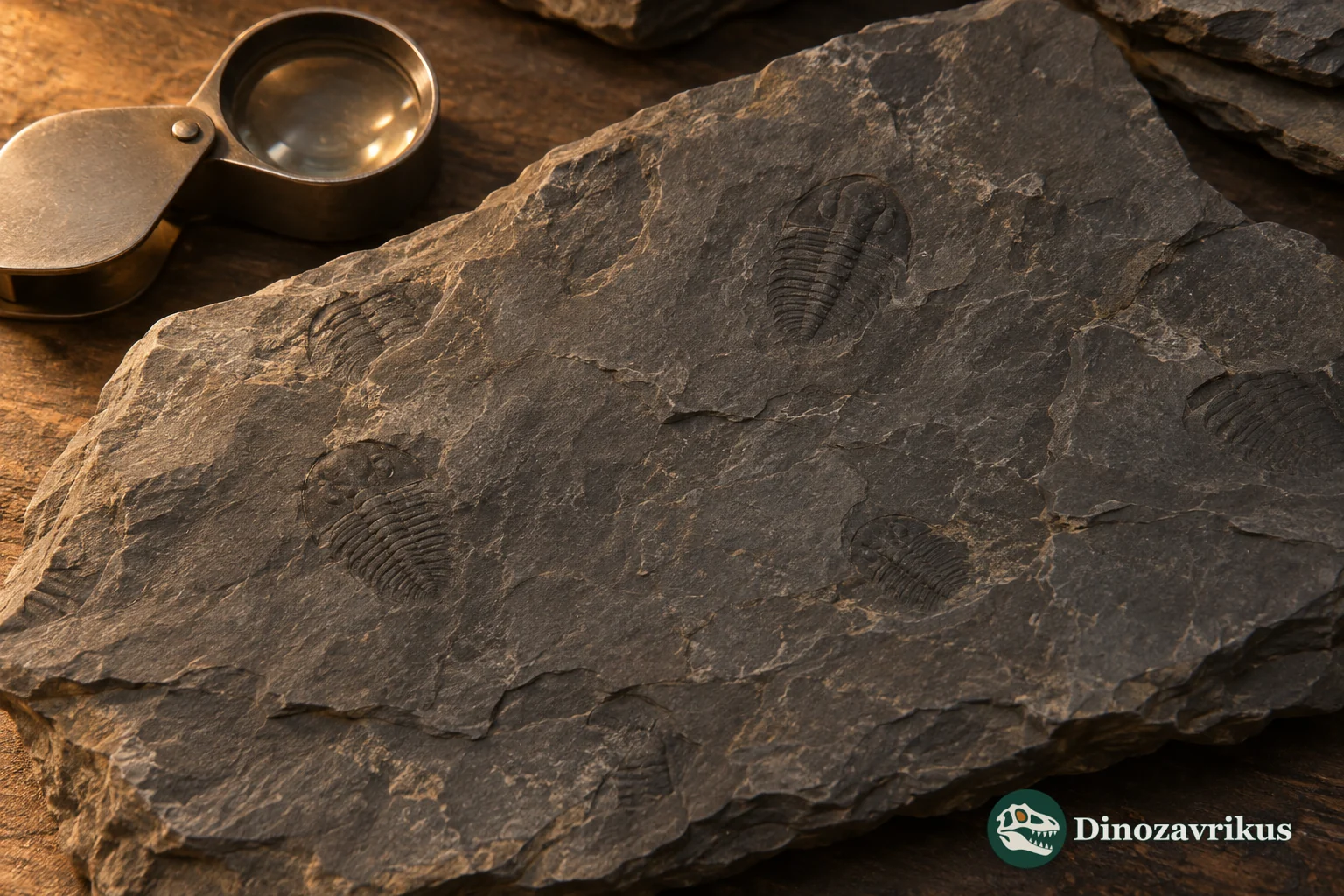
Elrathia was a Middle Cambrian trilobite. Its type species, E. kingii, crowds some bedding surfaces of Utah’s Wheeler Formation. The distribution of those concentrations led researchers to propose that the animals lived near the boundary between oxygen-poor and oxygen-free bottom waters.
Quick facts
| Group | Trilobites |
|---|---|
| Age | Middle Cambrian |
| Region | North America (United States and North Greenland) |
| Diet | Probable particle feeding |
| Type species | Elrathia kingii |
| Thorax | Usually 13 articulated segments in mature E. kingii |
What can the fossils tell us?
Their association with changes in the preserved fauna supports an oxygen-boundary interpretation. The shells themselves give no oxygen measurement.
The range of shell sizes and segment counts preserves the transition to the fixed mature thoracic count.
Its position and construction are consistent with collecting particles. This does not identify the material the animal ate.
Concentrations in the Wheeler Formation
Ferdinand Meek described the type species in 1870. Charles Walcott established Elrathia in 1924. E. kingii is recorded in the Wheeler and Marjum formations of western Utah. At some Wheeler horizons researchers recorded up to 500 complete individuals per square metre.
Robert Gaines and Mary Droser found that the dense assemblages were concentrated at transitions between beds representing different oxygen conditions. They proposed that the animal lived at the edge of oxygen-free bottom waters, where levels were low enough to exclude much of the other benthic fauna. The interpretation does not imply that Elrathia lived continuously in water with no dissolved oxygen.
A growth series in stone
Melanie Hopkins analysed growth using specimens from the House Range in Utah. During early development, articulated thoracic segments were released progressively from the tail-shield region through successive moults. In the mature condition the typical count was thirteen and size continued to increase after the count had stabilised.
Young trilobites from the same beds can resemble one another. Features such as the presence of axial spines helped distinguish co-occurring taxa in the growth study. The upper Ehmaniella and Bolaspidella biozones place the Utah material within a regional sequence.
Feeding and the rest of the genus
The hypostome, a plate on the underside of the head, is compatible with particle feeding. Gaines and Droser raised the possibility of a food web that could function independently of photosynthesis. No direct evidence establishes what E. kingii took in or the importance of a particular food source.
The geographic range of the genus was wider than the Utah occurrences of the type species. E. marjumi and E. hensonensis are both recorded in North Greenland. E. marjumi usually had twelve thoracic segments and a broader axial lobe than E. kingii.
Frequently asked questions
Where is Elrathia kingii known from?
The type species occurs in the Wheeler and Marjum formations of western Utah.
Did it live in anoxic water?
The Wheeler concentrations are interpreted as evidence for occupation near the boundary between low-oxygen and anoxic settings. They do not establish permanent life in water without oxygen.
How many thoracic segments did an adult have?
A mature individual of the type species usually had thirteen articulated thoracic segments.
What did Elrathia feed on?
Its hypostome suggests particle feeding. The specific food source is unknown.