

Borkenia was a freshwater turtle from the middle Eocene of Germany. Its type species is known from a lignite mine near Borken, where part of the shell preserved the sutures between bones and grooves left by the overlying scutes. Those traces help distinguish the Borken turtle from material assigned to the genus in the Geiseltal.
Quick facts
| Group | Turtles, Geoemydidae |
|---|---|
| Age | Middle Eocene, Lutetian for the type species |
| Region | Europe: Hesse, Germany |
| Type species | Borkenia oschkinisi |
| Holotype | No. 1992/2, shell remains |
| Scientific name | Borkenia |
| Diet | No direct evidence |
What can the fossils tell us?
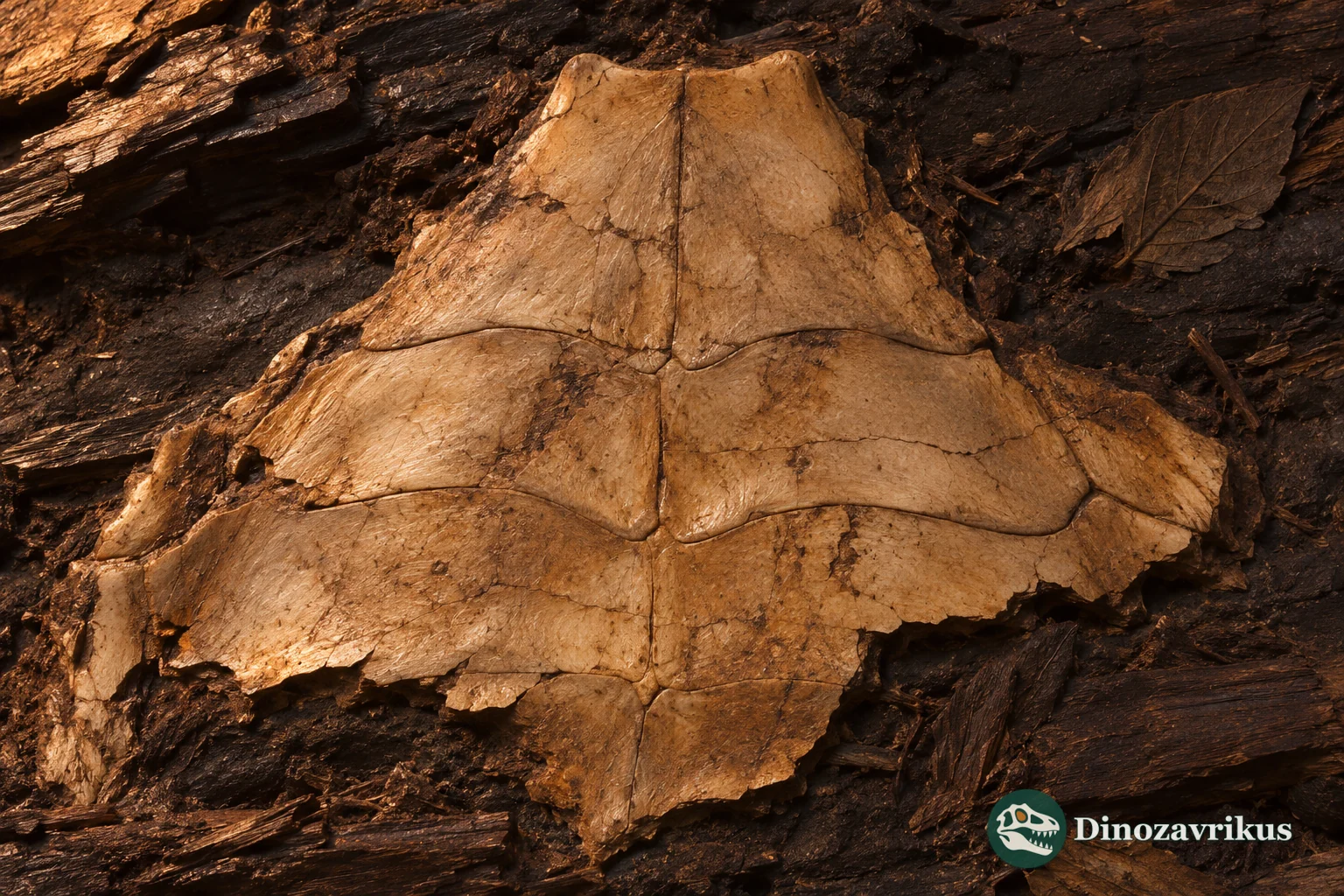
The type specimen, no. 1992/2, preserves parts of the shell including bones at the front. Its mining locality ties the specimen to middle Eocene deposits in Hesse.
The type species has a wider, rounder-edged plastron than the Geiseltal form. The groove between the humeral and pectoral scutes also falls in a different position.
The shell shares numerous features with Palaeoemys. Researchers have differed on whether the remaining differences justify a separate genus.
A turtle from Stolzenbach
Hans Hermann Schleich named Borkenia oschkinisi in 1994 from the Stolzenbach lignite mine near Borken. The type material belongs to the Borken museum collection. Sophie Hervet re-examined it while it was on deposit at the natural history museum in Kassel, and compared it with further material from the mine.
How the shells differ
The type species has a rounder carapace than Borkenia germanica, with a low, broad median keel that flattens at the top. Its plastron is wider, with more rounded margins. The two shells also differ in a feature that is easier to see from below.
In B. oschkinisi the groove dividing the humeral and pectoral scutes lies farther forward and meets the suture at the entoplastron. A scute boundary and a bone junction need not coincide, which makes their relative positions worth comparing.
Where the genus fits
Hervet recognised Borkenia and transferred Hummel’s Ocadia germanica from the Geiseltal to it. Julien Claude and Haiyan Tong suggested in a separate study that Borkenia might be synonymous with Palaeoemys, pointing out that features used to distinguish them can vary within other genera.
European geoemydids persisted well beyond the Eocene. The later Clemmydopsis offers a comparison from a different interval in the family’s fossil record. The Borken material supplies no direct evidence of diet.
Frequently asked questions
Where does the genus name come from?
It refers to Borken, near the mine that yielded the type specimen.
Did the type species have a ridge on its shell?
Yes. Its median keel was broad, relatively low and flattened along the top.
What distinguishes the turtle from the Geiseltal?
The material named Borkenia germanica has a narrower plastron and a less rounded carapace compared with the type species.
Do all researchers use the name Borkenia in the same way?
Some retain it as a separate genus. Others have suggested it could belong in Palaeoemys because the diagnostic shell features overlap.