

Clemmydopsis was a European turtle. On Miocene shells from Austria, several scutes down the middle reach the marginal row. Comparing several specimens from one bed helped researchers test which differences could distinguish species.
Quick facts
| Group | Turtles, geoemydids |
|---|---|
| Age | Miocene, based on C. turnauensis |
| Region | Europe: Austria, Germany and Hungary |
| Type species | Clemmydopsis sopronensis (original designation) |
| Material | Shells and disarticulated shell bones |
| Scientific name | Clemmydopsis |
| Diet | No direct evidence |
What can the fossils tell us?
Several specimens have central scutes that reach the marginals. The precise course of the scute boundaries varies between specimens.
The 8.3 mm bone has a weak keel and a scute groove that bends forwards. It provides a direct bone measurement, while the full shell length requires reconstruction.
The Austrian series overlaps in some details once used to distinguish the Turnau and Steinheim forms.
Fossils in the clay at Mataschen
Hermann von Meyer named material from Turnau, Austria, Emys turnauensis in 1847. Boda erected Clemmydopsis in 1927 for the Hungarian C. sopronensis. The Turnau species was later placed in the same genus.
Martin Gross studied shells from a late Miocene clay bed at Mataschen in Styria rich in carbonized plant remains. The first central scutes expand far enough to meet the marginal row. Grooves on the fossil bones trace those external boundaries, while sutures record the edges of the bones.
One bone from Gratkorn
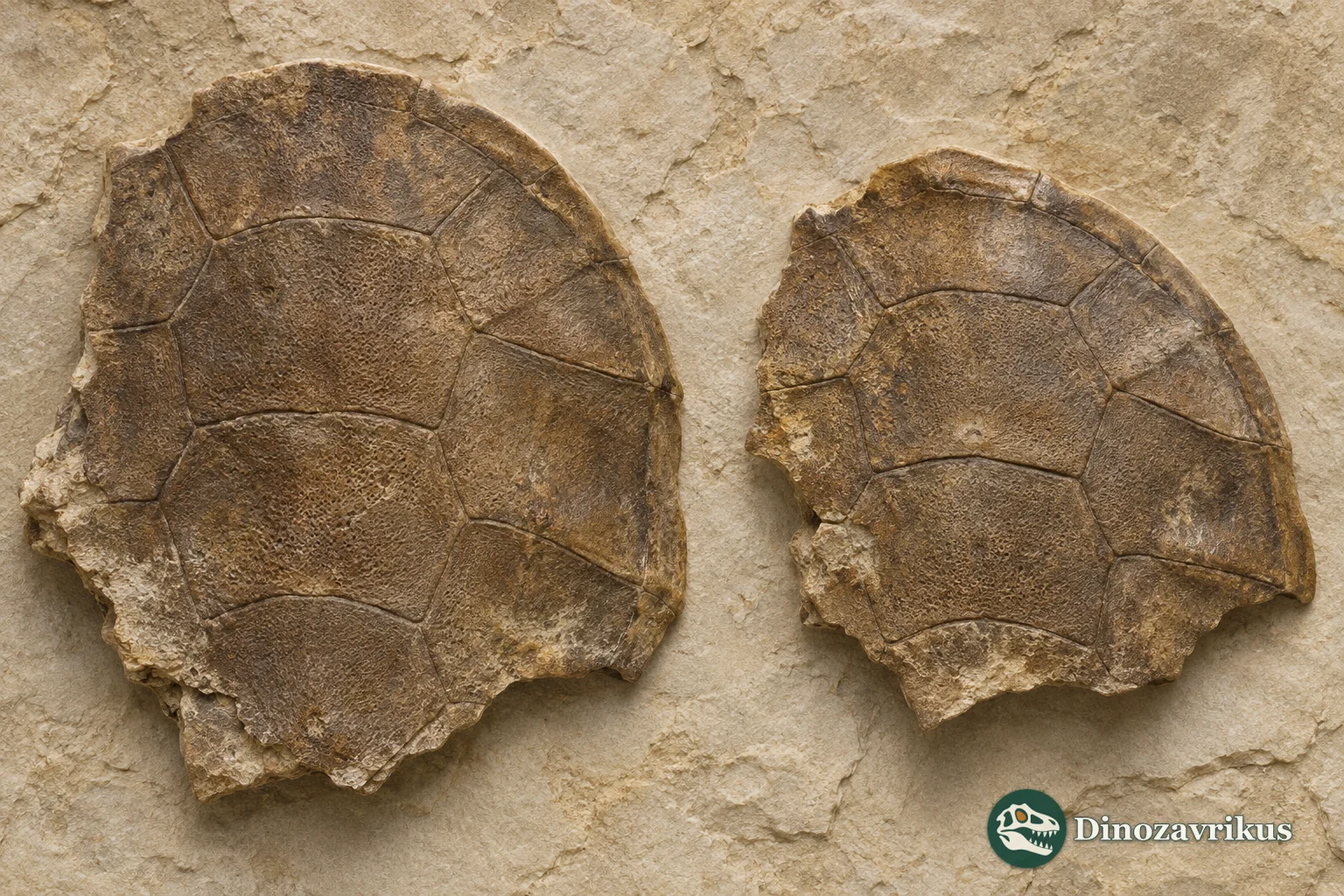
The middle Miocene material from Gratkorn includes two incomplete plates from the side of the shell and the first neural, UMJPG 204.057-1. The latter measures 8.3 mm and has a weak keel and an anteriorly pointed scute groove. That combination supported referral to C. turnauensis.
Scute grooves are also useful in other Miocene turtles. Their positions relative to the bone sutures informed work on the rear plastron of Paleotestudo. The Gratkorn material preserves evidence mainly from the upper shell.
Why authors disagree over the species
German material from Steinheim was named C. steinheimensis. Several of its reported shell characters vary across the Mataschen series. This supported treating the Steinheim fossils as part of C. turnauensis.
Researchers have differed over whether fossils called C. sopronensis and C. mehelyi in Hungary represent the same species. Those identifications have their own fossil and dating evidence, separate from the Austrian Miocene series.
Frequently asked questions
Where were the Austrian shells found?
Well-studied remains come from Mataschen and Gratkorn in Styria, from different parts of the Miocene.
How do researchers identify the shell?
Several central scutes extend to the marginal row in the Austrian species. Bone proportions and groove patterns provide additional characters.
Why were the Steinheim and Turnau forms combined?
The series from Mataschen showed that some supposed distinctions varied among individuals.
What did Clemmydopsis eat?
The Austrian material chiefly consists of shell remains and gives no direct evidence of diet.