

Paleotestudo is a name introduced for a small Miocene tortoise from France. Shells from Sansan closely resemble fossils from Germany. Some researchers unite them under one species of Paleotestudo, while others place related material in Testudo.
Quick facts
| Group | Turtles, land tortoises |
|---|---|
| Age | Miocene, with type material from the middle Miocene |
| Region | Europe: France and Germany, with additional Spanish assignments |
| Type species | Testudo canetotiana |
| Shell length | 18–21 cm in measurable specimens from Hohenhöwen |
| Scientific name | Paleotestudo |
| Diet | No direct evidence |
What can the fossils tell us?
Specimen MNHN.F.SA1868 from Sansan has been catalogued under both P. canetotiana and P. antiqua. These are successive identifications of the same object.
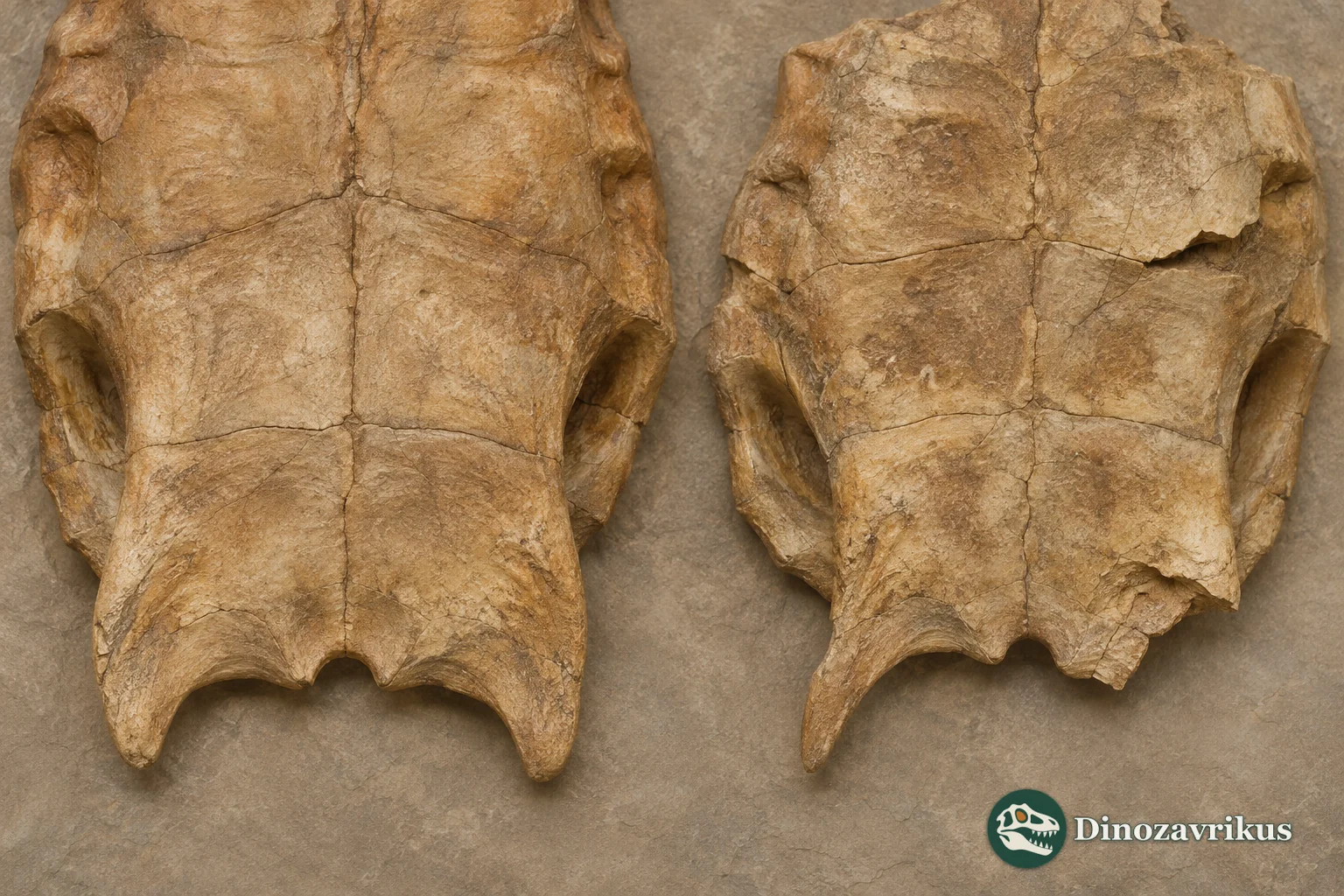
Specimen MT PAL.2012.0.10 was designated the neotype of the German species antiqua. Both shields are present despite damage to the rim. The specimen anchors the name.
In the German material, a rear bony suture and an adjacent scute boundary follow separate paths. Their positions support a rigid connection at the rear of the plastron.
The French and German material
Édouard Lartet named the French tortoise Testudo canetotiana in 1851. In a revision of Sansan turtles published in 2000, France de Lapparent de Broin erected the genus Paleotestudo for it. The collection history of specimen MNHN.F.SA1868 in Paris preserves the different identifications it has received.
Heinrich Georg Bronn named Testudo antiqua in 1831 for German shells from Hohenhöwen. Researchers revisiting the material in 2014 could no longer match the original account to individual specimens with confidence. They selected the well-preserved specimen MT PAL.2012.0.10 from the same locality as a neotype. Its shell is substantially complete, with deformation and some loss along the rim.
A domed shell with a rigid plastron
The measurable Hohenhöwen shells are 18–21 cm long. Their upper shells are high and broaden towards the rear. The front of the plastron has a thickened bony lip. Behind it, a scute boundary and the neighbouring bone suture take different paths, indicating the absence of a rear plastral hinge.
Shell proportions can vary across a series of individuals. The North American Stylemys gives a separate example of how comparisons among fossil tortoise shells inform species identification. For the Miocene specimens from Europe, the number and shape of individual bones are useful alongside their overall proportions.
Why several names remain in use
In 2016 Adán Pérez-García compared shells from Germany, France and several Spanish sites. He proposed that P. canetotiana from France and T. catalaunica from Spain were younger names for the same species, and used Paleotestudo antiqua. Under that interpretation, Bronn’s 1831 species name has priority.
A separate study retained Testudo catalaunica as a distinct Spanish species in Testudo. The Hohenhöwen revision likewise used Testudo for the German species. The original type species of Paleotestudo and the name used when several populations are combined therefore describe different nomenclatural decisions.
Frequently asked questions
Where does the original Paleotestudo material come from?
The genus was based on the species named from Sansan in southwestern France. A comparable series comes from Hohenhöwen in Germany.
How large are the measured shells?
The sufficiently complete German specimens range from 18 to 21 cm in length.
Could the rear of the plastron close?
The German fossils lack the alignment of bone and scute boundaries expected at a mobile rear hinge.
Why is the name Paleotestudo antiqua used?
A revision that united the French and German fossils gave precedence to Bronn’s older species name. Other studies classify some of those specimens differently.