

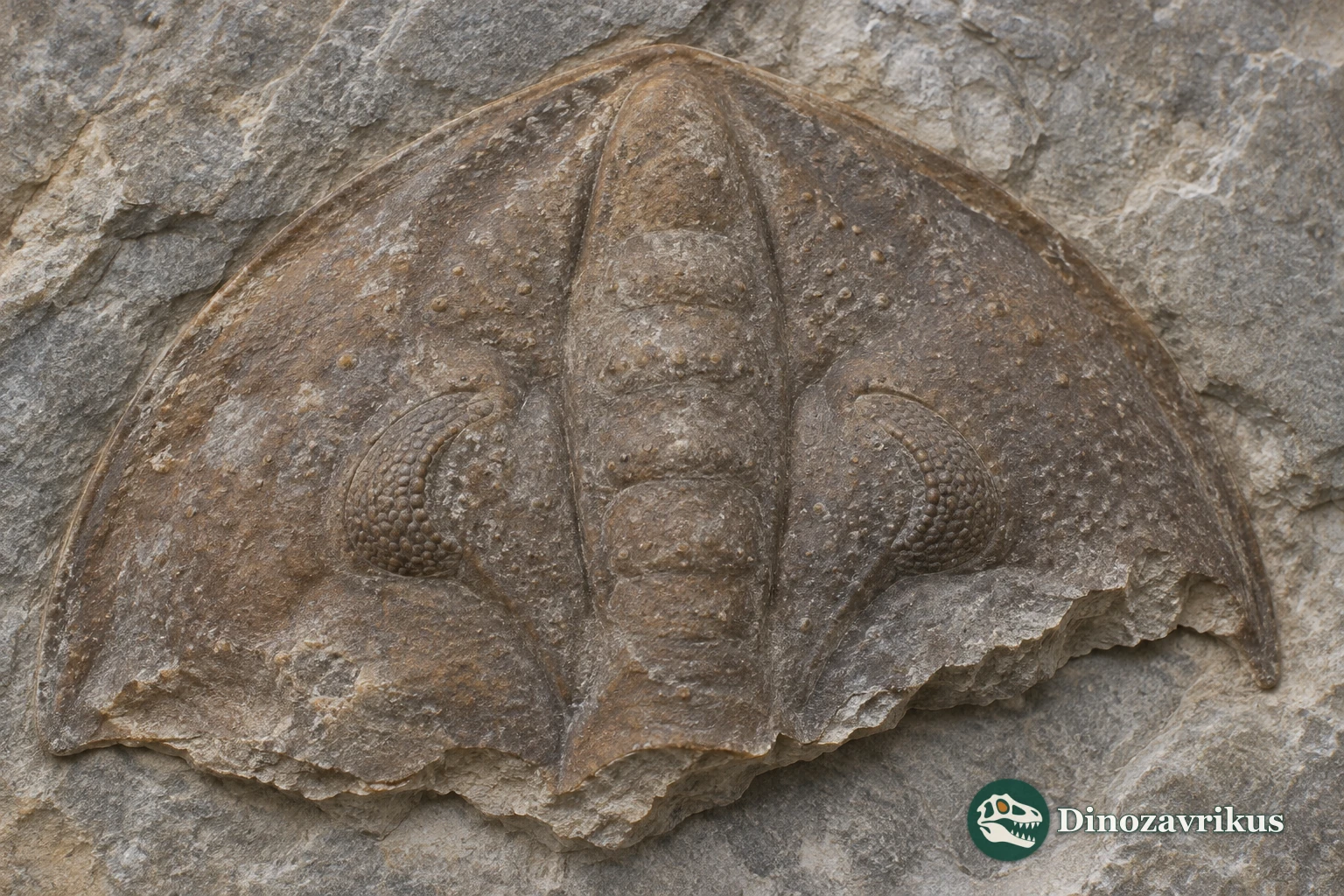
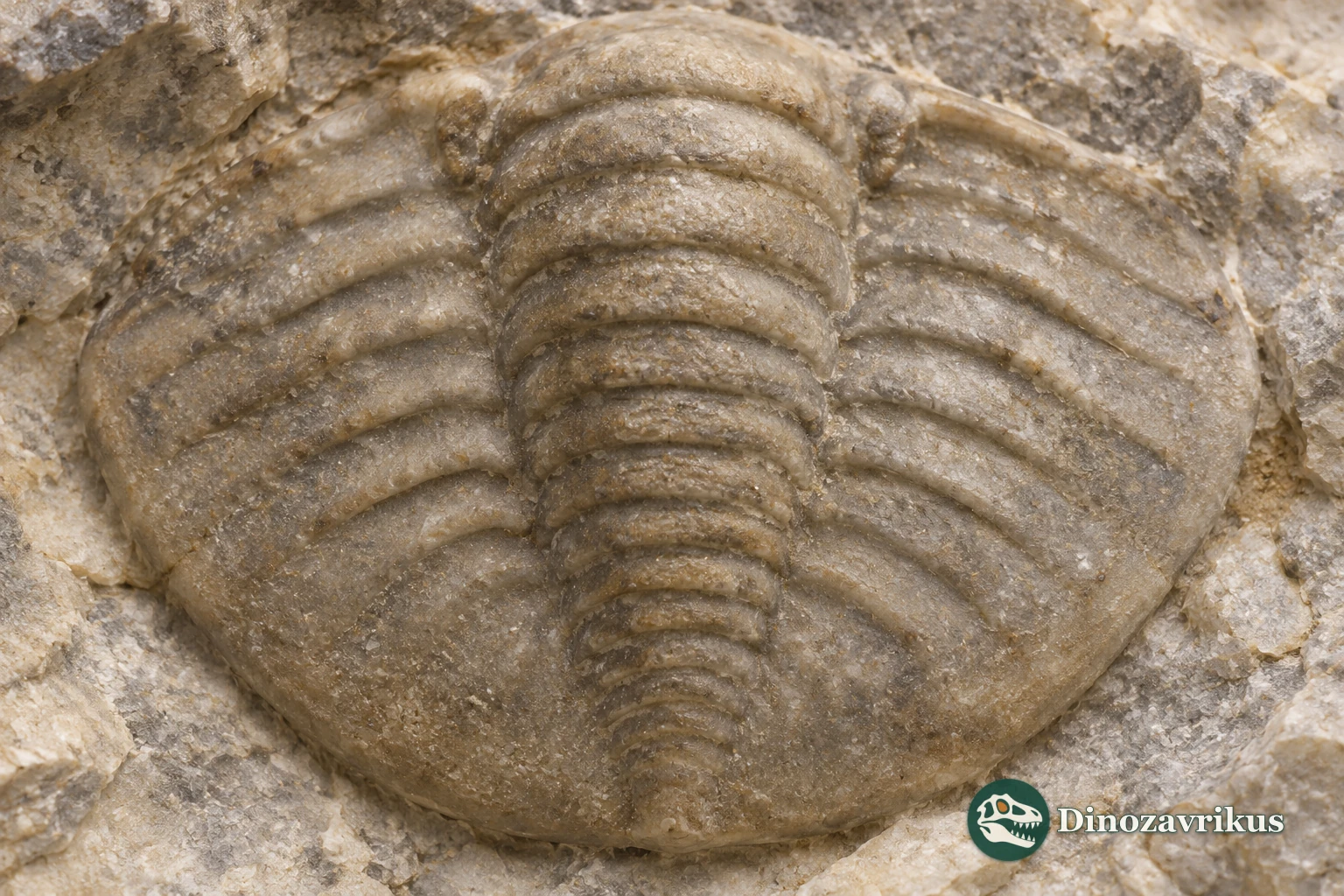
Brachymetopus was a Palaeozoic trilobite whose tail shield has a ringed axis and ribs on either side. A head mould and three detached tail shields from limestone near Kraków document the type species in the Early Carboniferous.
Quick facts
| Group | Trilobita, Brachymetopidae |
|---|---|
| Age of Polish material | Tournaisian, Early Carboniferous |
| Genus named | Frederick McCoy, 1847 |
| Type species | Brachymetopus maccoyi |
| Locality | Racławka Valley, Poland |
| Polish material | Cephalon and three pygidia |
What can the fossils tell us?
Sediment filled the space under the shell. The mould records overall shape, while fine details of the outer surface can be lost.
The width of the border and the form of the ribs help compare species, including specimens found without the head.
Some specimens lost the marginal spines as they grew. Identification uses other features of the shield as well.
From Phillipsia to Brachymetopus
Joseph Portlock named the type species Phillipsia maccoyi in 1843. Frederick McCoy established the genus Brachymetopus in 1847. The species is now known as Brachymetopus maccoyi.
The outline of the ringed axis, the course of the lateral ribs and their relation to the border all help in comparisons of tail shields. Researchers describe the same structures in other late Palaeozoic trilobites, including the Permian Pseudophillipsia.
Four shields from the Racławka Valley
Ewa Osmólska described B. maccoyi from light grey Tournaisian limestone in the Racławka Valley near Kraków. The collection consisted of an internal mould of the head and three tail shields. Patches of cuticle remained on some of the latter.
The Polish head is less triangular and its anterior border is less distinct than in the holotype. Osmólska suggested that preservation may partly explain the differences in the glabella, the raised middle of the head. A mould and the outside of a shield preserve different aspects of its shape.
What happens to the border spines during growth
Some forms of Brachymetopus had short spines along the tail margin. A form once grouped with the type species lost those spines as it grew. In other forms the spines persisted into adulthood. Other parts of the shield are therefore needed to interpret the significance of a smooth or spiny edge.
Fossils from several parts of the world have been assigned to Brachymetopus. A revision of Australian material distinguished several local species. Features documented in the Polish fossils describe the type species and the specimens at hand, while other species can combine these characters differently.
Frequently asked questions
What was the original name of the type species?
Portlock named it Phillipsia maccoyi. It was later transferred to Brachymetopus.
What was found in the Racławka Valley?
Tournaisian limestone yielded an internal mould of the head and three tail shields.
Why can marginal spines be absent?
The margin varied among different forms. In one, the spines disappeared during growth.
What is an internal mould?
It is sediment that hardened inside the shell. It preserves the interior shape, with some details of the outer surface lost.