

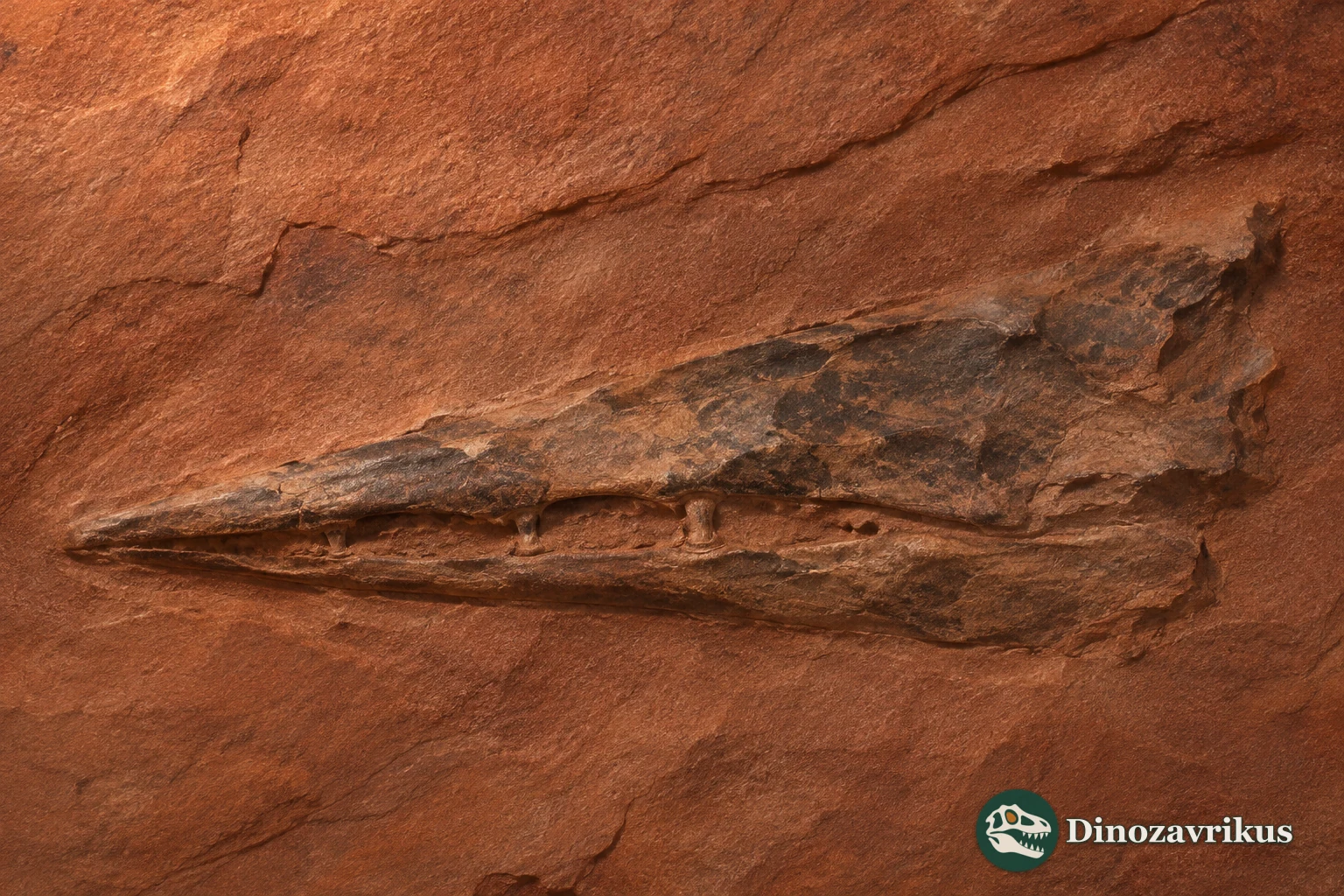
Bukobaja was a Middle Triassic temnospondyl from the southern Ural foreland. It was named from the front of a skull preserved together with the tip of the lower jaw. This fossil shows the outline of the snout and the openings where large lower teeth could fit when the jaws closed.
Quick facts
| Group | Temnospondyls, trematosaurids |
|---|---|
| Age | Middle Triassic, Ladinian |
| Region | Europe, Russia (Orenburg Oblast) |
| Type species | Bukobaja enigmatica |
| Scientific name | Bukobaja |
| Diet | Exact prey is unknown |
What can the fossils tell us?
Holotype PIN 4165/1 preserves the elongated front of the skull with the anterior part of the lower jaw still in place.
The bones near the front of the eye socket and their contacts suggest trematosaurid affinities. Features of the palate and frontal bones distinguish Bukobaja as a separate genus.
The type specimen establishes the width and outline of the snout. It does not establish total body length or which prey the animal ate.
The Bukobay I fossil
Vitaly Ochev described Bukobaja enigmatica in 1966. The holotype, PIN 4165/1, was previously catalogued as SGU 104/245. It was found at Bukobay I in the Sol-Iletsk District of Orenburg Oblast. The fossil comes from the Bukobay Horizon, assigned in the modern review to the Ladinian stage of the Middle Triassic.
How the jaws fitted together
The front of the skull is drawn out, with nearly straight sides when viewed from above. The premaxillae contain openings opposite the large teeth at the front of the lower jaw. These openings accommodated the lower tusks when the mouth shut. Part of the parasphenoid, a long bone in the floor of the skull, is broadly exposed on the front of the palate.
Comparison with Trematolestes
On re-examining the fossil, Rainer Schoch revised the identification of the lacrimal and the prefrontal. Their arrangement resembles that in Trematolestes, which lived at about the same time in what is now Germany. Bukobaja has a narrower snout and retains two separate frontal bones. Trematolestes has a single frontal. The front of the palate also differs between the two genera.
Changing ideas about its affinities
Ochev compared Bukobaja with capitosauroids, the branch that includes mastodonsaurids. Later comparisons of the snout favoured an affinity with trematosaurids. The recent review of Russian Triassic tetrapods places the genus in Bukobajinae. Some vertebrae and a pelvic bone assigned to Bukobaja differ from those of Trematolestes. More complete associated material would help resolve their identification.
Frequently asked questions
Where was Bukobaja found?
The type fossil is from Bukobay I, in the Sol-Iletsk District of Russia’s Orenburg region.
When did Bukobaja live?
The fossil dates to the Ladinian stage of the Middle Triassic.
What is preserved in the holotype?
The front part of the skull, still articulated with the front of the lower jaw.
How is Bukobaja different from Trematolestes?
It has a narrower snout, separate frontal bones and a different arrangement at the front of the palate.