

Californosaurus perrini is a Carnian ichthyosaur from Hosselkus Limestone in Shasta County, northern California. Its name changed as early researchers reconsidered the relationships of Triassic marine reptiles. The type skeleton is incomplete and lacks a skull.
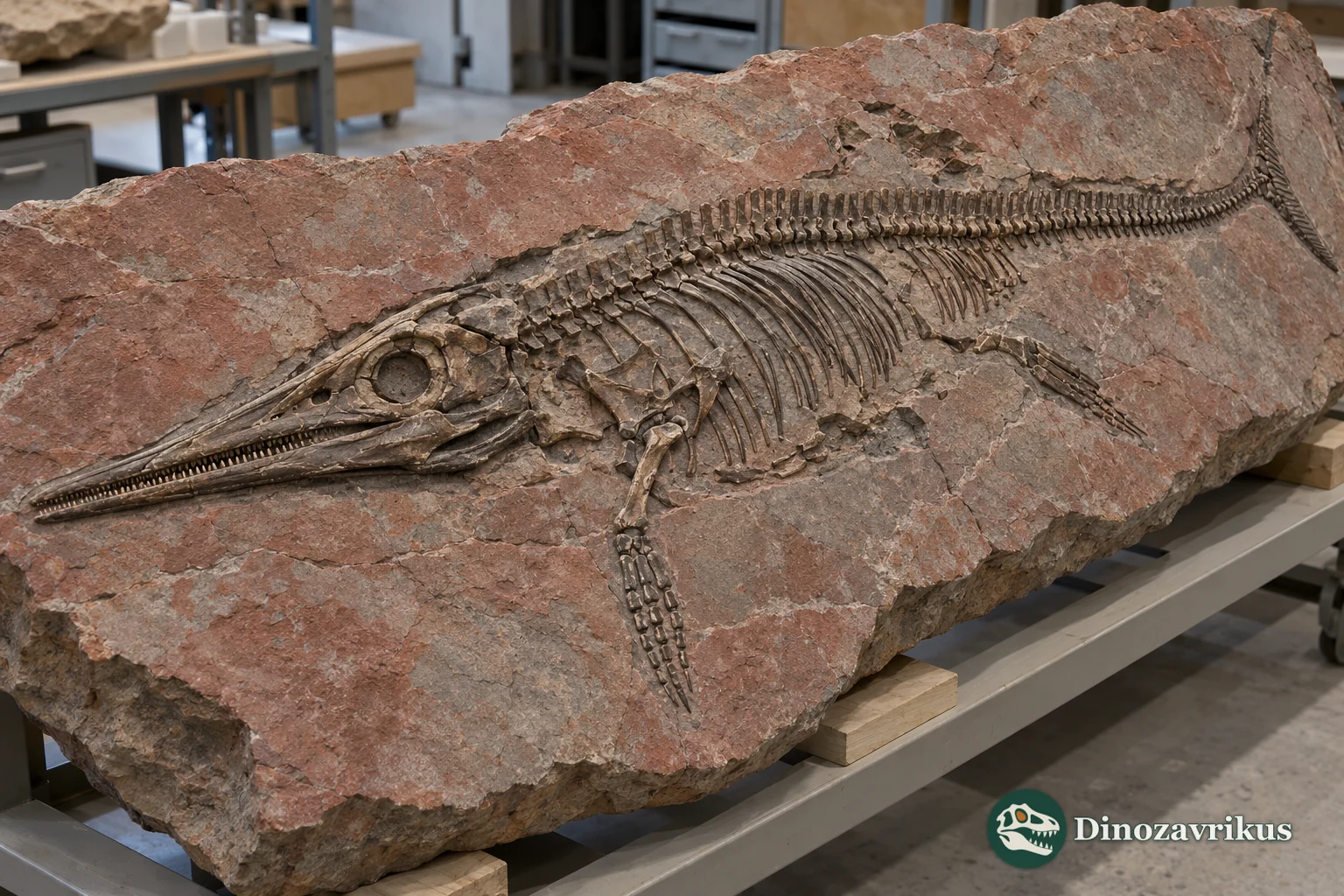
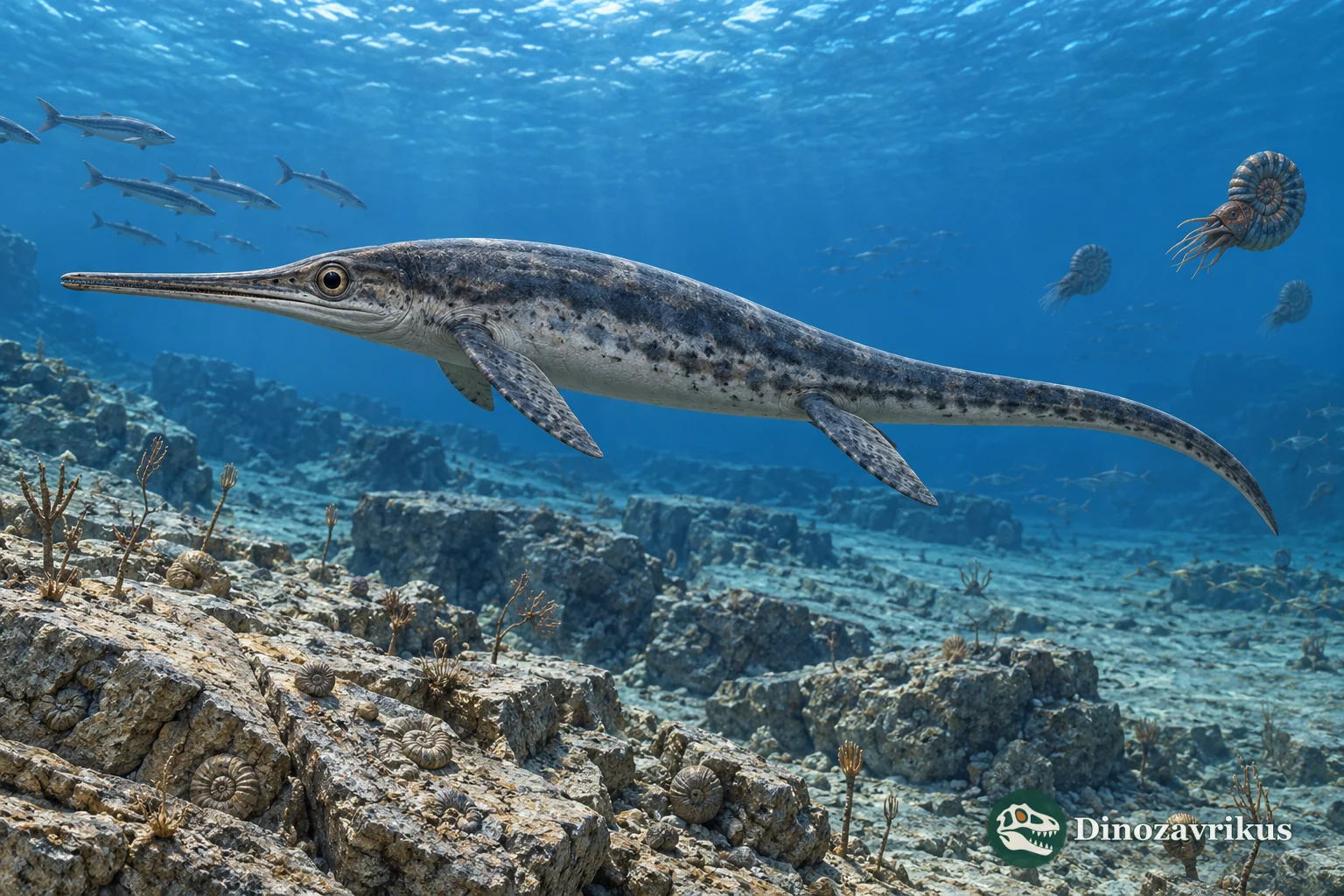
The cover and environmental scenes are artistic. Their snout, tail-fin outline and colors cannot be read directly from the name-bearing specimen.
Quick facts
| Type species | Californosaurus perrini (Merriam, 1902) |
|---|---|
| Original name | Shastasaurus perrini |
| Genus established | Oskar Kuhn, 1934 |
| Type specimen | UCMP 9119, incomplete skeleton without skull |
| Other early specimen | UCMP 10998, separate individual |
| Age | Carnian, Late Triassic |
| Place | Hosselkus Limestone, Shasta County, California |
What can the fossils tell us?
Merriam illustrated UCMP 9119 as the type. Its postcranial bones preserve information about the trunk and limbs, but no type skull establishes its snout shape.
Merriam described Shastasaurus perrini in 1902 and later used Delphinosaurus perrini. Californosaurus was established in 1934. These combinations refer to taxonomic reassessment, not a second type find.
The fossil-bearing strata are marine and Late Triassic. They constrain age and burial setting, not living color, ordinary swimming depth or exact prey.
Merriam's Shasta County material
John Campbell Merriam first described the species as Shastasaurus perrini in 1902, honoring paleontologist James Perrin Smith. In his later illustrated monograph, UCMP 9119 is explicitly labeled the type specimen; UCMP 10998 is a separate fossil, not the type. Merriam also used the combination Delphinosaurus perrini.
The marine Hosselkus Limestone dates to the Carnian stage of the Late Triassic. Present-day Shasta County is land, but the fossils were buried in a marine setting. Stratigraphy establishes context without showing hunting behavior or normal water depth.
Taxonomy and missing parts
Oskar Kuhn proposed Californosaurus in 1934. Later classifications separated the species from typical Shastasaurus; Maisch's 2010 systematic review retained C. perrini as the genus type in Californosauridae. That placement is a taxonomic interpretation of preserved skeletal features.
UCMP 9119 preserves substantial postcranial anatomy but no skull. A long rostrum in illustrations is comparative reconstruction. Tail vertebrae may inform the shape of the bend, yet soft-tissue outlines and fin contours are not fossil measurements. No exact full-body length can be read from one complete type skeleton because the skeleton is not complete.
Placing it among other swimmers
The earlier Grippia and Late Triassic Qianichthyosaurus offer comparisons of proportions without supplying Californosaurus's missing skull. The wider history of ichthyosaurs rests on dated specimens and skeletal characters, not shared silhouettes in paleoart.
Hosselkus also yielded other marine reptiles. Their presence in the same regional formation does not prove identical diets or direct encounters. Detailed color and prey choice for this species remain unknown.
Frequently asked questions
Where was the type Californosaurus found?
UCMP 9119 came from Carnian marine Hosselkus Limestone in Shasta County, California.
Does its type specimen preserve a skull?
No. The type is an incomplete skeleton without a skull; head shape is reconstructed by comparison.
Why was it once called Shastasaurus perrini?
Merriam described it under that name in 1902. Kuhn established the genus Californosaurus in 1934.
Is its full length exactly known from the type?
No. Missing skeletal parts make any whole-body length an estimate, not a direct measurement of a complete UCMP 9119.