

Grippia longirostris is a small Early Triassic marine reptile from Spitsbergen. Its skull, forefin, vertebrae and humerus document an early stage in the ichthyosaur lineage, before the strongly specialized body shapes of some later members.
The fossils support a swimmer with paddle-like limbs. They do not preserve its complete skin outline or color. Recent studies of bone tissue also distinguish Grippia from a larger contemporary ichthyosaur without directly observing either animal in motion.
Quick facts
| Type species | Grippia longirostris Wiman, 1929 |
|---|---|
| Group | Early ichthyopterygian |
| Age | Late Olenekian, Early Triassic |
| Region | Spitsbergen, Svalbard |
| Key material | Skull, articulated forefin, vertebrae and humerus |
| Formation | Vikinghøgda Formation, later humerus material |
| Body length | No precise whole-body measurement from one complete skeleton |
What can the fossils tell us?
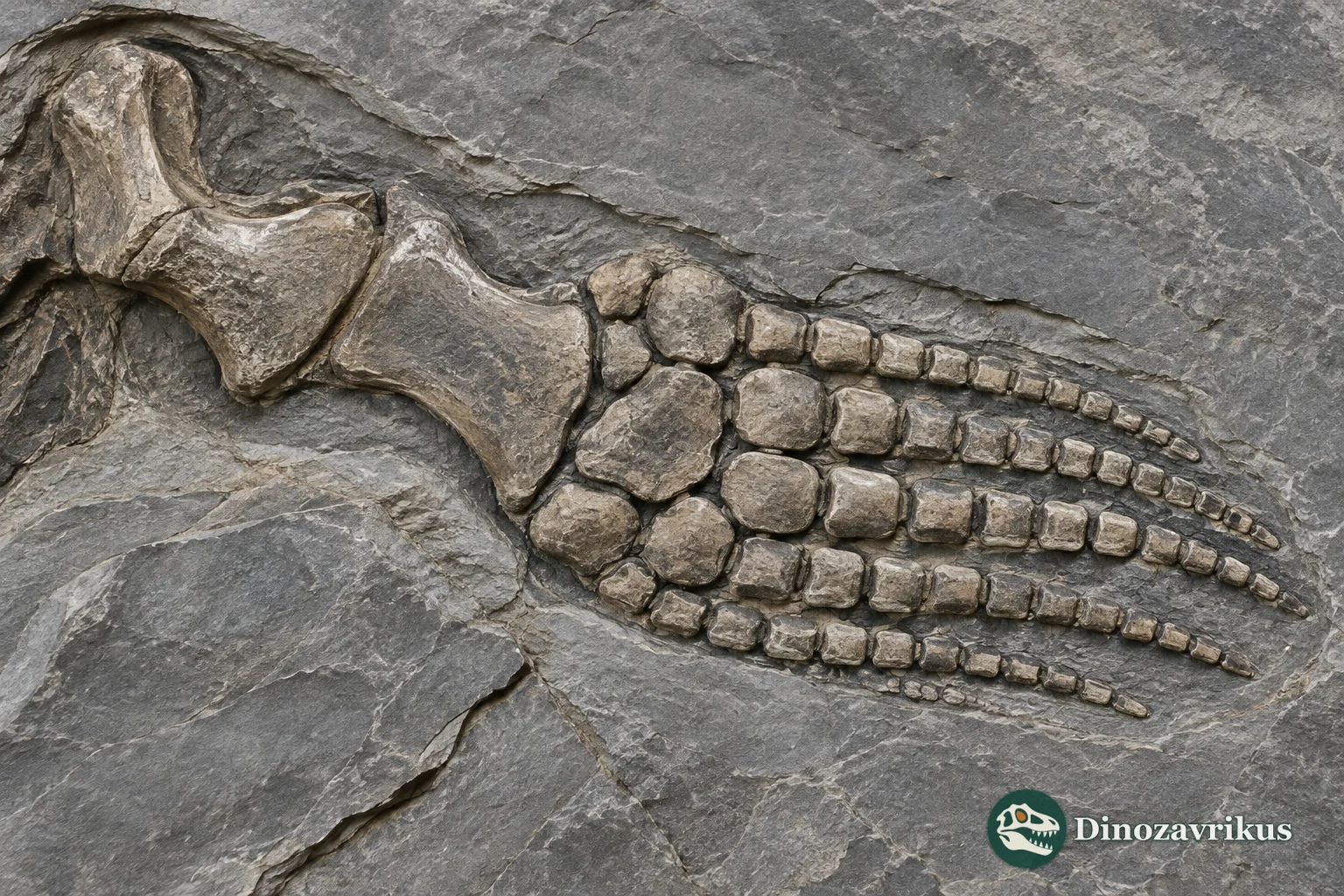
The articulated limb described in 1998 preserves digits and phalanges. Their ends do not support earlier hoof-like reconstructions, though the single fin cannot record swimming motion.
A 2025 study found a comparatively compact outer zone in Grippia vertebrae. Contrast with Cymbospondylus suggests different locomotor mechanics, not a measured swimming speed.
A humerus collected in 2022 shows rapidly deposited tissue and cancellous interior. It informs bone growth but cannot alone establish whole-body size or exact temperature.
The Svalbard material
Carl Wiman named Grippia longirostris in 1929 from Spitsbergen material; the genus name honors geologist Karl Gripp, who collected the type skull near the Agardh Range. Fossils from the archipelago come from several horizons, so a bonebed label alone cannot identify every specimen.
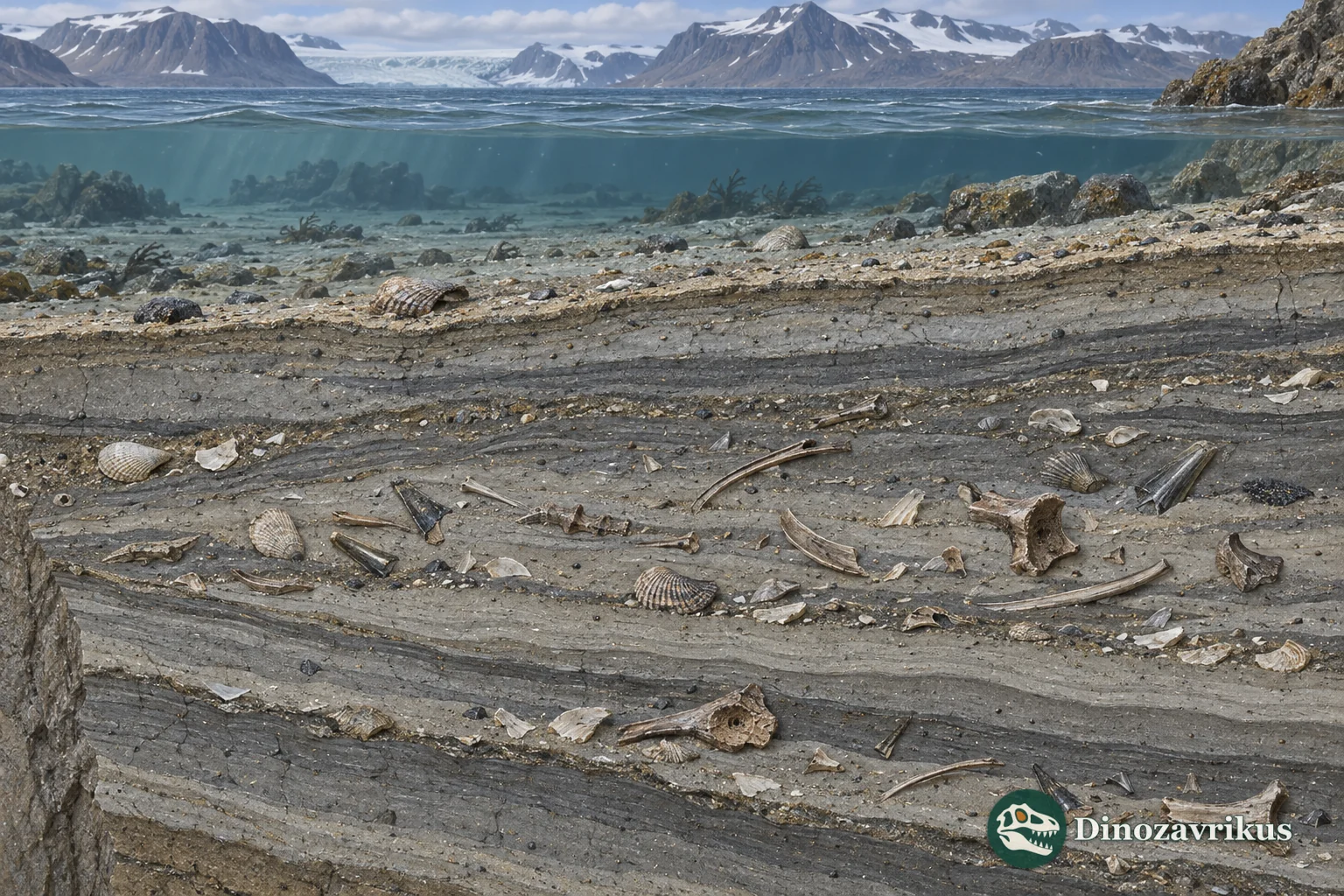
A humerus assigned to Grippia was collected at Eistraryggen in August 2022, near the base of the Grippia Niveau interval in the lower Vendomdalen Member of the Vikinghøgda Formation. A larger humerus from about three metres higher was left as an indeterminate ichthyosauriform. They are separate specimens, not one skeleton.
A forefin without hooves
Ryosuke Motani described a nearly complete articulated forefin in 1998. Its terminal phalanges did not support the old suggestion of hoof-like endings. The limb shares features with early Utatsusaurus while also showing more derived characteristics in comparison with younger ichthyosaurs.
Forefins from British Columbia once assigned to Grippia lack key shared characters and were excluded from the genus in that study. This makes the Arctic record especially important for understanding its limb. Compare the much later ichthyosaurs for how aquatic limb anatomy diversified, without assuming that every member swam in the same manner.
Bone growth and movement
A 2025 vertebral study identified a relatively compact outer layer in Grippia and a different inner structure in the large contemporary Cymbospondylus. The researchers inferred different locomotor styles, with more body undulation proposed for Grippia. Thin sections do not directly record speed, depth or exact movement.
Another 2025 study found rapidly deposited tissue and primary coarse cancellous bone in a Grippia humerus. That informs growth and aquatic adaptation but does not by itself yield a temperature or maximum length. A 2026 investigation of the Svalbard bonebed described a mixed assemblage; isolated remains require their own taxonomic evidence. The much later Acamptonectes and Aegirosaurus illustrate how much ichthyosaur anatomy changed across the Mesozoic, not a direct reconstruction of Grippia's skin or tail.
Frequently asked questions
Where was Grippia found?
Its securely studied material comes from Early Triassic marine deposits of Spitsbergen in Svalbard.
Did it have hooves on the forefins?
No. The articulated forefin described in 1998 does not support that older reconstruction.
What do its vertebrae show?
Thin sections show a relatively compact outer bone layer, unlike that of the compared Cymbospondylus material.
Does every bone in the Grippia Niveau belong to Grippia?
No. The layer contains remains from several animals, and individual bones need diagnostic comparison.