

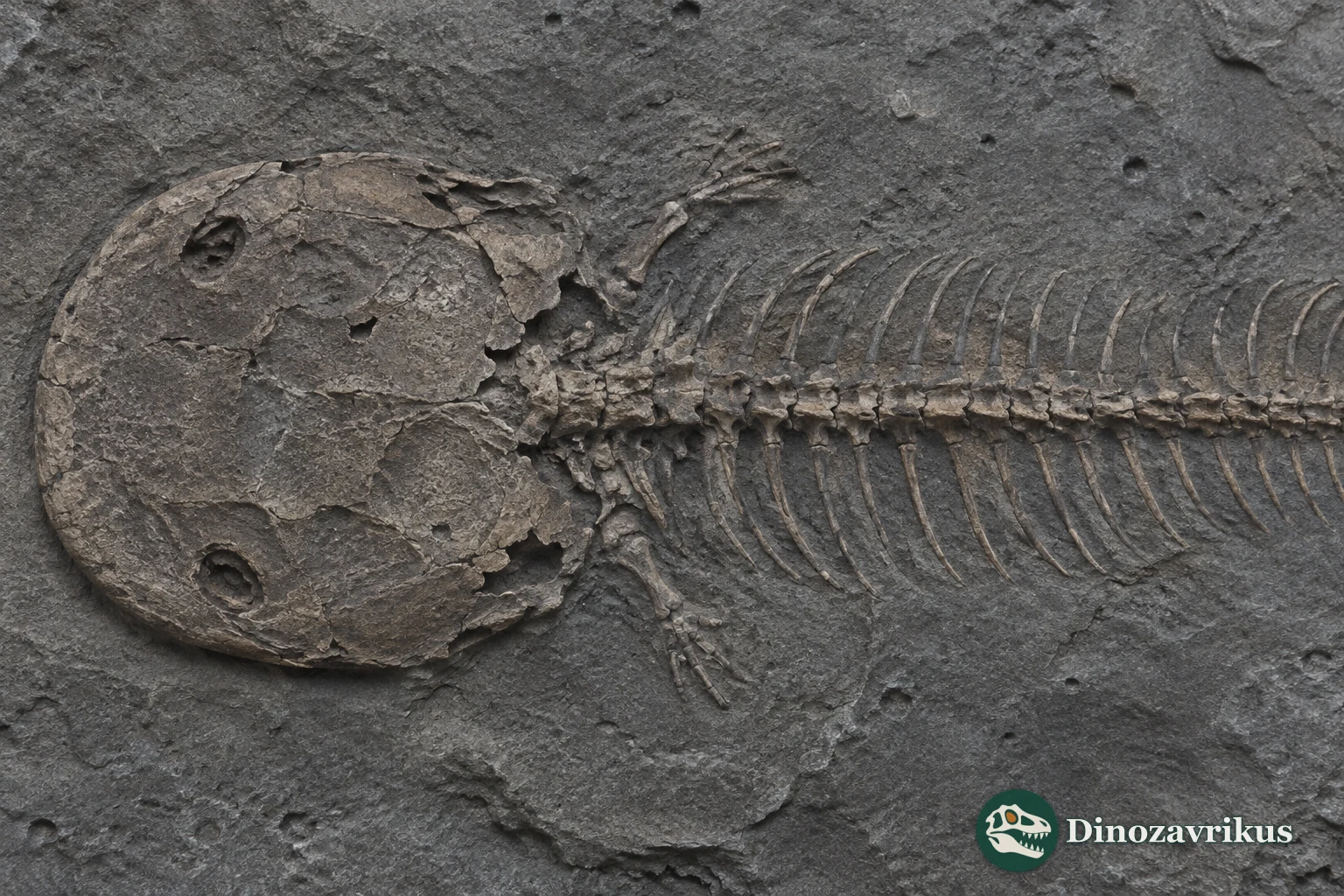
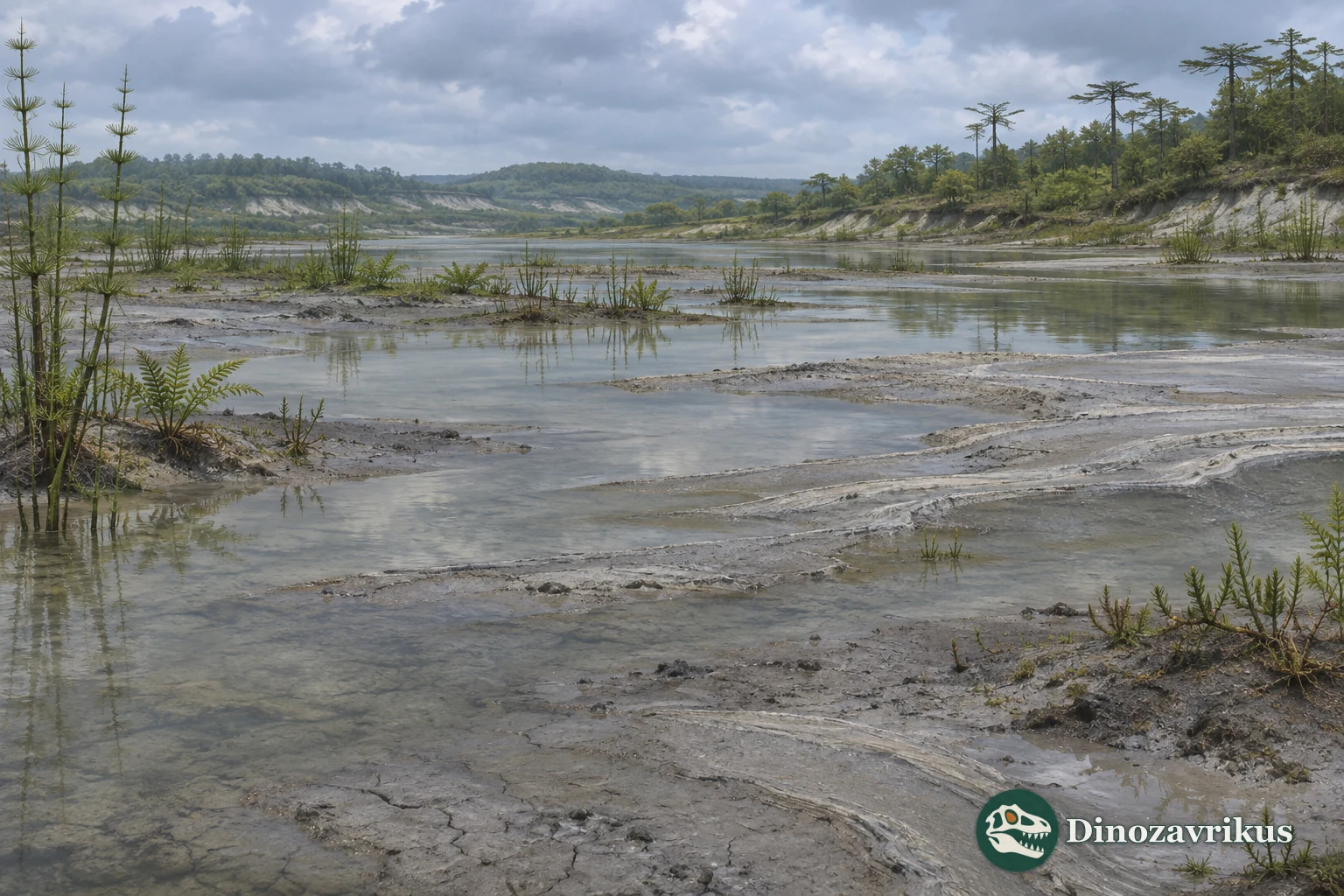
Callistomordax kugleri lived in what is now southern Germany during the Middle Triassic. Nearly complete skeletons reveal a short, flat head followed by a slender elongated trunk and a long tail. Those proportions suggest an animal that swam well.
Quick facts
| Group | Temnospondyls, stereospondyls |
|---|---|
| Age | Middle Triassic, late Ladinian |
| Region | Europe (Baden-Württemberg, Germany) |
| Length | 1.23 m of the type skeleton is preserved |
| Type species | Callistomordax kugleri |
| Scientific name | Callistomordax |
| Diet | Exact prey is unknown |
What can the fossils tell us?
The holotype SMNS 82035 preserves 1.23 m of skeleton, including a skull 137 mm long. Other specimens reveal details of the limb girdles and palate.
The trunk was about three times as long as the skull. A long, laterally flattened tail supports the interpretation that the animal was a capable swimmer.
The tail tip is missing in the holotype. Large fangs suggest how prey may have been restrained, while the exact diet remains unknown.
A skeleton from Vellberg
Rainer Schoch named Callistomordax in 2008 from fossils collected in the Schumann quarry near Vellberg. The holotype SMNS 82035 is held by the State Museum of Natural History in Stuttgart. It came from the top of the Lower Grey Marls in the Erfurt Formation. The species honours Werner Kugler, who found and prepared the first specimen. SMNS 90700 adds detail on the girdles and the front limb.
Built to swim
Schoch counted 26–28 presacral vertebrae from several specimens. The trunk was about three times as long as the skull. The humerus was short and robust, with a prominent crest. The tail was laterally flattened and approximately the length of the trunk. Another amphibian from the Middle Triassic of Germany, Trematolestes, shows how different the proportions of the head and trunk could be in this setting.
Fangs on the palate
Large, blade-edged fangs at the front of the palate were flattened from side to side. On the vomers their bases occupied nearly the full width of each bone. The construction of the jaws and the space for closing muscles led Schoch to propose that the animal could hold struggling prey. The teeth do not identify the particular prey it took.
An early branch near the metoposaurids
The palate and skull helped place Callistomordax near the metoposaurid branch of Triassic temnospondyls in Schoch’s 2008 analysis. Its slender trunk contrasts with the more compact body of many later metoposaurids. Recorded specimens span several levels of the Lower Keuper, all in the later part of the Ladinian.
Frequently asked questions
How long is the type skeleton?
The preserved skeleton measures 1.23 m, with a skull length of 137 mm. The tip of the tail is missing.
Where was the type found?
In the Schumann quarry near Vellberg, in the German state of Baden-Württemberg.
Why is it interpreted as a capable swimmer?
The elongated body and long, laterally flattened tail provide the main skeletal evidence.
Where were the biggest teeth?
The large fangs grew on the front of the palate. Their bases took up most of the space on the bones bearing them.