

Camptognathosaurus was a European Paleocene lizard with a smoothly curved lower edge to its dentary. The genus was erected for French fossils. Researchers later compared them with older remains from Walbeck, Germany, and concluded that the two samples belong to one species.
Quick facts
| Group | Squamates (Squamata) |
|---|---|
| Age | Paleocene, Selandian and Thanetian |
| Region | Europe, Germany and France |
| Accepted species name | Camptognathosaurus walbeckensis |
| Scientific name | Camptognathosaurus |
| Diet | No direct evidence |
What can the fossils tell us?
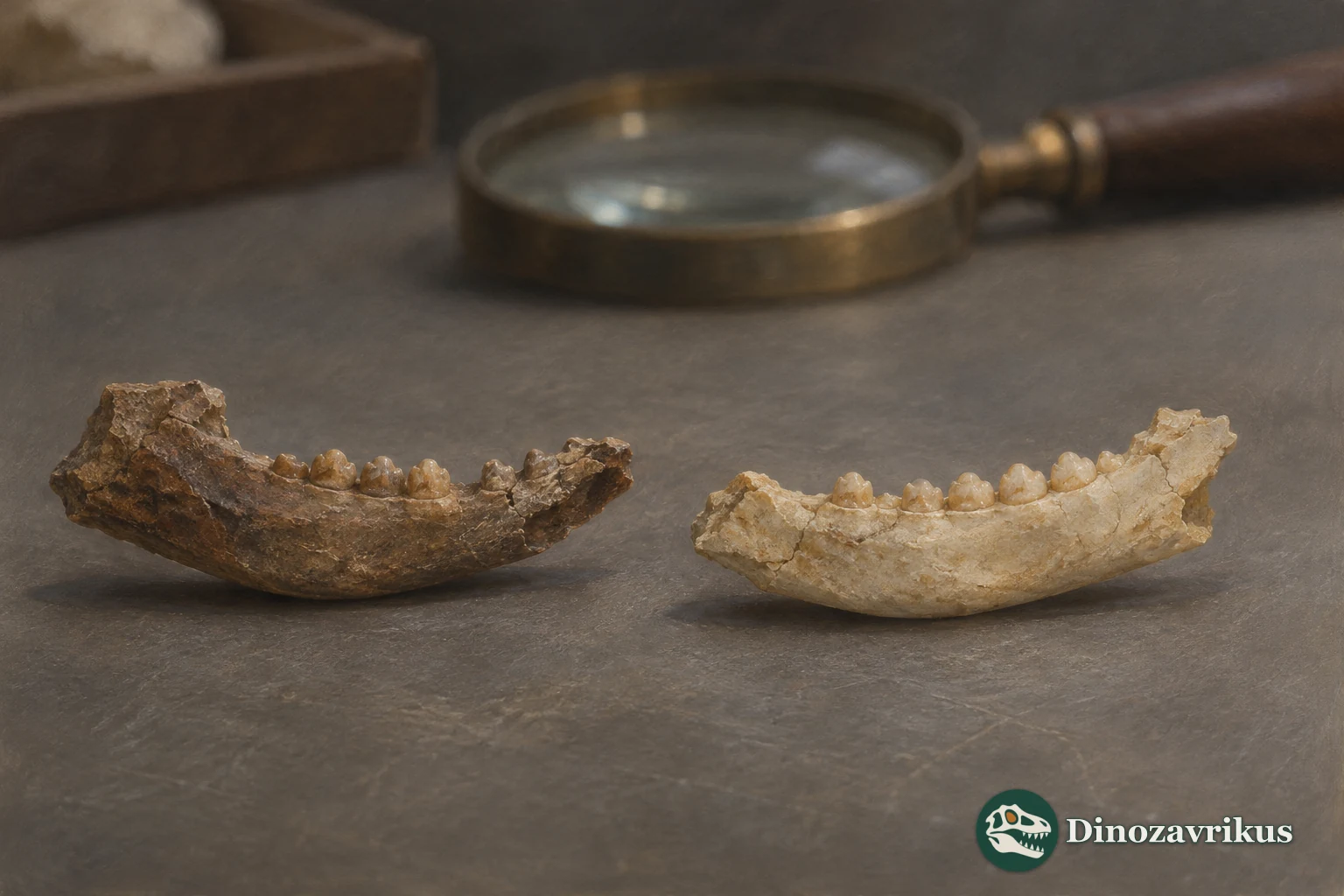
Jaws from Walbeck and the Paris Basin preserve a smoothly curved lower margin and broad tooth crowns.
The 2024 revision treated the French species name and the earlier German name as synonyms. The epithet published in 1940 had priority.
New comparisons linked Camptognathosaurus with true lizards. That assignment remains tentative.
The French jaws
Annelise Folie and colleagues described Camptognathosaurus parisiensis in 2013. The jaws come from late Paleocene deposits at Rivecourt and Cernay-lès-Reims. The near-complete right dentary RIV PP 413 from Rivecourt is about 9 mm long. It preserves eight teeth across eleven tooth positions. The lower edge is smoothly curved and the rear teeth are short and sturdy.
Why the species name changed
Oskar Kuhn described a Walbeck lizard as Glyptosaurus walbeckensis in 1940. In 2024, Andrej Čerňanský and Davit Vasilyan reexamined the German material and concluded that it belonged to the same species as the French fossils. The earlier epithet had priority, so they proposed the combination Camptognathosaurus walbeckensis. Since Kuhn's figured specimen could not be located, they designated a nearly complete left dentary from the same locality, MLU.GeoS.4045, as the neotype.
Where the genus fits
The first study of the French fossils treated the genus as an early worm lizard. The revision identified differences from the bones used in that comparison and tentatively referred it to Lacertidae. Broad, blunt teeth also occur in some members of that family, for example the much younger Amblyolacerta. Tooth shape helps compare the finds, while the exact diet of Camptognathosaurus remains unknown.
Frequently asked questions
Which country yielded the older jaws?
Germany. The Walbeck material is Selandian, while the French jaws are from younger Thanetian deposits.
Why is the name walbeckensis used now?
It was published in 1940. Once the German and French fossils were assigned to the same species, the earlier species name had priority.
What does Camptognathosaurus mean?
It is formed from Greek words meaning curved, jaw and lizard.
How many teeth are preserved on the Rivecourt jaw?
RIV PP 413 preserves eight teeth and eleven tooth positions.