

Carbonemys cofrinii is a large freshwater side-necked turtle from the Late Paleocene Cerrejón Formation of northern Colombia. Its name is often paired with a nearly two-metre shell, but the diagnostic type is a skull. A large carapace was found separately in the same fossil horizon, without a direct connection to the holotype. It belongs in the other fossil reptile catalogue alongside extinct reptiles of ancient South American rivers.
Quick facts
| Scientific name | Carbonemys cofrinii Cadena et al., 2012 |
|---|---|
| Group | Testudines, Pleurodira, Podocnemididae |
| Age | Late Paleocene, about 58–55 million years ago |
| Locality | La Puente pit, Cerrejón coal basin, Colombia |
| Holotype | UF/IGM 41, nearly complete but flattened skull |
| Skull length | Up to about 21 cm, not body length |
| Separate shell | UF/IGM 71, about 173 cm, not associated with the skull |
| Diet | Unknown; robust jaws do not identify prey |
What can the fossils tell us?
UF/IGM 41 is nearly complete but dorsoventrally crushed. Its bone contacts and snout shape do not reveal total body length or diet.
UF/IGM 71 is about 173 cm and comes from the same horizon, but no direct association assigns it to Carbonemys.
The La Puente clay bed is dated to the Late Paleocene, about 58–55 million years ago, partly by palynology.
A broad skull supports a strong-bite inference. No stomach contents or diagnostic feeding traces are known.
Discovery and name
Edwin Cadena, Daniel Ksepka, Carlos Jaramillo and Jonathan Bloch described Carbonemys in 2012. The name combines Latin carbo, coal, with Greek emys, freshwater turtle, for the Cerrejón coal mine. The species name cofrinii honours David Cofrin, who supported expedition and museum work.
The diagnostic fossil was collected in 2005 at the La Puente section of the Cerrejón mine in Colombia’s Guajira Peninsula. Catalogued as UF/IGM 41, it is held by the Florida Museum of Natural History. Skull comparisons and anatomical characters supported recognition of a new genus.
The skull and the separate shell
The holotype is a nearly complete skull with a maximum length around 21 cm. It is compressed from above, so deformation complicates some proportions and bone contacts. The original description noted contact between prefrontal and postorbital bones, a reduced basisphenoid and a broad rear snout narrowing toward its tip.
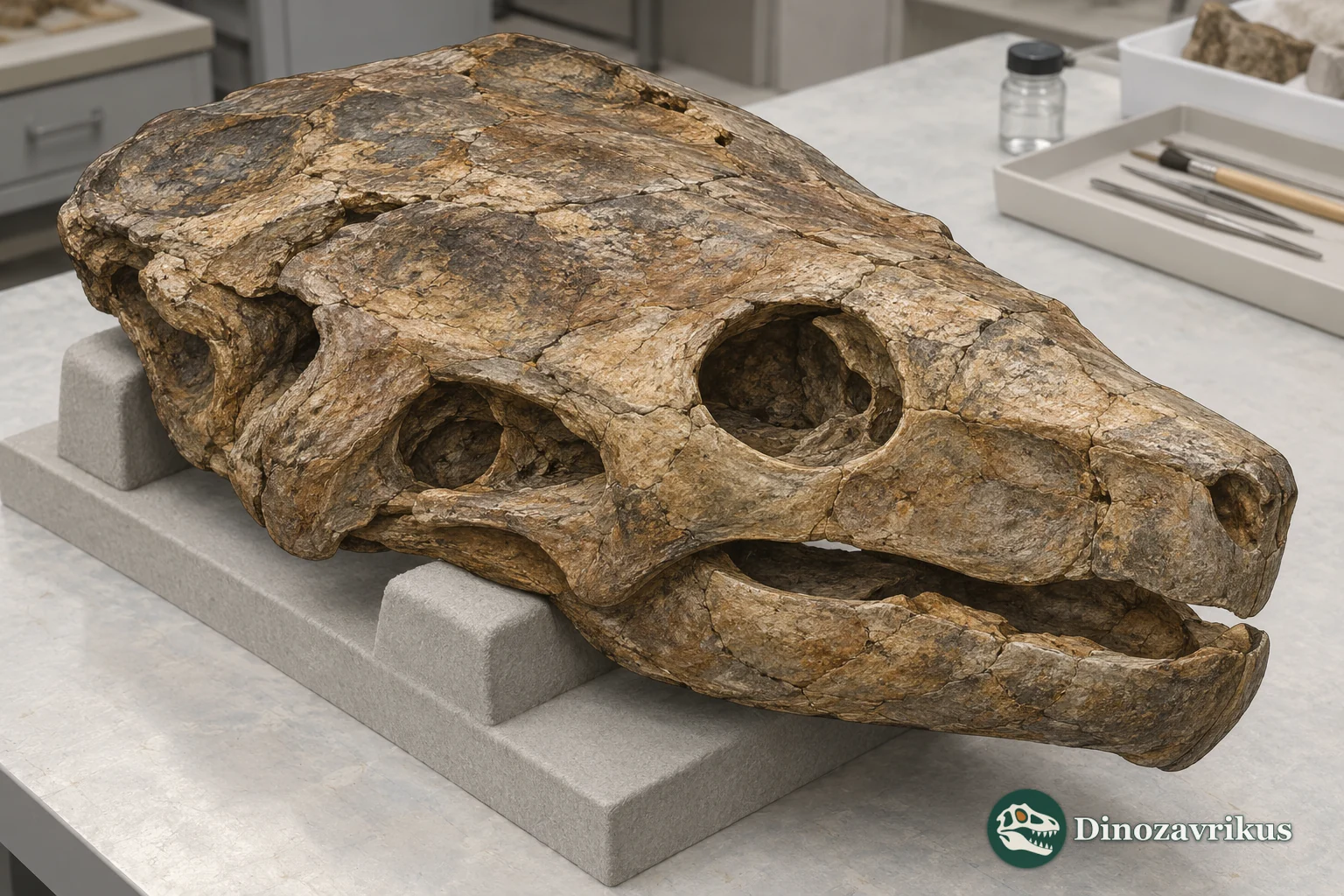
No complete skeleton is securely assigned to Carbonemys. Carapace UF/IGM 71 measures about 173 cm and comes from the same stratigraphic horizon, but was not physically associated with the holotype. The authors treated it separately as “Pelomedusoides shell taxon A.” Other shells from the section may represent additional turtle species.
Age and Cerrejón habitat
The holotype came from a clay bed in the middle Cerrejón Formation at La Puente. Palynology places it in the Late Paleocene, about 58–55 million years ago. This is the age of the layer, not an exact date for the individual.
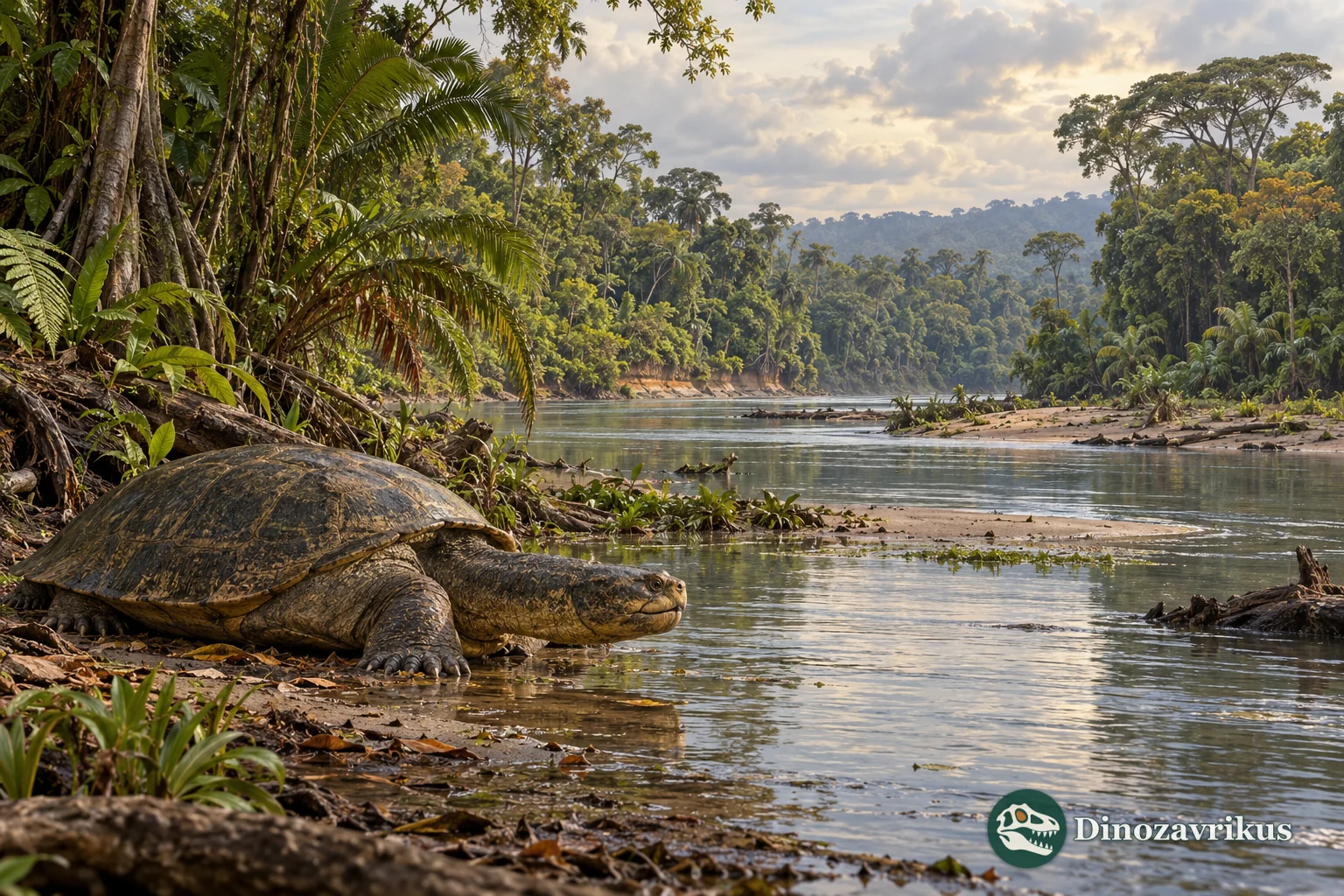
Cerrejón preserves warm, humid river, wetland and forest environments. The dyrosaurid Acherontisuchus documents long-snouted aquatic predators in the regional river system. Ecological overlap is plausible but does not show that it hunted Carbonemys.
Classification, anatomy and size
Skull anatomy places Carbonemys among Podocnemididae, a family of side-necked turtles with living and fossil members in South America and Africa. Phylogenetic placements may change as new taxa and characters are analysed.
The broad rear skull and robust jaw apparatus support an inference of a powerful bite, not a particular menu. No stomach contents or direct feeding traces are known. Neither body length nor mass can be estimated securely from the skull alone. The separate carapace is compatible with a giant turtle but not proven to belong to this species, so it should not be silently joined to the holotype.
What remains unknown
The fossils establish a large podocnemidid in the Cerrejón ecosystem, but do not preserve colour, soft tissues, sex, nests or eggs. No trackway or meal is securely tied to Carbonemys. Detailed hunting scenes are reconstructions, not direct observations. The contrast between a diagnostic skull and uncertain body remains is central to an accurate profile.
Frequently asked questions
What is the Carbonemys holotype?
UF/IGM 41, a nearly complete but flattened skull from the La Puente section of the Cerrejón Formation.
Was its shell almost two metres long?
A 173 cm carapace was found in the same horizon but not with the holotype; it is not securely assigned to Carbonemys.
What did Carbonemys eat?
Its diet is unknown. Robust jaws suggest bite strength, but no evidence identifies specific prey.
Why the name Carbonemys?
It combines words for coal and freshwater turtle, referring to Cerrejón. Cofrinii honours David Cofrin.