

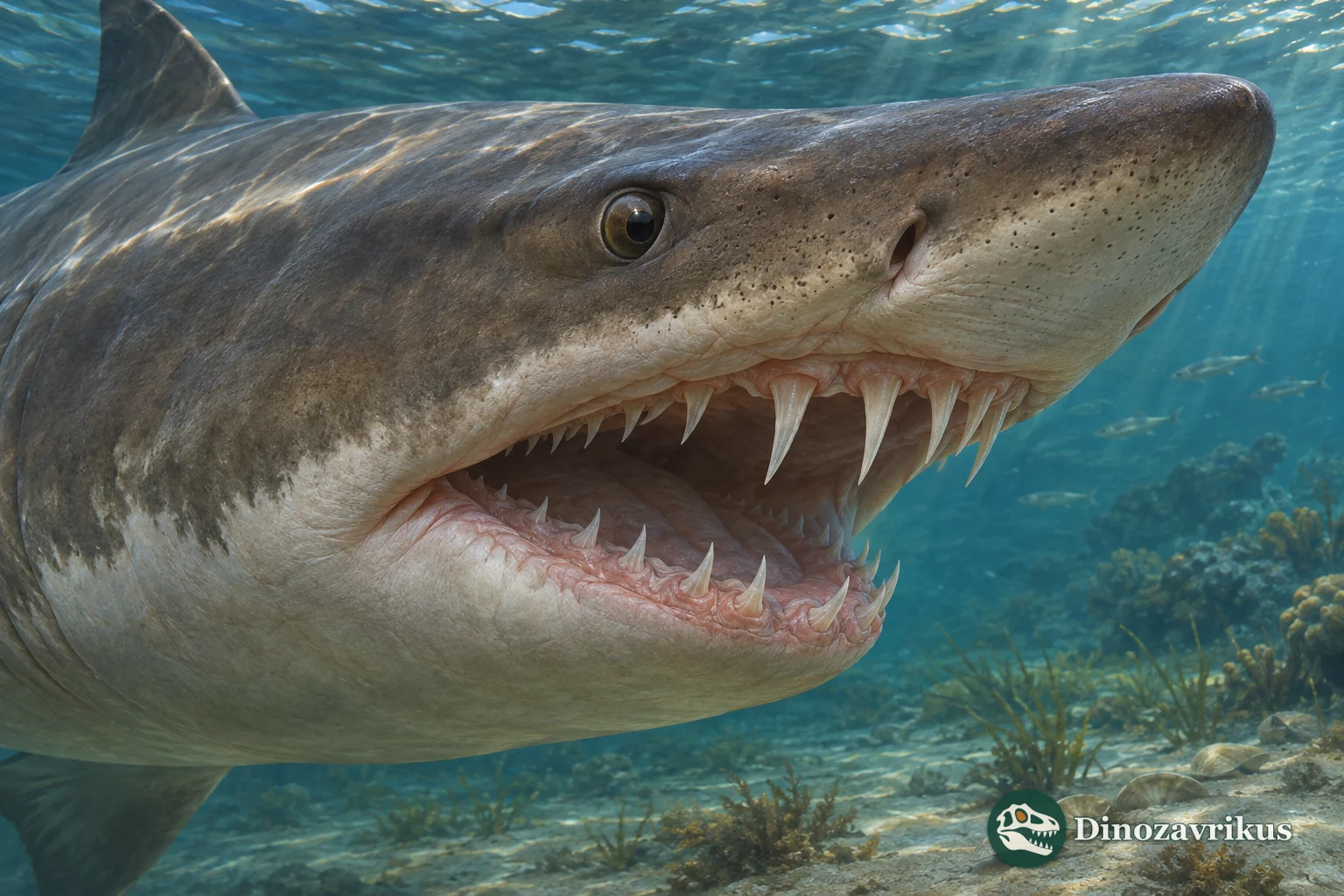
Carcharoides was an extinct lamniform shark documented mainly by isolated teeth. Comparing anterior and lateral positions has revealed dental differences and several species. No complete skeleton in the studies discussed here establishes its body proportions. The animal on the cover is therefore an artistic reconstruction.
Quick facts
| Genus | Carcharoides Ameghino, 1901 |
|---|---|
| Type species | C. totuserratus |
| Group | Lamniformes, Odontaspididae |
| Principal evidence | Isolated fossil teeth |
| Occurrence | At least middle to late Eocene through middle Miocene |
| Studied regions | North Sea Basin and Southern Hemisphere |
| Body length | Not established from the known teeth |
What can the fossils tell us?
Anterior and lateral teeth differ. A detached tooth does not reveal the entire animal.
A 2018 study reconstructed the dental positions of C. catticus using teeth from different individuals, not an articulated jaw.
A 2020 reassessment showed that teeth once grouped under Carcharias acutissimus may represent different forms.
A shark reconstructed from loose teeth
Sharks replace their teeth continuously, and anterior crowns may differ from lateral ones. A single fossil therefore provides only part of the dental pattern. Reinecke and coauthors compared Oligocene and Miocene material from the North Sea Basin in 2018 and assembled an artificial tooth set for C. catticus. It illustrates probable jaw positions but is not one preserved jaw.
The study recognized two enlarged upper anterior tooth files in Carcharoides, compared with three described in Carcharias. Crown and root characters must be assessed together. Cretalamna presents a related problem: isolated shark teeth are informative, but their original positions matter.
The type species and geographic record
Florentino Ameghino established the genus in 1901 for C. totuserratus from Patagonia. The type species must not be confused with C. catticus, a European species also referred to this genus. Later work described C. lipsiensis from late Rupelian deposits near Leipzig, with an upper anterior tooth, NKML Pal4138b, as holotype.
Teeth assigned to C. totuserratus also occur in Southern Hemisphere deposits, including Chilean Miocene strata. A tooth in the Navidad Formation establishes its presence in the deposited assemblage, but mixed shallow- and deep-water material means that burial setting alone cannot establish a preferred habitat.
Why names have changed
Earlier collections grouped some similar teeth under Carcharias acutissimus. Hovestadt's 2020 reassessment tentatively referred the two syntypes to C. catticus, while noting that other teeth under the old name resemble young Carcharias cuspidatus. A reassignment reflects comparison of fossils, not a change to the age of the rock.
A connected skeleton makes dental placement easier to test. In Haimirichia, a partial articulated specimen linked teeth to head anatomy. Carcharoides remains more dependent on comparisons among detached teeth.
What its teeth do and do not tell us
The pointed crowns are consistent with grasping aquatic prey, but they do not identify particular food animals. The cited dental studies provide no stomach contents associated with these fossils. Membership in Lamniformes permits a broad shark-like reconstruction but not a measured body length or precise fin arrangement.
The direct evidence consists of teeth and their stratigraphic contexts. The composite dental set is a scientific reconstruction. Color, body outline and underwater scene in the illustrations are artistic choices rather than fossil observations.
Frequently asked questions
What fossils document Carcharoides?
The published record discussed here consists chiefly of detached teeth. Comparative sets help infer their original positions.
Which species anchors the genus name?
Carcharoides totuserratus, named by Ameghino in 1901, is the type species.
Is a complete skeleton known?
No complete skeleton in these studies establishes the illustrated body proportions.
Why do species identifications change?
Tooth shape varies across a jaw and potentially with age. Researchers revise old names by comparing series and type specimens.