

Cardichelyon was a big-headed turtle from late Paleocene and early Eocene Wyoming. Its fossil shells preserve a joint consistent with movement of the rear lobe of the plastron, the underside of the shell. This feature became part of a new assessment of the turtle’s ancestry.
Quick facts
| Group | Turtles, placement debated |
|---|---|
| Age | Late Paleocene and early Eocene |
| Region | North America: Wyoming, United States |
| Type species | Cardichelyon rogerwoodi |
| Holotype | YPM PU14671, partial skeleton |
| Scientific name | Cardichelyon |
| Diet | No direct evidence |
What can the fossils tell us?
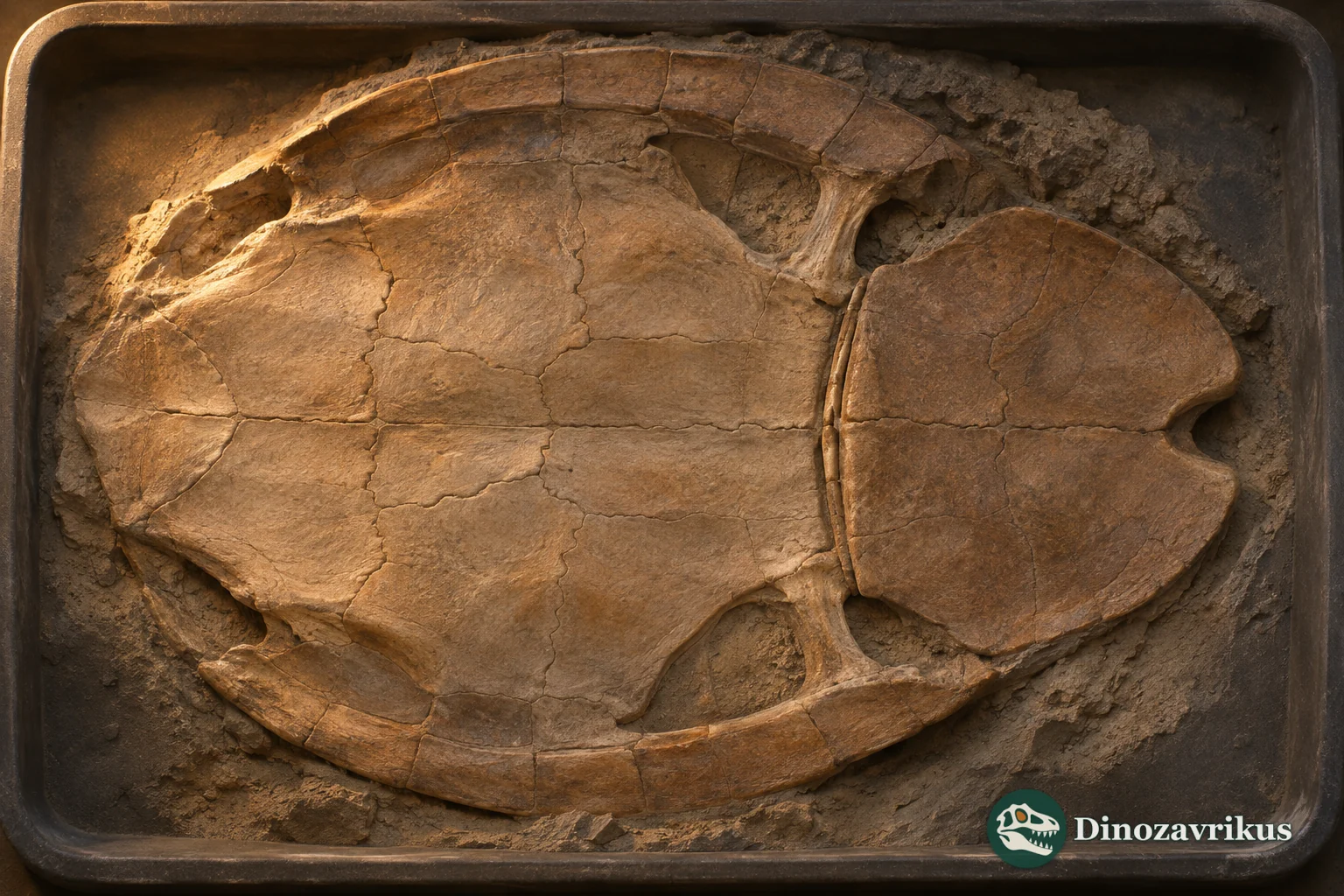
YPM PU14671 includes a restored shell, part of the skull and fragments of the limbs and girdles.
The contact between the hyoplastron and hypoplastron points to a moveable rear lobe. Its muscles and ligaments are missing.
A 2020 study found that placement depended on which turtles were included in the analysis. The authors favoured a relationship with mud and musk turtles.
A turtle collected by Princeton teams
Princeton University teams collected the type material during the 1930s and 1940s. Yale’s Peabody Museum now houses it. J. Howard Hutchison formally named Cardichelyon rogerwoodi in 2013. The holotype, YPM PU14671, is from Reis Quarry in Park County, in late Paleocene beds of the Fort Union Formation.
The bones of the upper shell are largely fused in the holotype, so researchers compared other shells to reconstruct their arrangement. Referred specimens also occur in early Eocene deposits elsewhere in Wyoming.
How the underside moved
The plastron protects the turtle’s underside. A transverse joint divided the hyoplastron from the hypoplastron in Cardichelyon, ahead of a broad, notched rear lobe. The fossil contact indicates movement at this joint. The extent to which the rear lobe closed the shell remains uncertain.
The bridge joining the upper and lower shell also preserves openings for musk ducts. Related openings occur across several turtle lineages. In Hoplochelys, researchers likewise examine the structure of the bridge and the bones around it when testing relationships.
Why the family tree remains unsettled
Hutchison first allied Cardichelyon with the living Asian big-headed turtle, citing its large head and multiple musk duct openings. In 2020 Walter Joyce and Julien Claude added other features to the comparison, including short projections at the front of the carapace and a rib-like projection from the plastron.
One analysis grouped Cardichelyon with testudinoids, which include big-headed and pond turtles. When testudinoids were excluded, the fossil appeared nearer the lineage of mud and musk turtles. The researchers favoured the latter view after weighing shell anatomy and the timing and geography of fossil occurrences. Better cervical vertebrae and girdle material could refine that assessment.
Frequently asked questions
Where did Cardichelyon live?
Its fossils are documented in late Paleocene and early Eocene deposits in Wyoming, in western North America.
Is the head known from fossils?
Yes. A partial skull is preserved with the holotype. It provides evidence of an unusually large head.
Which part of the shell moved?
The hind lobe of the plastron could move along a transverse joint on the underside of the shell.
Was it related to the living big-headed turtle?
That was the first interpretation. A later study favoured mud and musk turtle affinities, but the exact position remains debated.