

Carentonosaurus was a marine lizard known from scattered Late Cretaceous bones in western Europe. Its trunk vertebrae are both thick on the outside and compact within. A CT study of a Spanish specimen tested what the structure might imply about buoyancy in shallow water.
Quick facts
| Group | Anguimorphs (Anguimorpha), pythonomorphs (Pythonomorpha) |
|---|---|
| Age | Late Cretaceous, Cenomanian. Santonian referrals are tentative |
| Region | Europe, France and Spain |
| Type species | Carentonosaurus mineaui |
| Scientific name | Carentonosaurus |
| Diet | No direct evidence |
What can the fossils tell us?
The French type species is based on a trunk vertebra from Madame Island. The Spanish species was named from a complete isolated vertebra from Algora.
Bone occupies an average of about 96% of the area in six sampled sections of the Spanish vertebra. This structure may have made submergence easier.
Scattered bones leave the total length, tail anatomy and position of the limbs during swimming open.
Two Cenomanian species
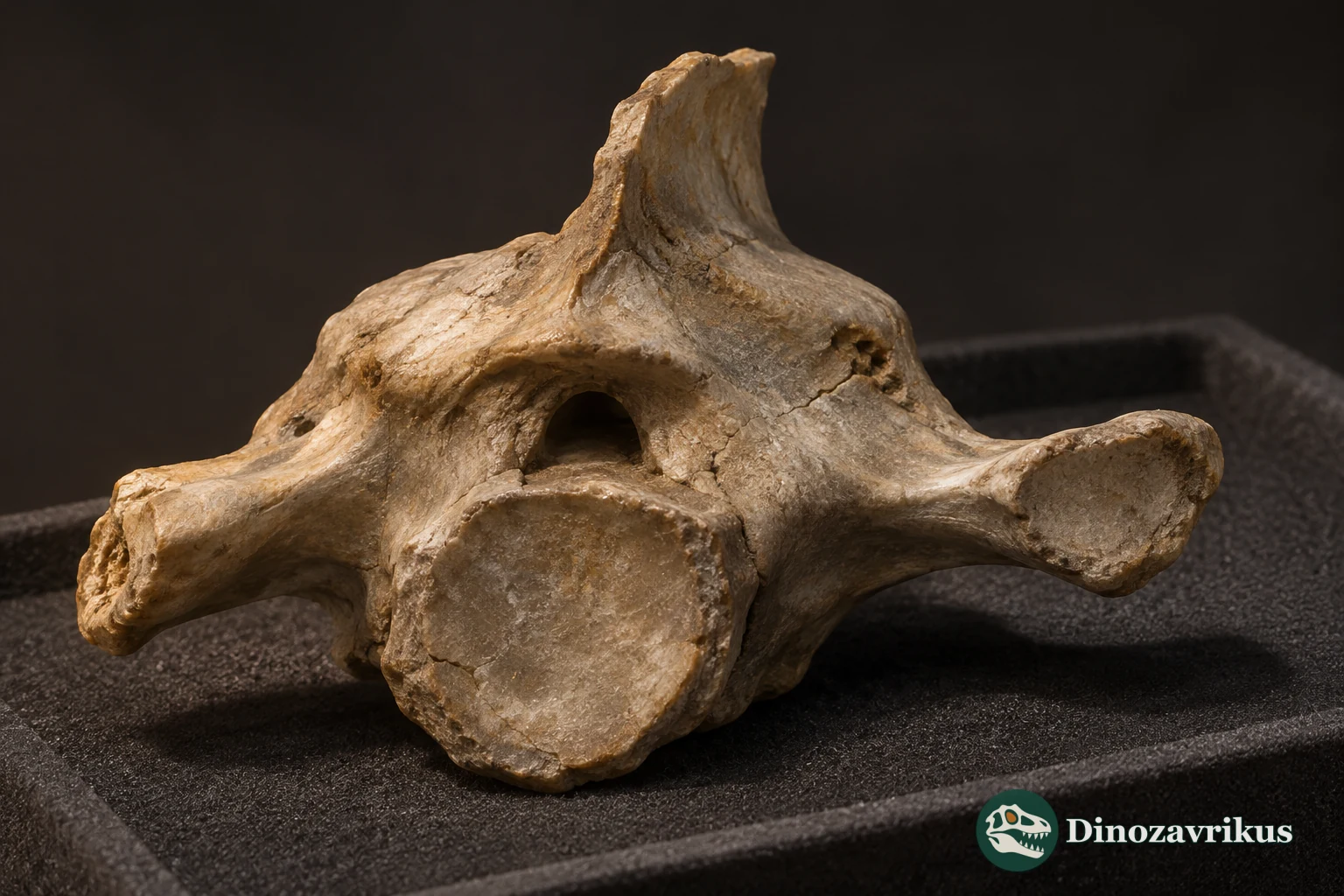
Jean-Claude Rage and Didier Néraudeau named Carentonosaurus mineaui in 2004 from Madame Island on the Atlantic coast of France. Its holotype, MNHN IMD 21, is a trunk vertebra from the early part of the late Cenomanian. More vertebrae, a rib and part of the shoulder girdle are known from the same site. In 2023, a vertebra from Algora in Spain, ALG 200, became the holotype of C. algorensis. It dates to around the transition from the middle to the late Cenomanian.
Features visible from the outside
In a Carentonosaurus trunk vertebra, the arch is wider at the front, and the rib articulations project far out to the sides. A thick arch surrounds a relatively small spinal canal. The notch at the back of the arch is much deeper in the Spanish specimen than in the French type species, one difference visible without a scan.
Measuring the inside of the bone
In the Algora specimen, the vertebral body is 13 mm long and the neural arch measures 17 mm. Both numbers describe a single vertebra. The CT study measured the bone area relative to empty spaces in each slice. Average compactness across the sections was 95.81%. The exterior thickening is called pachyostosis, and the increased internal compactness is osteosclerosis. Both occur in Carentonosaurus.
What heavier bones might have done
A heavier skeleton could have helped the animal stay submerged in shallow water. A comparable combination of thickening and compact bone occurs in Pachyvaranus, another Cretaceous marine lizard. In Carentonosaurus, the large joints between trunk vertebrae may also have made the trunk stiffer. The fossils offer clues to how it swam, with neither the tail nor its movement preserved directly.
Evidence beyond the two type localities
A Cenomanian vertebra from near Oviedo has been assigned to the genus without a species name. Material from Pinilla del Valle in Spain was tentatively referred to the type species. Those fossils are considered Santonian in age and were redeposited into much younger cave sediments. Portuguese bones initially named Carentonosaurus soaresi were transferred to the genus Segurasaurus in 2024.
Frequently asked questions
Why is Carentonosaurus considered marine?
It occurs in coastal marine deposits. The structure of its bones is consistent with submergence and swimming.
Why is the Algora vertebra important?
It is the type specimen of the Spanish species. CT scans showed both the thick exterior and the unusually compact internal structure.
Was Carentonosaurus a mosasaur?
It is classified as a pythonomorph, a broader grouping that includes mosasaurs. Its known vertebrae differ from those of members of Mosasauridae.
How long was it?
Researchers have measured individual vertebrae. Too little of the spine or the rest of the skeleton is known for a reliable total length.