

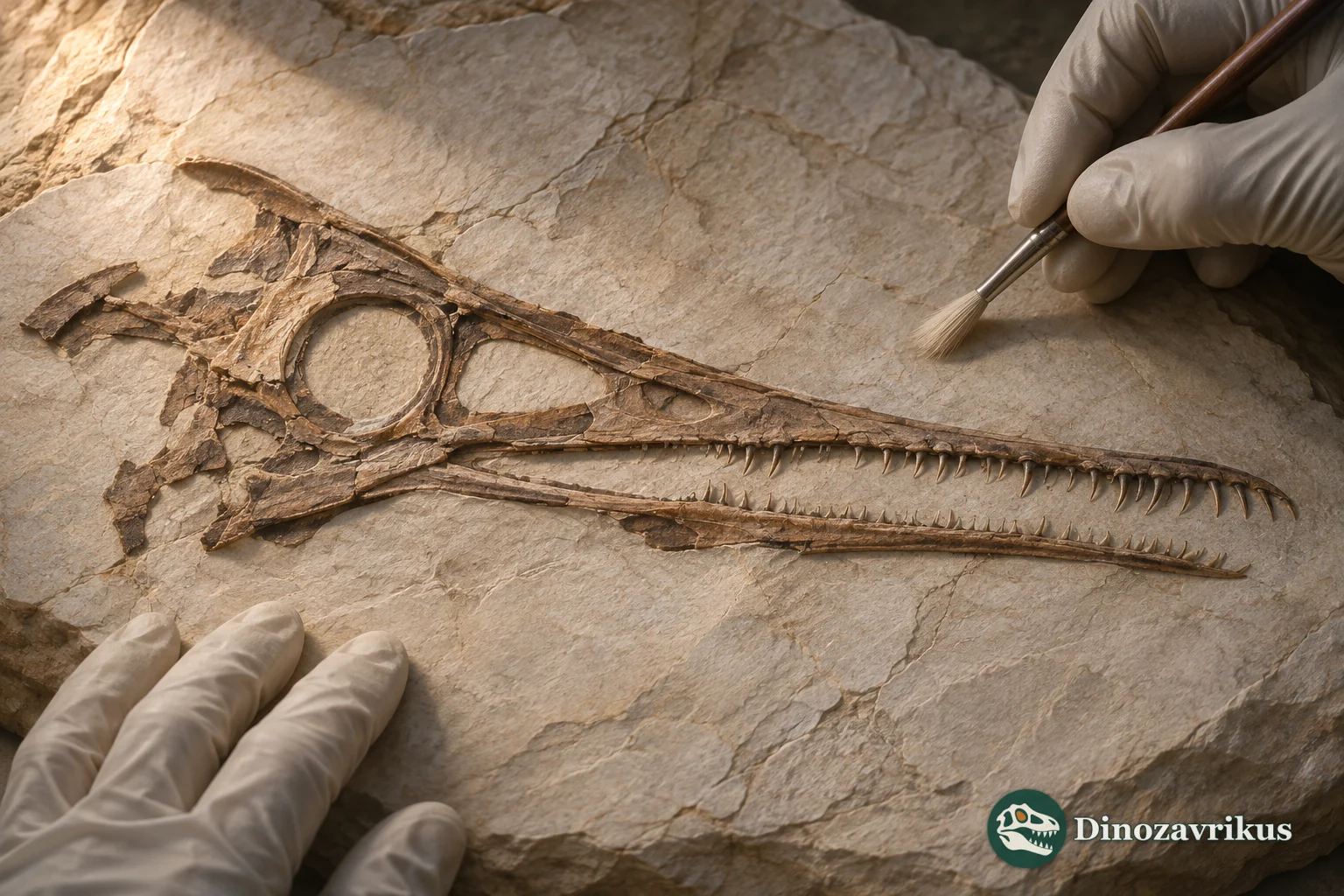
Cathayopterus grabaui is known from an incomplete skull found in Early Cretaceous rocks of western Liaoning, China. Its long jaws carry numerous fine teeth. Their shape led researchers to propose feeding on small aquatic invertebrates, although no meal was preserved with the fossil. The wings and full body proportions remain unknown.
Quick facts
| Scientific name | Cathayopterus grabaui, Wang and Zhou, 2006 |
|---|---|
| Holotype | IVPP V13756, an incomplete skull |
| Locality | Western Liaoning, China |
| Rock unit | Dawangzhangzi Bed, middle Yixian Formation |
| Age | Early Cretaceous |
| Dentition | Numerous fine, laterally directed teeth |
| Wingspan | Cannot be measured from the known skull |
What can the fossils tell us?
IVPP V13756 preserves an incomplete skull and jaws. Wings and trunk bones are not documented for the type specimen.
Many thin teeth project sideways. Their structure is directly observable, whereas the exact prey is not.
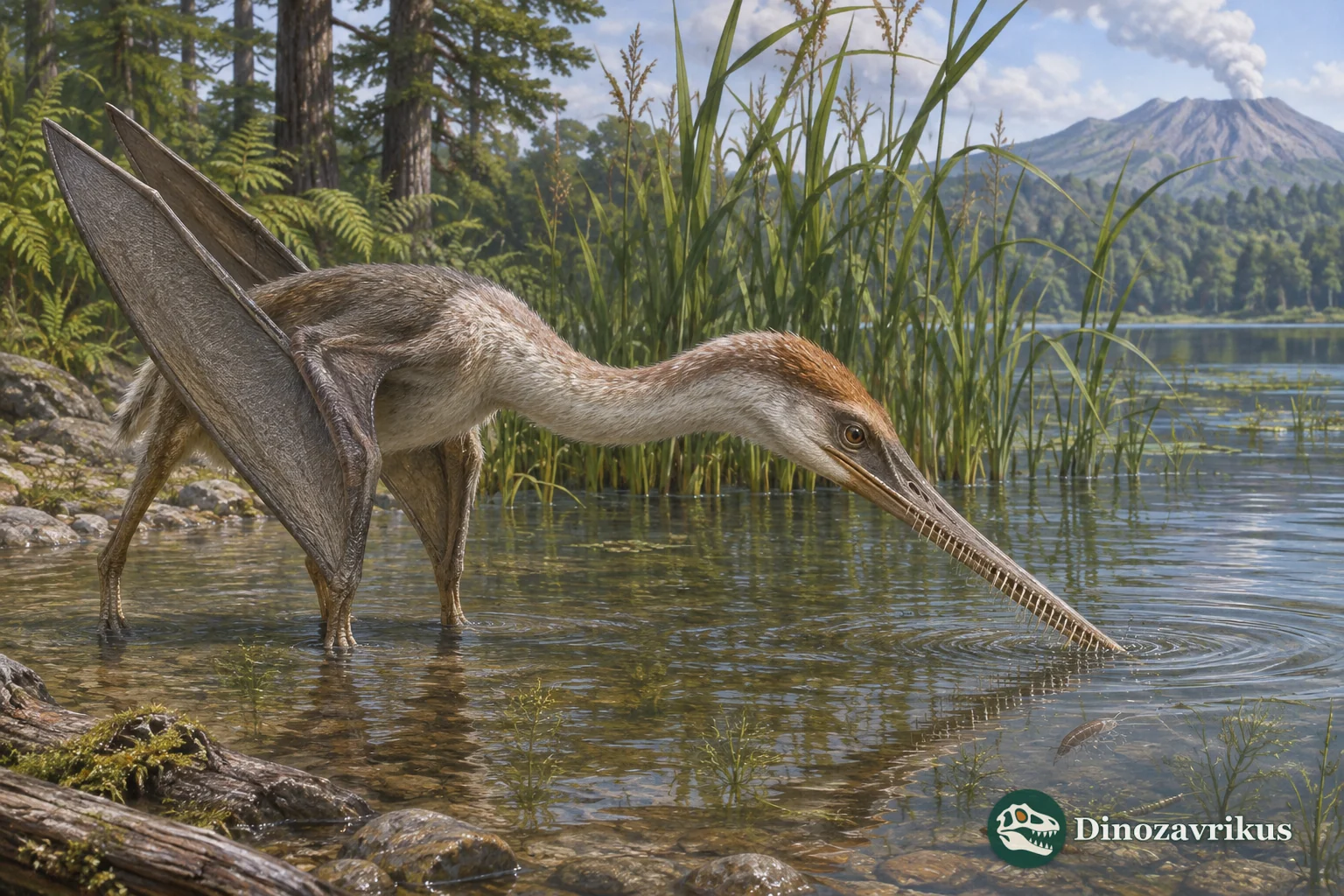
The describing authors proposed gathering small aquatic invertebrates. No gut contents directly confirm a particular diet.
Wingspan, body proportions, colour and particular feeding movements cannot be established from this skull.
A skull from the Yixian Formation
Xiaolin Wang and Zhonghe Zhou described Cathayopterus grabaui in 2006 from specimen IVPP V13756. It comes from the Dawangzhangzi beds in the middle Yixian Formation of western Liaoning. The genus name invokes China and a wing; the species name honours geologist Amadeus William Grabau.
The material is an incomplete skull rather than an articulated body. Its long, low snout and tooth rows can be studied directly, but no wingspan can be measured. Beipiaopterus comes from the broader Yixian fossil record, yet its body measurements cannot be assigned to Cathayopterus.
Teeth and a feeding proposal
Numerous slender teeth extend laterally from the long jaws. Wang and Zhou placed the animal among ctenochasmatids and proposed that the dentition could strain small invertebrates from shallow water. This is a functional interpretation of anatomy, not evidence from preserved stomach contents.
Pterodaustro shows another tooth arrangement associated with filtering, but its exceptionally dense teeth should not be copied into this Chinese genus. The two pterosaurs are separate taxa known from different fossils.
What remains unknown
The type skull does not reveal the wing skeleton, body mass, colour, reproductive biology or exact flight mechanics. Neither a numerical adult wingspan nor a precise list of prey species follows from the known material.
Scenes of an animal feeding at a lake are plausible illustrations of the original hypothesis. They are not photographs of a specific behaviour or exact reconstructions of the missing body.
Why the fossil matters
The skull documents a distinctive combination of elongate jaws and fine teeth in the Early Cretaceous pterosaur record of China. Better associated remains could test both the size reconstruction and the ecological interpretation without changing what this specimen actually preserves.
Frequently asked questions
Where was Cathayopterus found?
Its type skull comes from the Dawangzhangzi beds of the middle Yixian Formation in western Liaoning, China.
Why is filtering proposed?
The long jaws bear many fine teeth that could retain small aquatic animals. This is an anatomical inference rather than preserved food.
Is its wingspan known?
No secure measurement is possible because the described type material consists of an incomplete skull without wing bones.
Who does grabaui honour?
The species name honours the geologist Amadeus William Grabau.