

Centrophoroides was an extinct squaliform shark. An articulated skeleton from Lebanon anchors its type species. Antarctic and Patagonian finds preserve a very different record: a natural tooth cast and isolated teeth with low, backward-leaning crowns. They broaden the record of the genus without resolving the range of the Lebanese species.
Quick facts
| Group | Dogfish sharks |
|---|---|
| Named by | James William Davis, 1887 |
| Holotype | Skeleton from Sahel Alma, Lebanon |
| Holotype age | Santonian, Late Cretaceous |
| Southern finds | Patagonia and James Ross Island |
| Tooth size | Under 7 mm in comparative descriptions |
What can the fossils tell us?
The Natural History Museum specimen provides information about the body beyond what isolated teeth preserve.
The angle and fine irregularities in the edge help identify the tooth. Root structures also matter when comparing related genera.
The teeth and the natural cast broaden the geographical record of the genus without identifying the Lebanese species.
The skeleton from Sahel Alma
James William Davis described Centrophoroides latidens from Lebanon in 1887. Its holotype, BMNH P.4021 in the Natural History Museum, London, is an articulated skeleton from Santonian deposits at Sahel Alma. It provides information about proportions and fin positions that the isolated teeth found elsewhere cannot supply.
Arthur Smith Woodward placed the species in a different dogfish genus in 1889. Later authors reinstated Centrophoroides and figured the skeleton in comparisons of extinct squaliforms. Cretascymnus also occurs at Sahel Alma. The locality preserves several dogfish forms and makes it possible to compare more than one set of anatomical characters.
Recognising an isolated tooth
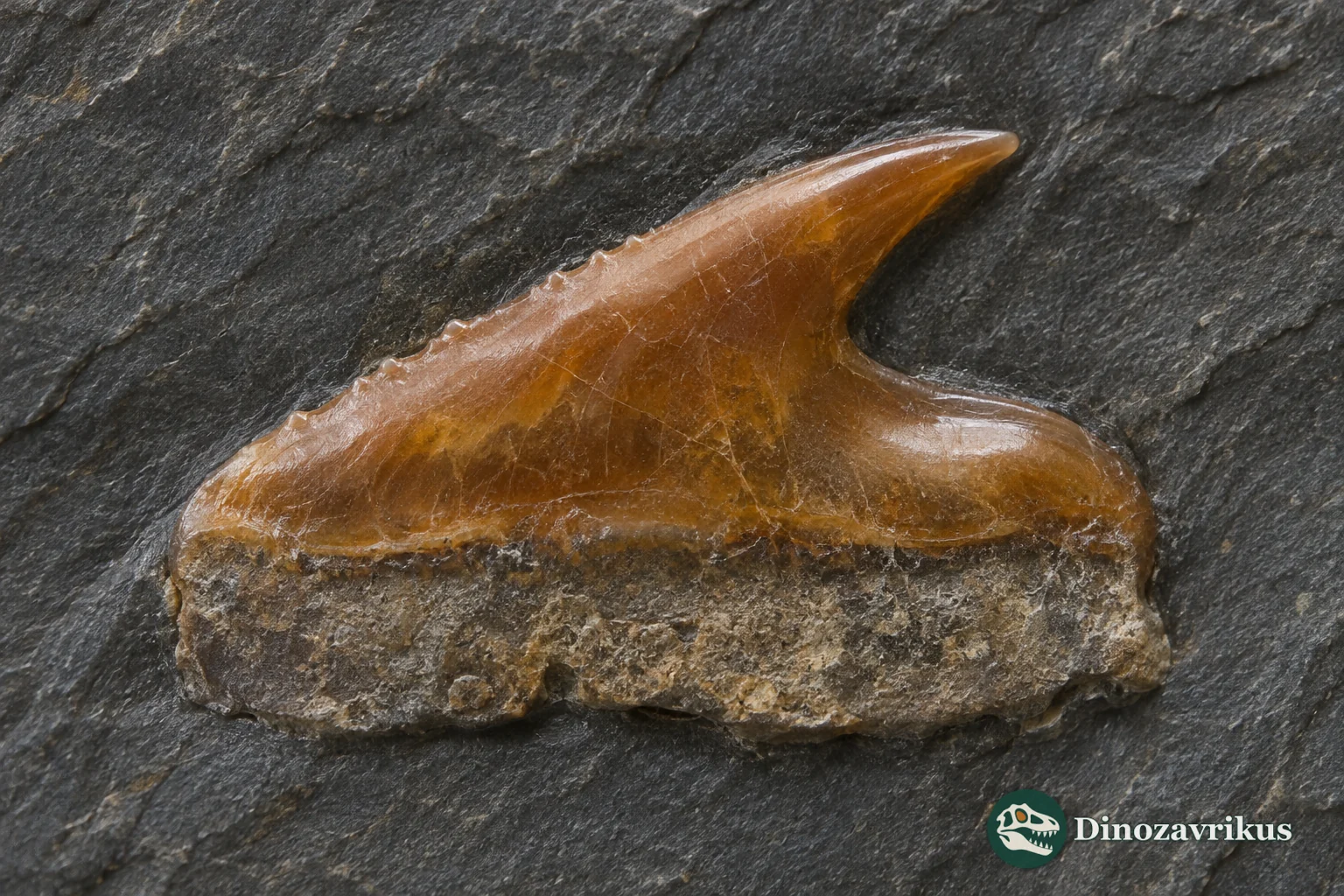
The crown is low and broader than high. Its main cusp points backwards over a low shoulder known as the heel. Part of the cutting edge may bear irregular serrations, while the heel has a smooth edge. A small apron of enameloid projects down the outer face over the root. Related genera can have similar crowns, so the position of grooves and openings in the root is important.
Campanian teeth in the Belgian Obourg Chalk were once compared with the Lebanese type species. They were subsequently assigned to another dogfish. Changing determinations affect the distribution shown in older species lists and illustrate why teeth from equivalent positions are compared.
Two records from southern waters
SGO.PV.6662 from James Ross Island, Antarctica, is a cast of a lateral tooth from the late Campanian Gamma Member of the Santa Marta Formation. The low, backward-leaning crown is visible on the cast. The material was assigned to the genus, with no species identification.
In Chile's Sierra Baguales, two Maastrichtian teeth, SGO.PV.6643a and b, came from the upper Dorotea Formation. They preserve irregularities along part of the cutting edge, an outer apron and openings in the root. A larger tooth previously cited from the area might instead belong to Squalus. The two smaller teeth preserve several useful features in combination.
Frequently asked questions
What survives of the Lebanese shark?
An articulated skeleton, BMNH P.4021, is the holotype of the type species.
Has the genus been found in Antarctica?
Yes. A natural cast of a lateral tooth was reported from James Ross Island.
What does a Centrophoroides tooth look like?
It typically has a low crown with a backward-leaning cusp and a low, smooth-edged heel.
Did the Lebanese species occur in Patagonia?
The Patagonian teeth have been assigned to the genus. Their species is undetermined.