

Cretascymnus is an extinct squaliform shark in the family Somniosidae. Its type species, C. adonis, is unusual among fossil sharks known from dental remains because a small articulated skeleton was described from Lebanon. Other named species are represented chiefly by isolated teeth. The genus therefore preserves direct evidence for one animal’s body and a much broader, less complete record of its relatives.
Quick facts
| Group | Squaliform shark in the family Somniosidae |
|---|---|
| Type species | Cretascymnus adonis, first described as Centrophorus adonis |
| Associated skeleton | Holotype MNHN 1946-18-238 from Sahel Alma, Lebanon |
| Known age range | Santonian Late Cretaceous to Danian Paleocene records |
| Measured type specimen | About 20 cm long in the original description; not a genus-wide estimate |
| Other named species | C. westfalicus and C. beauryi, known mainly from teeth |
| Diet | Specific prey are not established by the available fossils |
What can the fossils tell us?
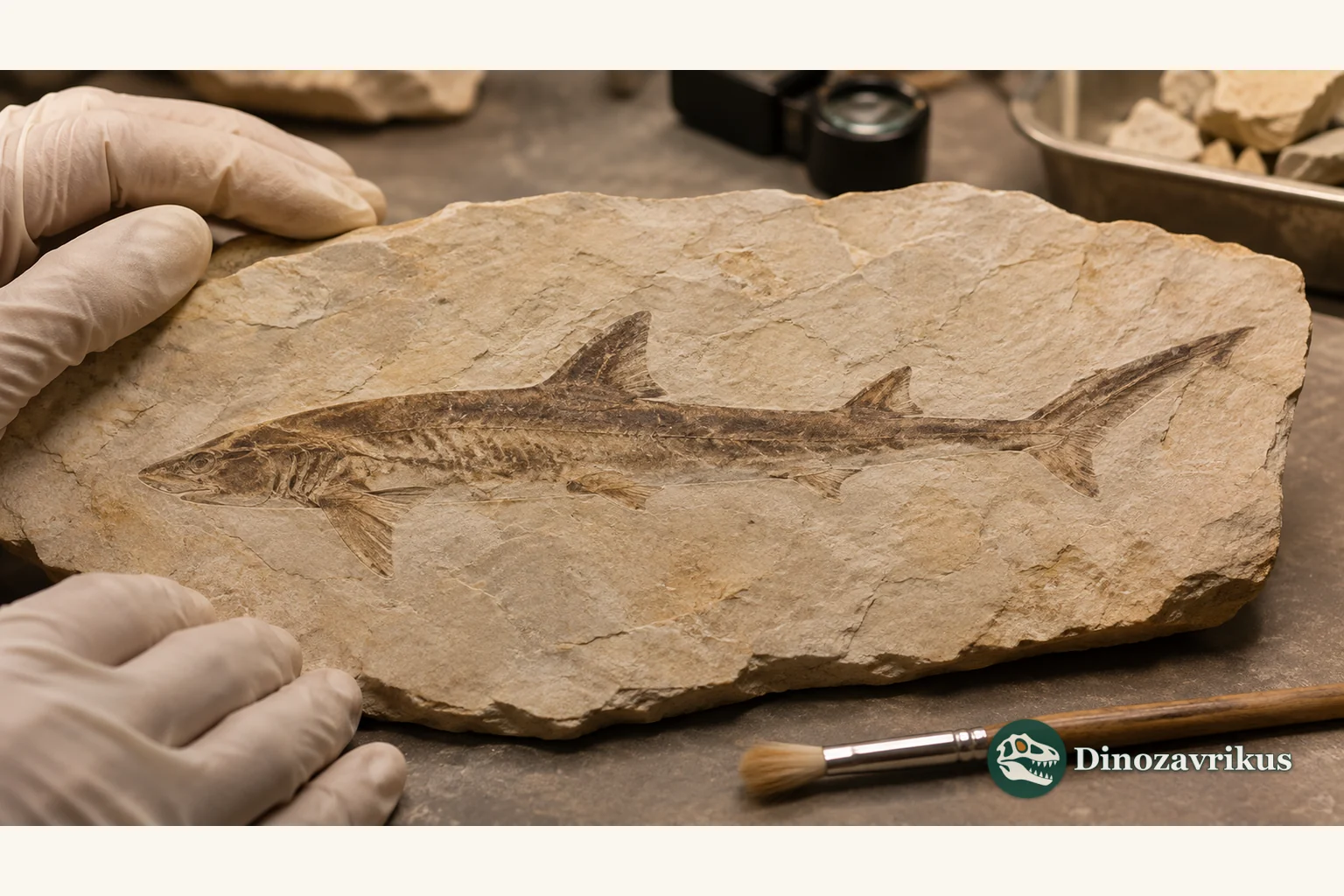
Jean Signeux described holotype MNHN 1946-18-238 from Sahel Alma in 1950 as Centrophorus adonis. The paper records an elongate body, dorsal fins with spines, scales, teeth and more than 70 vertebrae. Its estimated length was about 20 cm.
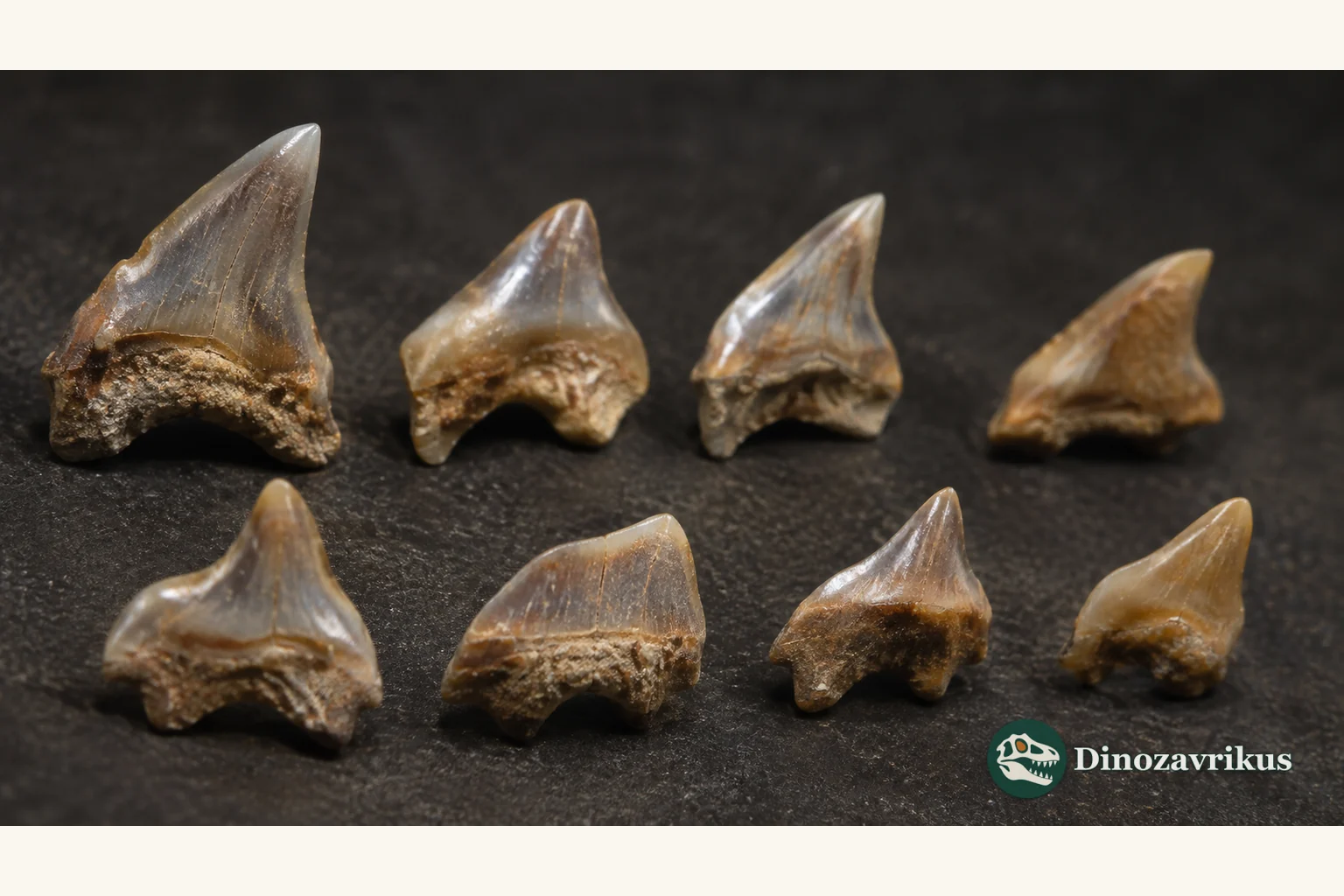
Dental series of C. westfalicus and C. beauryi vary along the jaw. High, narrow anterior crowns give way to lower, broader teeth toward the rear. Crown shape, roots and foramina help distinguish taxa, but a loose tooth does not preserve the complete body.
One complete tooth from a Danian horizon in the Byala 2b section was assigned to C. beauryi. Two less complete teeth were identified only as Cretascymnus sp., one Maastrichtian and one Danian. The authors interpret the sequence as evidence that the genus survived the end-Cretaceous extinction; the sample does not establish the survival of every species.
From Centrophorus adonis to Cretascymnus
Jean Signeux described the Lebanese fossil in 1950 under the name Centrophorus adonis. The holotype, now catalogued as MNHN 1946-18-238, belonged to the collection of the Muséum national d’Histoire naturelle in Paris. The published account does not identify the person who found the fish or describe its collection history, so no individual discoverer can be named from that source.
Henri Cappetta later revised the Late Cretaceous sharks of Lebanon and established Cretascymnus in 1980. The species became Cretascymnus adonis. This was a change in classification, not a second animal or a newly discovered skeleton. Later researchers named C. westfalicus from Campanian Germany and C. beauryi from Maastrichtian Austria, mostly from isolated teeth.
A small skeleton preserves the body outline
Signeux described the type specimen as an elongate fish about 20 centimetres long and 2.5 centimetres high. Those are approximate measurements of one fossil. The skeleton preserves parts of the body and fins, teeth, scales and more than 70 vertebrae, giving C. adonis a much fuller anatomical record than the other named species.
The description places two dorsal fins along the back and records a spine associated with each. The first dorsal lay above the rear part of the pectoral fin; the pelvic fins were nearer the second dorsal than the first. The tail is preserved as well. These observations describe the Lebanese type species. They do not demonstrate that all teeth assigned to the genus belonged to sharks with identical proportions.
Teeth change from the front of the jaw to the rear
Large samples of C. westfalicus teeth helped researchers reconstruct a tooth sequence. Teeth near the front are taller and narrower. Farther back, crowns become lower and broader, while their tips lean more strongly toward the rear of the jaw. A loose tooth therefore has to be compared with the likely jaw position as well as with the details of its crown and root.
Descriptions of C. beauryi also distinguish upper and lower teeth and document differences in root openings and the surfaces that allowed neighbouring teeth to interlock. These structures are small, but they carry much of the taxonomic evidence. As with the Cretaceous shark Johnlongia, the study of fossil teeth can reveal a lot about identification while leaving most body proportions uncertain.
A record extending from the Cretaceous into the Danian
The type skeleton is Santonian and comes from Lebanon. C. westfalicus is best known from Campanian deposits in Germany, with later records from Bavaria extending the species into the Maastrichtian. C. beauryi was described from Maastrichtian Austria. The scattered sites do not imply a continuous population across every sea or geological interval between them.
In 2026, a study of the Byala 2b section in Bulgaria reported teeth of the genus below and above the Cretaceous–Paleogene boundary. A well-preserved Danian tooth was assigned to C. beauryi; two less complete specimens were left at genus level, one from a Maastrichtian horizon and another from the Danian. The authors interpret this local sequence as evidence that Cretascymnus survived the end-Cretaceous extinction.
The conclusion rests on a small sample. It does not show that every named species crossed the boundary, nor does it reveal how abundant the shark was afterward. One tooth is identifiable to species, while the other material supports only a genus-level assignment. The distinction between a dated layer, an anatomical identification and an inference about survival matters here.
What the fossils do not establish
The approximate 20 cm length belongs to the C. adonis holotype. There is no equivalent body measurement for C. westfalicus or C. beauryi, and an isolated tooth cannot be converted into total length without a validated relationship to a complete jaw and body. The smaller type specimen should not be treated as a typical size for the entire genus.
The teeth preserve cutting edges and differences among jaw positions, but the cited material does not include stomach contents or unambiguous bite marks that identify prey. Growth, reproduction, swimming speed and colour are also unknown. The cover is an artistic reconstruction informed by the general body evidence from C. adonis; it does not depict a measured specimen or preserve its soft tissues.
Frequently asked questions
Is Cretascymnus known only from teeth?
No. The type species, C. adonis, is known from an articulated skeleton from Lebanon. Most other material assigned to the genus consists of isolated teeth.
How large was Cretascymnus?
The original description estimated the C. adonis holotype at about 20 cm long. That measurement cannot be transferred to the tooth-known species.
Did the genus survive the end-Cretaceous extinction?
A 2026 study reported one C. beauryi tooth and two teeth identified only as Cretascymnus sp. from Danian horizons in Bulgaria. The authors interpret the section as evidence of survival, but the sample is small and does not show that every species persisted.
What did Cretascymnus eat?
Its teeth show cutting surfaces and differ by jaw position, but no stomach contents or securely linked bite marks establish particular prey.