

Cetarthrosaurus walkeri is one of the most unusual and least known ichthyosaurs of the Early Cretaceous. Its name is based not on a complete skeleton but on a distinctive limb bone from a Cambridge collection. Researchers later found a second similar specimen. Together the bones identify a peculiar form, but they do not establish the animal's length, full appearance or way of life.
Quick facts
| Type species | Cetarthrosaurus walkeri |
|---|---|
| Holotype | CAMSM B58069, one proximal limb bone; Sedgwick Museum, Cambridge |
| Fossil age | Late Albian, Early Cretaceous |
| Find context | Cambridge Greensand, reworked from the Gault Formation |
| Additional material | CAMSM X50170, a similar isolated limb bone |
| Body length | No reliable estimate; only isolated limb bones are known |
Evidence guide
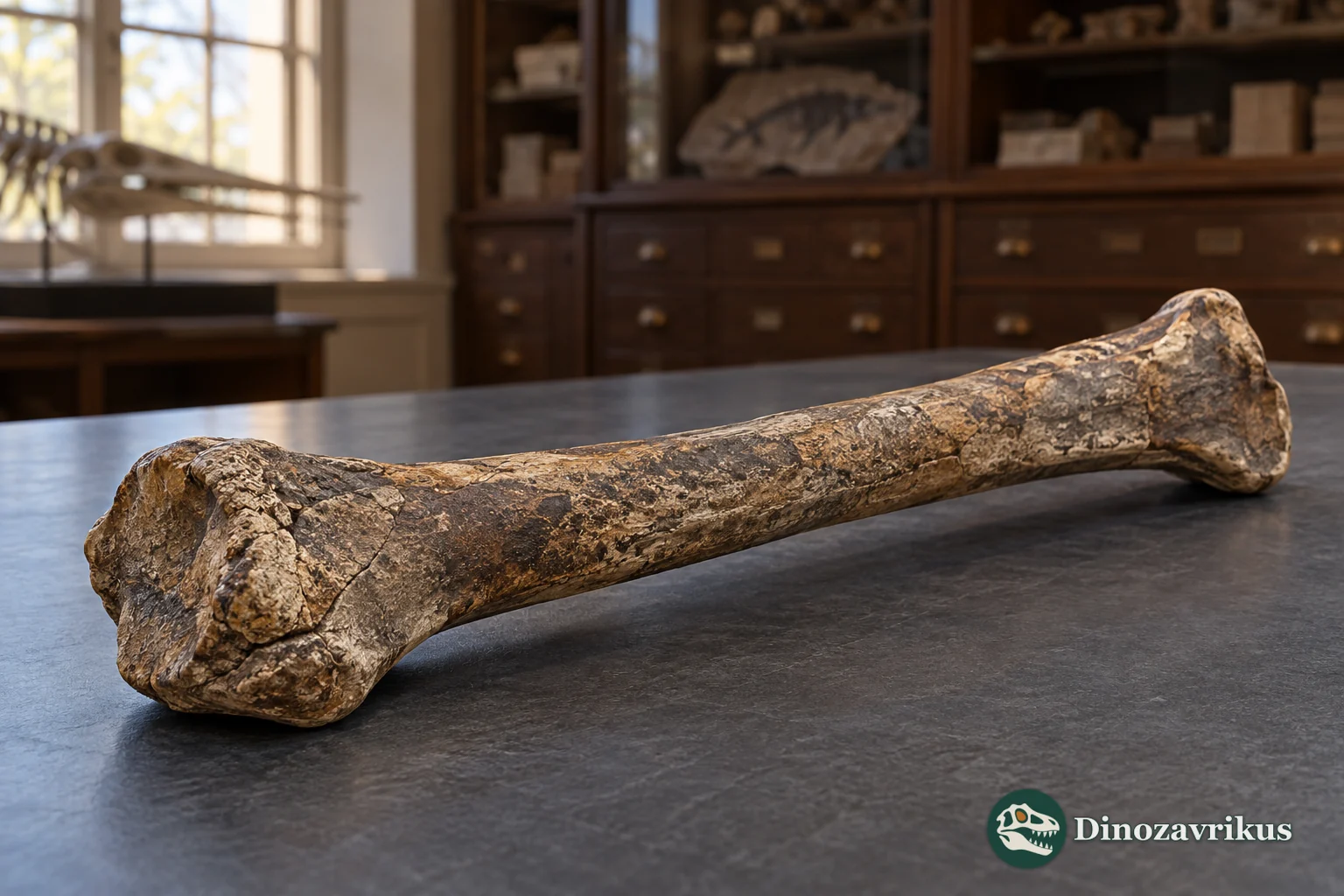
The elongated limb bone has a rounded head separated from its trochanters and three distal facets. Its proportions can be studied, but the complete skeleton and body length are unknown.
Researchers found a similar bone in a museum collection. Its shared unusual features support recognition of a distinct morphotype, but do not reveal the animal's full appearance.
The phosphatised bone entered the Early Cretaceous Cambridge Greensand after erosion of older Gault Formation deposits. The 2014 revision assigns the animal to the late Albian, not the early Cenomanian host bed.
Only two isolated limb bones are known. Without a skull, vertebral column or articulated skeleton, body length, diet and swimming behaviour cannot be established for this taxon.
Discovery and changing identifications
Harry Govier Seeley mentioned the bone as Ichthyosaurus walkeri in 1869. In 1873 he described it separately and proposed the genus Cetarthrosaurus. Seeley interpreted the element as a femur. Because its exact position in the forelimb or hindlimb cannot be established confidently, later authors use the broader term propodial.
The fossil was subsequently mistaken for a mosasaur. McGowan and Motani's 2003 ichthyosaur review called I. walkeri a nomen dubium without separately discussing the published genus. In 2014, Valentin Fischer and colleagues re-examined the type and described a second similar specimen. They considered the combination of features diagnostic and regarded Cetarthrosaurus walkeri as a valid but very poorly known ichthyosaur.
Two isolated bones
The holotype CAMSM B58069 is held by the Sedgwick Museum of Earth Sciences at the University of Cambridge. It is one right proximal limb bone. Referred specimen CAMSM X50170 is another isolated bone, found in the museum collection with a label linking it to the Cambridge Greensand. It is similar to the type and preserves some surfaces more clearly.
Both bones have a long, slender shaft and a rounded head separated from the dorsal and ventral trochanters. Three articular facets are present at the distal end. The identification rests on the combination of those features, not on a complete skull, vertebral column or associated skeleton.
Late Albian age and reworking
The specimens came from the Cambridge Greensand, a phosphatic deposit at the base of the Cretaceous succession in eastern England. The age of the host bed is not automatically the age of every fossil in it. The bone had been phosphatised and reworked after erosion of older Gault Formation sediment. Fischer and colleagues therefore assigned the animal to the late Albian, the final age of the Early Cretaceous.
The occurrence does not show that Cetarthrosaurus lived during the early Cenomanian, when the Cambridge Greensand host sediment accumulated. Reworking can place an older fossil in a younger bed and shift an apparent locality or age if the sedimentary history is ignored.
Classification and limits of the evidence
Fischer and colleagues placed the genus among ichthyosaurs of uncertain position. Three distal facets also occur in some ophthalmosaurids and in members of other ichthyosaur lineages, so that feature alone does not establish a family assignment. It also does not make Cetarthrosaurus a direct ancestor or close relative of any one named genus such as Stenopterygius.
No skull, teeth, vertebrae, pelvis or nearly complete skeleton is known. Body length cannot be estimated reliably from the limb bone without assumptions about the proportions of the missing animal. Diet, swimming speed, colour, reproduction and behaviour have not been demonstrated for this taxon. A more complete Jurassic example such as Catutosaurus shows how much more anatomy becomes available when skull and other skeletal regions are preserved.
Frequently asked questions
What fossils are known for Cetarthrosaurus?
Two isolated proximal limb bones are known: holotype CAMSM B58069 and similar referred specimen CAMSM X50170. No complete skeleton has been found.
Why is Cetarthrosaurus classified as an ichthyosaur?
The joint surfaces and proportions are consistent with ichthyosaurs, and the combination of unusual features distinguishes the bones from other described material. The second specimen strengthens the comparison.
How old is Cetarthrosaurus?
The animal is assigned to the late Albian of the Early Cretaceous. Its bones were reworked from the Gault Formation into the younger Cambridge Greensand.
How long was Cetarthrosaurus?
There is no reliable body-length estimate. An isolated limb bone cannot provide the length of the full animal without uncertain assumptions about its proportions.