

Catutosaurus gaspariniae is a Late Jurassic ichthyosaur from Patagonia, described in 2021. Its name refers to the Los Catutos area and palaeontologist Zulma Gasparini. The genus was diagnosed from a combination of skull, external narial and forefin features. The holotype is nearly complete but strongly flattened; two referred specimens preserve mainly snout fragments.
Quick facts
| Type species | Catutosaurus gaspariniae |
|---|---|
| Holotype | MOZ-PV 1854, nearly complete but flattened skeleton; Museo Olsacher, Zapala |
| Age | Tithonian, Late Jurassic |
| Locality | El Ministerio quarry, Los Catutos, Neuquén, Argentina |
| Rock unit | Los Catutos Member, Vaca Muerta Formation |
| Referred material | MOZ-PV 103 and MOZ-PV 7260, mainly snout and jaw fragments |
| Length estimate | About 3 m for an adult in an institutional summary; approximate only |
Evidence guide
The nearly complete but flattened skeleton includes the skull, teeth, vertebral column, shoulder girdle and remains of both forefins. The tail and limbs are incomplete.
MOZ-PV 103 and MOZ-PV 7260 preserve mostly three-dimensional snout fragments. Similarities support referral to the same species, but they do not supply a complete second skeleton.
Researchers described a partly divided external narial opening and tightly packed polygonal forefin bones. These traits identify anatomy, not swimming speed.
The 2021 character matrix recovered Catutosaurus near the base of Panplatypterygiinae. This is an analytical hypothesis, not a directly observed ancestor.
Naming the Los Catutos ichthyosaur
The holotype MOZ-PV 1854 had been held in the collection of the Olsacher Provincial Museum of Natural Sciences in Zapala before a detailed description was published. The available sources do not securely identify an individual discoverer or the collection date of the type, so neither should be supplied by guesswork. Marta S. Fernández, Lisandro Campos, Erin E. Maxwell and Alberto C. Garrido named the genus and species in 2021.
The genus name refers to Los Catutos, the area of the type locality. The species epithet gaspariniae honours Zulma Gasparini, a leading researcher of Argentina’s Mesozoic marine reptiles. Before the 2021 description, the specimen had appeared under several identifications, including material of Ophthalmosaurus monocharactus, Aegirosaurus sp. or an indeterminate ophthalmosaurid. These were earlier referrals, not automatically formal synonyms of the new species.
The holotype and two referred specimens
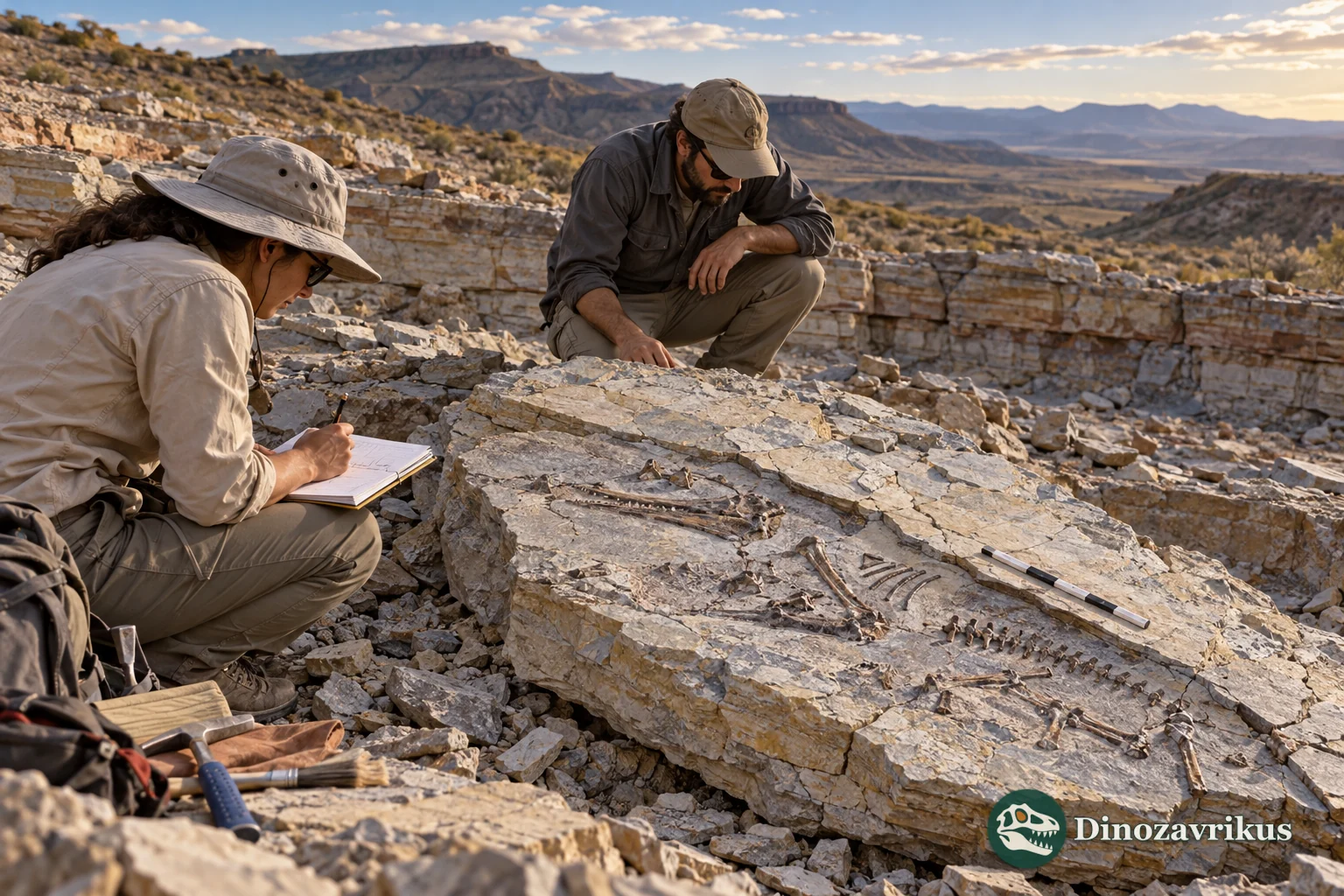
MOZ-PV 1854 comes from El Ministerio quarry in Los Catutos. The nearly complete skeleton is preserved in two dimensions: the skull lies on its right side, and the specimen also includes teeth, vertebrae, the shoulder girdle and remains of both forelimbs. It is unusually informative for a Jurassic ichthyosaur, although flattening limits three-dimensional reconstruction.
Two additional specimens were referred to the species. MOZ-PV 103 includes three-dimensional fragments of the snout and lower jaw with teeth and comes from the Pampa Tril–Yesera del Tromen area. MOZ-PV 7260 preserves snout fragments from Cerro Lotena. Their similarities helped test whether features of the holotype were affected by crushing, but neither fragment fills the missing tail or provides a complete limb.
A distinctive skull and forefin
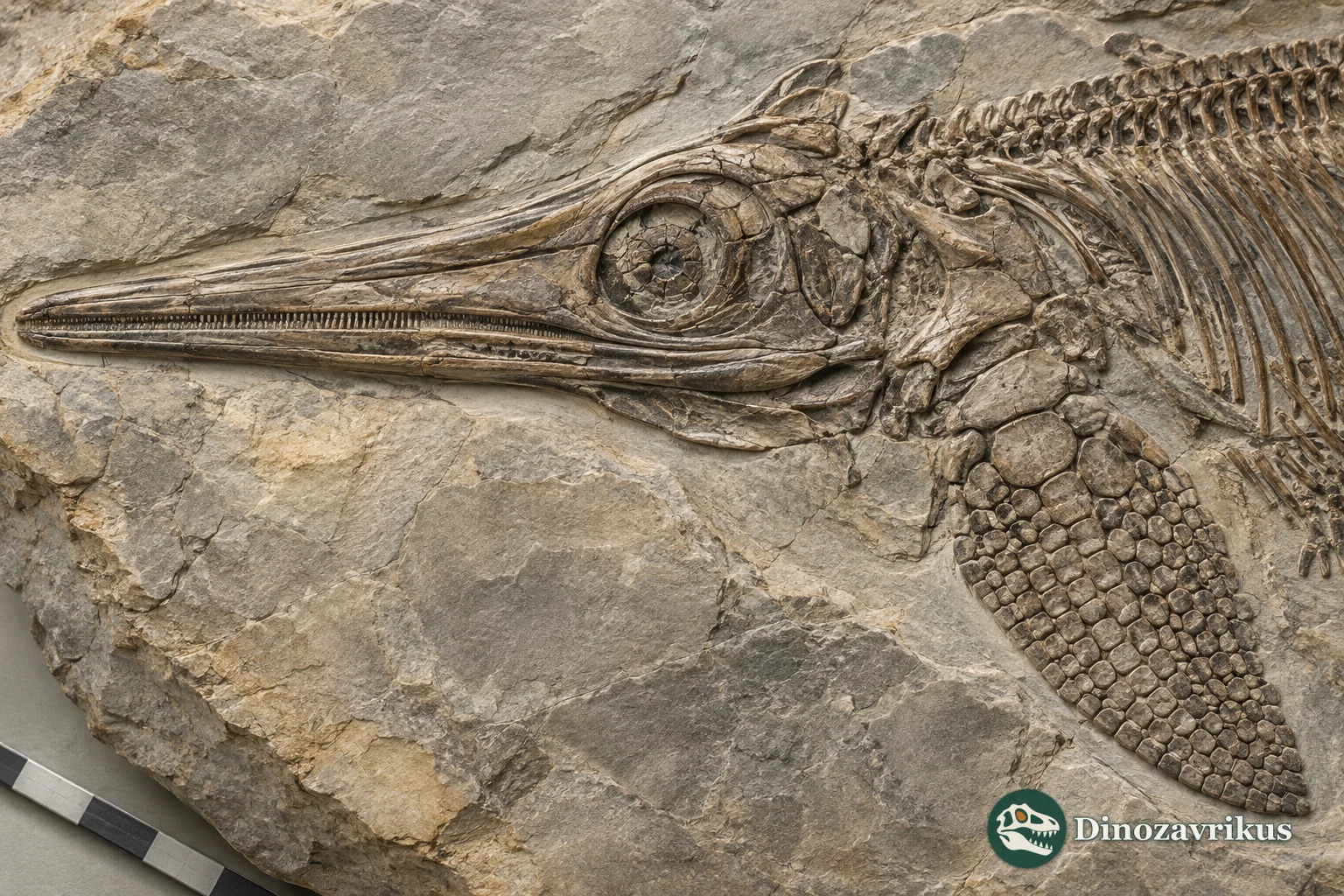
Catutosaurus has a slender, delicate snout and small pointed teeth with rounded roots. Its external narial opening is incompletely divided into a horizontal anterior lobe and a vertical posterior lobe. The nasal and premaxillary processes contribute to this arrangement. It distinguishes the taxon but does not demonstrate a special diving or sensory ability.
The forefin combines traits that researchers compared with different ophthalmosaurid groups. The humerus has a broad articulation with the forearm elements, while the hand bones are tightly packed and polygonal. The authors described the forefin as ‘platypterygiine-like’ and parts of the skull as ‘ophthalmosaurine-like’. These comparisons do not make the animal a literal intermediate between modern genera.
Phylogenetic placement
The 2021 phylogenetic analysis recovered Catutosaurus near the base of a large group named Panplatypterygiinae. The authors argued that narial features and complexity in the forefin did not evolve as one simple stepwise sequence among ophthalmosaurids. Similar character states can arise independently in different branches.
A phylogenetic position depends on the taxa and anatomical characters included and on how bones are interpreted. It is a supported hypothesis from comparative data, not an observed chain of ancestors. The Early Cretaceous Muiscasaurus, Jurassic Argovisaurus and Mexican Acuetzpalin help illustrate the variety of ophthalmosaurid anatomy, but none is established as an ancestor of Catutosaurus.
Age, habitat and limits of reconstruction
The type material comes from the Los Catutos Member of the Vaca Muerta Formation and is dated to the Tithonian Stage of the Late Jurassic. Stratigraphic summaries place the beds in the middle to late Tithonian. This dates the rock layer rather than a precise moment in the animal’s life. Los Catutos is known for marine lithographic limestones and fossils that help describe the Neuquén Basin ecosystem.
An institutional science summary gives an approximate adult length of about 3 m, but does not set out a measurement method. The flattened holotype does not preserve the entire body length without losses, so the figure is a broad estimate, not a direct measurement. Diet, swimming speed, reproduction, colour and social behaviour have not been established for this species. Small pointed teeth inform hypotheses about prey capture but do not identify a specific meal.
Frequently asked questions
Where was Catutosaurus found?
Holotype MOZ-PV 1854 came from El Ministerio quarry in the Los Catutos area of Neuquén, Argentina, in the Vaca Muerta Formation.
Which fossils are known?
The holotype is a nearly complete but flattened skeleton. MOZ-PV 103 and MOZ-PV 7260 add fragmentary snouts and jaws.
Why did the fossil have different earlier identifications?
Before its 2021 description, researchers referred the specimen to Ophthalmosaurus, Aegirosaurus or an indeterminate ophthalmosaurid. A comparative study then named Catutosaurus gaspariniae.
How long was Catutosaurus?
An institutional summary gives an approximate adult estimate of about 3 m. The method is not specified there, so it should not be treated as a direct measurement of the holotype.