

Acuetzpalin carranzai is an ophthalmosaurid ichthyosaur from Kimmeridgian marine rocks in northern Mexico. It was described from skeleton IGM 9519 in the La Casita Formation. The skull and several postcranial elements supported a distinct species, although the remains do not provide a complete body reconstruction. A later suggestion of synonymy remains unresolved.
Quick facts
| Type species | Acuetzpalin carranzai |
|---|---|
| Holotype | IGM 9519, National Paleontology Collection, UNAM |
| Age | Kimmeridgian, Late Jurassic |
| Locality | Cerro de Palotes, Durango, Mexico |
| Rock unit | La Casita Formation |
| Known material | Skull, jaws, teeth, vertebrae, shoulder elements and left forelimb |
| Total length | No secure complete-body estimate |
Evidence guide
The UNAM collection lists skull, lower jaw, teeth, vertebrae, shoulder-girdle elements and the left forelimb. It is not a complete skeleton.
Ammonites date the Cerro de Palotes beds. Their age applies to the rock layer, not a precise moment in the animal’s life.
The diagnosis uses several bones, including the skull base and forelimb. No single element establishes swimming behaviour or speed.
A 2021 revision suggested that Acuetzpalin might match a humeral morphotype but left the question outside its scope. This remains a hypothesis, not a synonymy.
A find from Cerro de Palotes
During 1979–1980 fieldwork by students from the National Autonomous University of Mexico, two ichthyosaur specimens were recovered near Cerro de Palotes. The fieldwork was led by professors Oscar Carranza Castañeda and René Hernández Rivera. One specimen was prepared for exhibition at the UNAM Museum of Geology in 1980, but a detailed scientific description came later.
In 2020, Jair Barrientos-Lara and Jesús Alvarado-Ortega named Acuetzpalin carranzai. The holotype, IGM 9519, is held in UNAM’s National Paleontology Collection. It includes a skull and lower jaw, teeth, vertebrae, parts of the shoulder girdle and elements of the left forelimb. That combination supports an anatomical diagnosis; the missing parts cannot be treated as known simply because an illustration can fill in the outline.
The authors derived the genus name from a Nahuatl word translated as ‘aquatic reptile’. The species name honours Oscar Carranza Castañeda, one of the fieldwork leaders. The name records the language and research history of the region, not a behaviour unique to the animal.
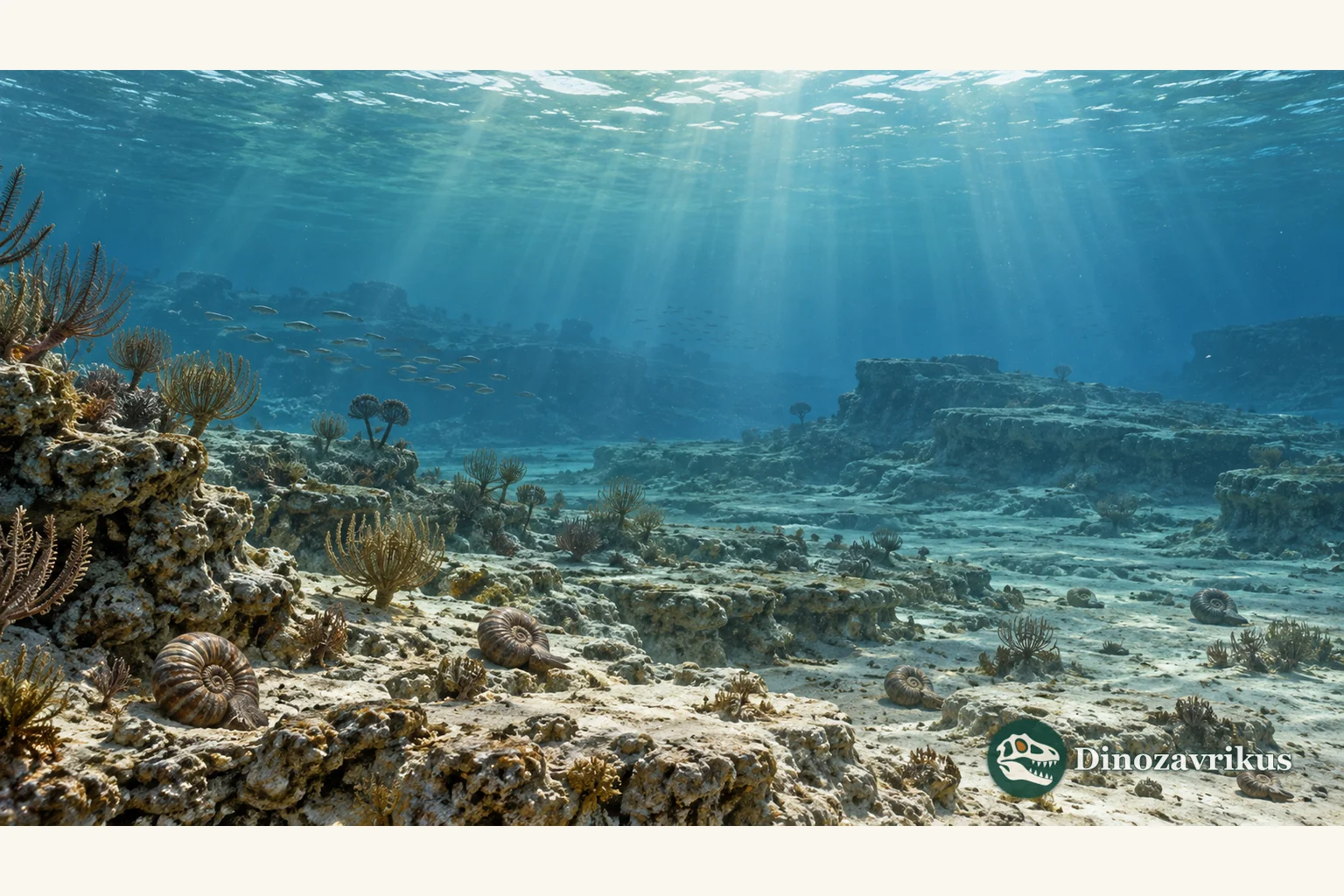
The Kimmeridgian sea of Durango
The locality lies about 24 kilometres southwest of Cuencamé in Durango. Dark grey limestones and dark pink siltstones of the La Casita Formation crop out there. Ammonites including Glochiceras, Taramelliceras and Procraspedites indicate a Kimmeridgian age for the beds with IGM 9519.
These fossils establish the age and marine geological setting, but they do not reveal the precise depth at which this animal swam. A comparison with another Jurassic ophthalmosaurid, Cryopterygius from Svalbard, helps frame the group’s wider distribution. Geographically distant fossils do not show that the species lived in the same population or at the same time.
Bones used to recognize the species
The 2020 diagnosis draws on features of the parietal, skull base, stapes and forelimb joints. It is a combination rather than one overall silhouette: for example, the parietal foramen is enclosed by the parietals, while the intermedium separates the radius from the ulna and does not contact the humerus.
The authors placed Acuetzpalin in Ophthalmosauridae and Platypterygiinae. In a 2021 revision, Nikolay Zverkov and Megan Jacobs suggested that Acuetzpalin carranzai might be the same taxon as a separate humeral morphotype from Late Jurassic rocks. They explicitly left that issue outside the scope of their study. The suggestion is therefore not a formally established synonymy. Compare its family with Ophthalmosaurus and the Early Cretaceous Muiscasaurus.
What cannot yet be reconstructed
The available descriptions do not provide a complete skeleton from which to measure the animal from snout to tail. A numerical length estimate must be tied to a stated method and the bones used; without that context it is not a measurement of IGM 9519. The type also does not determine colour, exact prey, speed, reproduction or behaviour.
IGM 9519 documents an ophthalmosaurid in the Kimmeridgian sea of present-day Durango and preserves diagnostic areas of the skull and forelimb. The cover art shows a possible general ichthyosaur form, but the type does not preserve soft tissue, colour or exact body proportions.
Related profiles: Ophthalmosaurus · Muiscasaurus · Cryopterygius.
Frequently asked questions
Where was Acuetzpalin found?
Holotype IGM 9519 came from Cerro de Palotes in Durango, about 24 kilometres southwest of Cuencamé, in the La Casita Formation.
When did it live?
The beds with IGM 9519 are dated to the Kimmeridgian Stage of the Late Jurassic, using associated ammonites.
Which bones are known?
The holotype includes the skull, lower jaw, teeth, vertebrae, shoulder-girdle elements and the left forelimb. It is not a complete skeleton.
Is Acuetzpalin a synonym of Nannopterygius?
No formal synonymy has been established. A 2021 revision suggested a possible identity with a humeral morphotype but left the question unresolved.