

Chacaicosaurus cayi is a Middle Jurassic ichthyosaur from the Neuquén Basin of northwestern Patagonia. It was described from a partial skeleton in the Los Molles Formation. Its long snout and forefin anatomy prompted comparisons with other Jurassic ichthyosaurs, while its generic name remains debated: some researchers combined it with Stenopterygius, but many later studies retained Chacaicosaurus.
Quick facts
| Type species | Chacaicosaurus cayi |
|---|---|
| Holotype | MOZ-PV 5803, partial skeleton; Professor Juan Olsacher Museum, Zapala |
| Age | Early Bajocian, Middle Jurassic |
| Locality | Chacaico Sur, Neuquén Basin, Patagonia, Argentina |
| Rock unit | Los Molles Formation |
| Preserved material | Skull, part of the vertebral column, interclavicle and remains of fore- and hindlimbs |
| Alternative combination | Stenopterygius cayi, proposed in 2007 |
Evidence guide
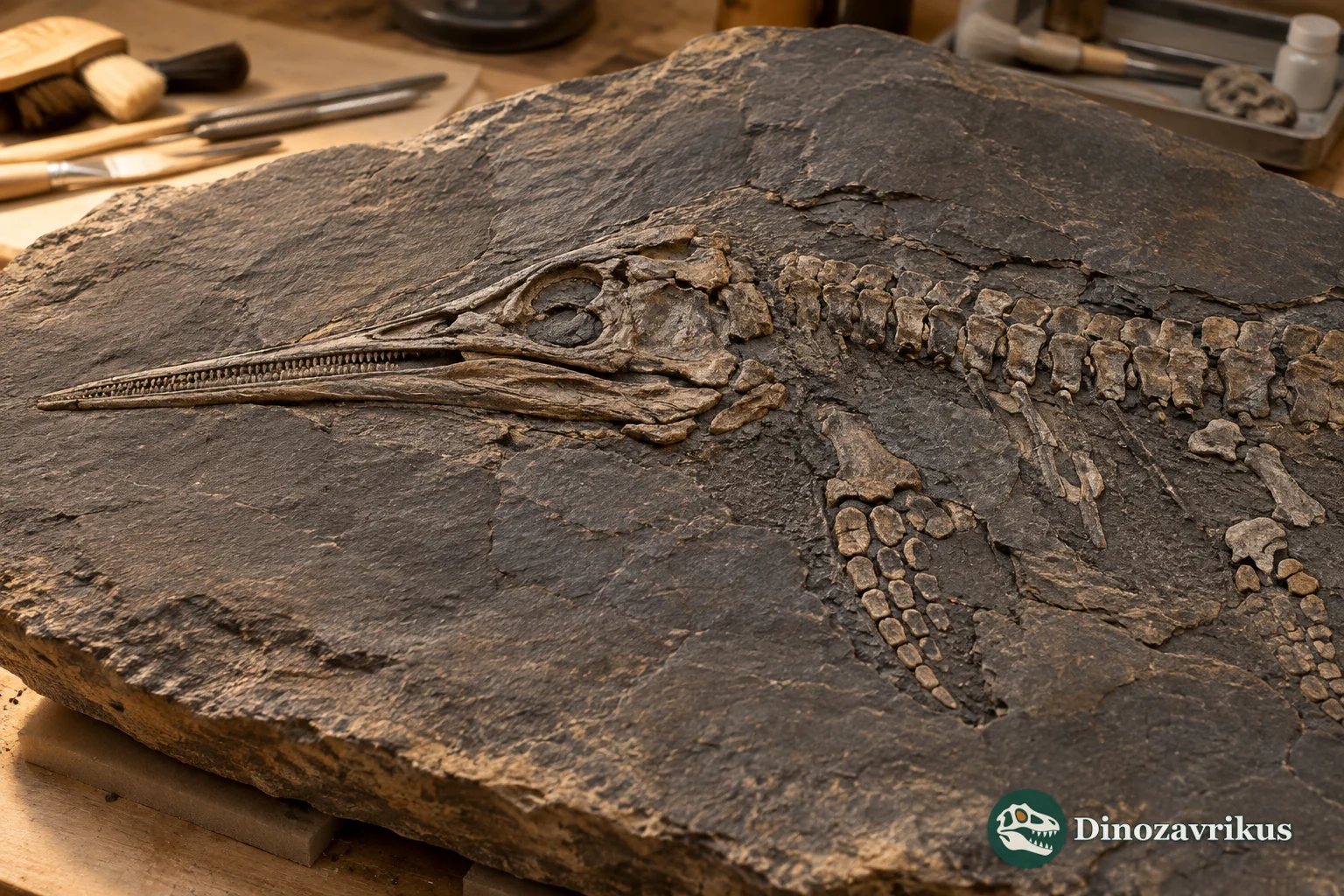
The partial specimen includes a skull, part of the vertebral column, an interclavicle and remains of the fore- and hindlimbs. It is informative but does not preserve a complete body length.
The arrangement of forelimb bones shares features with the pattern traditionally associated with Stenopterygius. This comparison informed an alternative generic combination but does not alone settle the genus boundary.
The type comes from Early Bajocian Los Molles Formation deposits at Chacaico Sur. Associated fossils, including ammonites, help constrain the bed's age; they do not provide an exact date for the animal.
Fernández named Chacaicosaurus in 1994 and later proposed Stenopterygius cayi. Many later studies continued to use Chacaicosaurus; phylogenetic analyses have not erased the difference in published nomenclature.
Discovery and the type specimen
Marta Fernández named Chacaicosaurus cayi in 1994 from material collected at Chacaico Sur in Neuquén Province. The holotype, MOZ-PV 5803, is held by the Professor Juan Olsacher Museum in Zapala. It includes a skull, part of the vertebral column, an interclavicle and remains of the fore- and hindlimbs.
The skeleton is incomplete, so it does not directly provide total body length. Published sources do not securely identify an individual finder or exact collection date for the holotype. The catalogue number identifies one specimen; it does not mean that numerous skeletons were described.
The Los Molles Formation and age
Chacaico Sur lies in the Neuquén Basin of northwestern Patagonia. The type comes from marine Early Bajocian strata of the Los Molles Formation. Stratigraphic position and associated fossils, including ammonites, constrain the age of the deposits. This dates the rock layer rather than a precise moment in the animal's life.
Published accounts of the Los Molles fauna also mention the ichthyosaur Mollesaurus periallus and plesiosaurs. Their presence in the same region and nearby beds shows that marine reptiles were diverse there, but it does not prove identical ecology or direct interaction. Mollesaurus is known from its own type specimen and is not a second individual of Chacaicosaurus.
Skull and limb anatomy
The preserved skull and jaws show an elongated rostrum. The incomplete material does not establish the exact proportions of a complete skull or the outline of its soft tissues. Longirostry is an observable feature of the preserved anatomy; a particular hunting technique does not follow directly from it.
The forelimb has an arrangement compared with the pattern of Stenopterygius. The shape and relative positions of the hand and forearm elements are relevant to classification. Without biomechanical measurements they do not establish swimming speed, agility or a precise stroke.
Chacaicosaurus or Stenopterygius?
Fernández described Chacaicosaurus in 1994. In a later systematic treatment published in 2007, she considered its differences from Stenopterygius insufficient and proposed the combination Stenopterygius cayi. The alternative name therefore appears in literature from the 2000s onward.
Later descriptions and phylogenetic analyses often retained Chacaicosaurus cayi. Moon's 2017 analysis used Chacaicosaurus and placed it outside Ophthalmosauridae, while Maxwell and colleagues in 2012 compared Stenopterygius cayi with species of that genus. These differences concern how diagnostic characters and genus boundaries are interpreted; they do not represent two different animals.
Both combinations remain useful when reading the literature. The fossil evidence does not justify presenting one as universally accepted or treating Chacaicosaurus as the direct ancestor of Stenopterygius.
Ecology and what remains unknown
The long rostrum and jaw shape can inform hypotheses about capturing marine prey, but the principal studies do not report direct stomach contents for this taxon. Specific fish or cephalopods should therefore not be described as a confirmed diet. Forefin similarities are likewise not measurements of speed.
A reliable body length or mass with a stated method has not been established. Growth rate, maturity, reproduction, colour, pathologies and behaviour are also unknown. The partial skeleton directly preserves features of the skull, sections of the vertebral column and limbs; the full outline and soft tissues in a life reconstruction remain artistic interpretation.
Frequently asked questions
Where was Chacaicosaurus found?
The holotype comes from Chacaico Sur in Neuquén Province, Argentina, in the Los Molles Formation of the Neuquén Basin.
What parts of the skeleton are preserved?
MOZ-PV 5803 includes a skull, part of the vertebral column, an interclavicle and remains of the fore- and hindlimbs. It is a partial, not complete, skeleton.
Why is it sometimes called Stenopterygius cayi?
In 2007 Fernández considered the diagnostic differences from Stenopterygius insufficient and proposed that combination. Many later studies continued to use Chacaicosaurus cayi.
How large was Chacaicosaurus?
A reliable body-length or mass estimate with a verifiable method has not been established. The partial skeleton does not directly preserve total body length.