

Chasmaporthetes was a hyena, although its slender limbs depart from the familiar outline of the living spotted hyena. Its fossils span parts of Eurasia, Africa and North America. The genus was named for a damaged Arizona jaw; two teeth recognised much later in Yukon established a striking Arctic record. Those discoveries illuminate geography more securely than behaviour.
The long-limbed Miracinonyx offers a useful comparison in running adaptations, but it was a cat, not a close hyena relative.
Quick facts
| Family | Hyaenidae |
|---|---|
| Type species | Chasmaporthetes ossifragus |
| Named | Oliver P. Hay, 1921 |
| Holotype | USNM 10223, damaged left mandible |
| Range | Eurasia, Africa and North America |
| Northern evidence | Two isolated teeth from Old Crow, Yukon |
What can the fossils tell us?
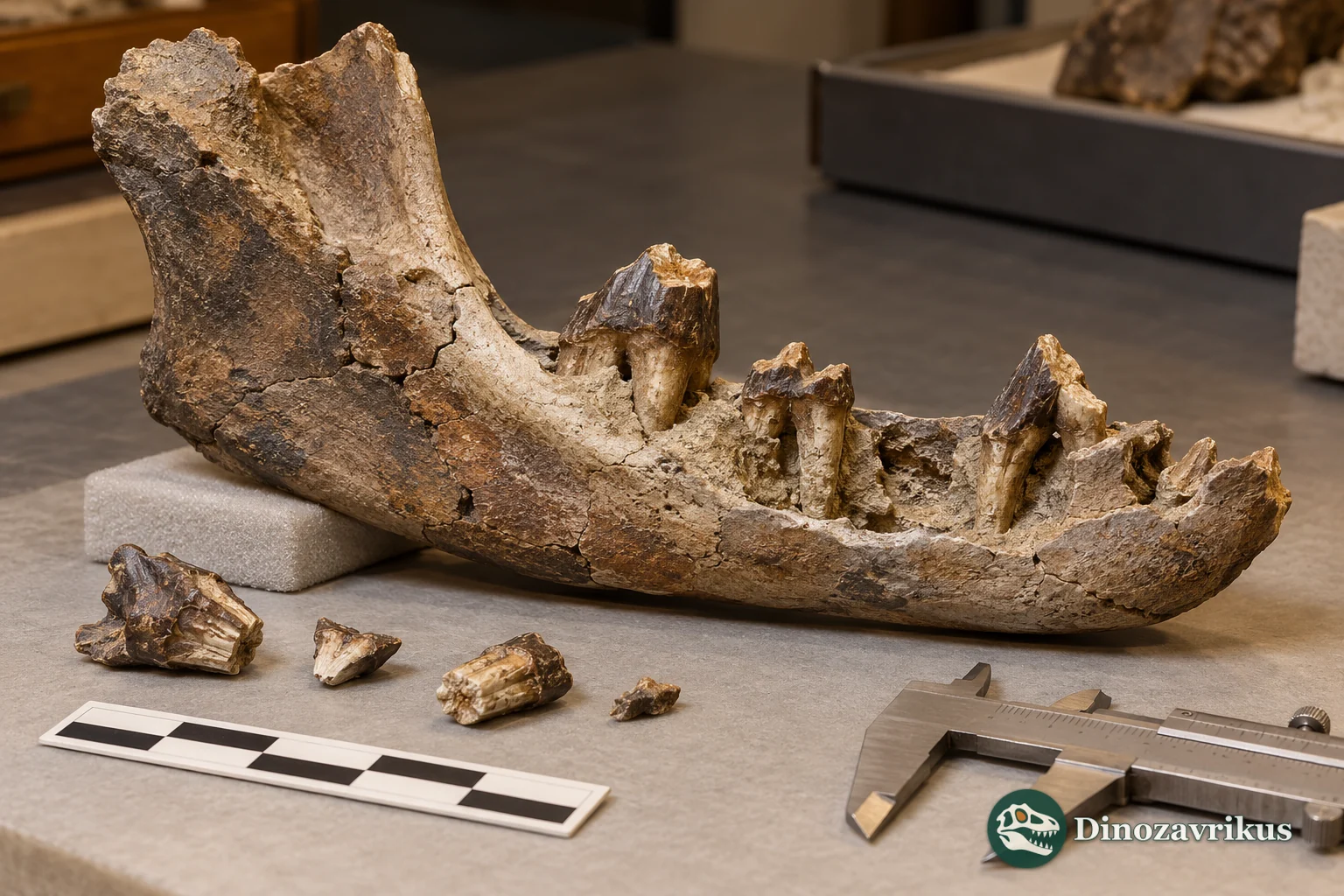
USNM 10223 is the rear of a left lower jaw with shattered tooth crowns. It establishes the name but cannot by itself show the full skull, limbs or hunting behaviour.
CMN 24958 and CMN 38053 share dental features of Chasmaporthetes. They were cautiously compared with C. ossifragus and do not form one complete animal.
Premolar comparisons imply a flesh-heavy diet, while modelling of a European species shows resistance to strong bite forces. Neither line measures the frequency of bone eating or proves pack hunting.
A name from an Arizona jaw
Oliver P. Hay described Chasmaporthetes ossifragus in 1921 using USNM 10223, the posterior portion of a left lower jaw with damaged crowns and preserved roots. The Smithsonian catalogue records P. C. Bicknell as collector in 1901 and places the fossil in Coconino County, Arizona. Hay referred the genus name to the Grand Canyon. The species epithet suggests bone breaking, but a name cannot establish a diet.
Hay regarded the type deposit as early Pleistocene. Later North American comparisons use a late Pliocene to early Pleistocene framework, and the fragment does not carry its own precise numerical date. It remains the name-bearing fossil even though other specimens preserve more useful anatomy. Kurtén and Werdelin's 1988 review treated Euryboas as a synonym of Chasmaporthetes and recognised forms from several continents. Their taxonomy does not mean every fossil belongs to the Arizona species.
Two teeth in the far north
Z. Jack Tseng, Grant Zazula and Lars Werdelin published the first Arctic records in 2019. The Old Crow material consists of a right lower third premolar, CMN 24958, and a left lower first molar, CMN 38053, held by the Canadian Museum of Nature. The former was collected by Richard Harington's team in 1973; William Irving and Brenda Beebe recovered the latter in 1977. Their tooth shapes support assignment to Chasmaporthetes, but the authors used cf. C. ossifragus for the species-level comparison.
The most likely age, about 1.4 to 0.85 million years, follows from geological and faunal context rather than a direct date on either tooth. Old Crow closes part of the geographic gap between Old World and southern North American records and supports dispersal through Beringia. Two teeth cannot reveal the Yukon animal's coat, its exact prey or the social structure of its population.
What running limbs and biting teeth can tell us
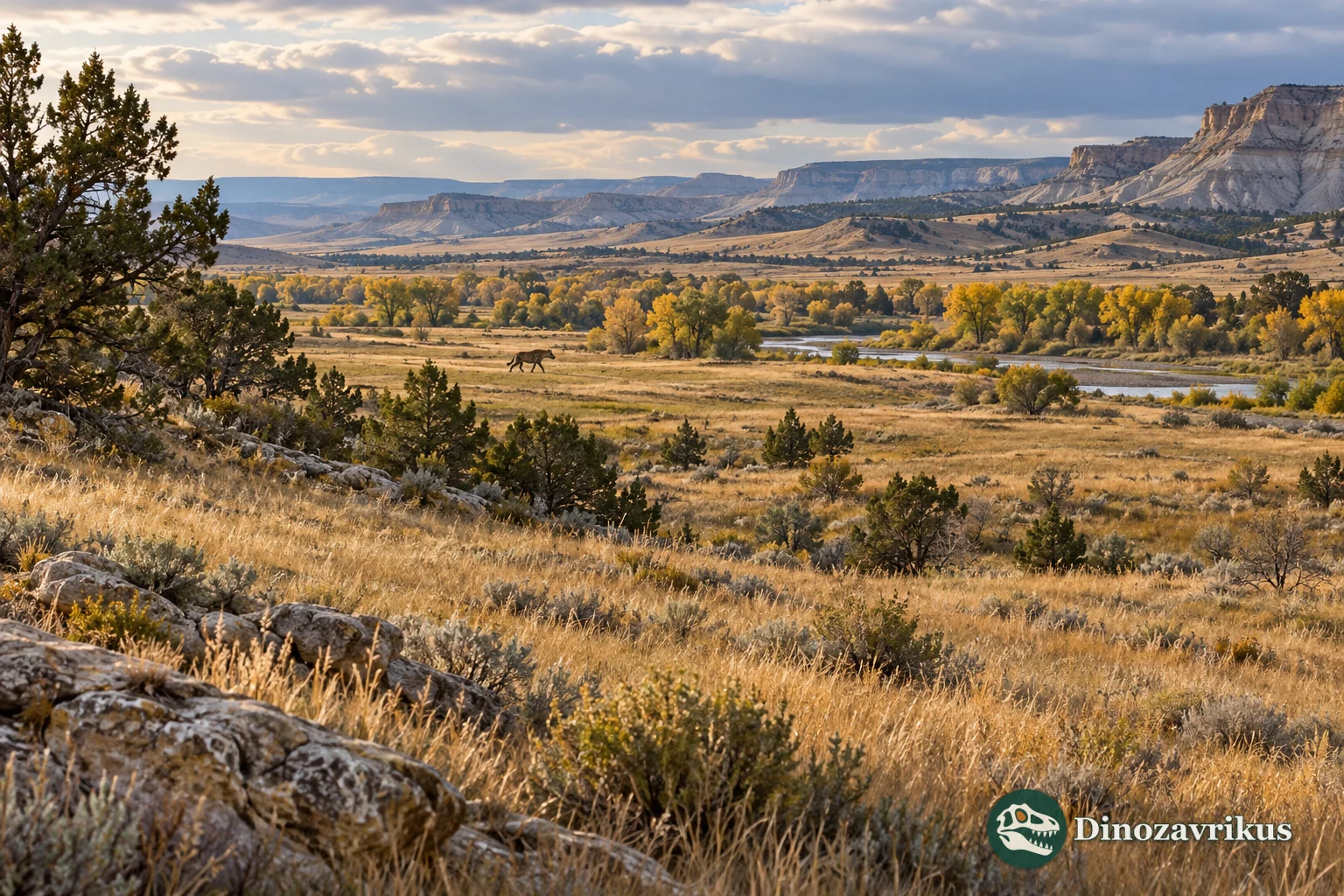
European C. lunensis material has relatively gracile limbs and elongated lower leg and foot elements. These proportions support cursorial locomotion, but they cannot be turned into an exact top speed or proof of coordinated pursuit. The full species range extends beyond the time and place represented by those European skeletons.
A comparative study of premolar notches inferred a more flesh-focused diet than that of modern heavily bone-cracking hyenas. Finite-element work on the C. lunensis skull nevertheless found substantial resistance to stresses that bone processing can generate. Tooth-edge form and whole-skull strength test different properties. Together they permit a powerful and mobile carnivore, but do not establish how often it cracked bones, scavenged or hunted in groups. The fur pattern in the cover remains an artistic choice.
Frequently asked questions
Was Chasmaporthetes really a hyena?
Yes. Its jaws, teeth and cranial anatomy place the genus in Hyaenidae, despite its unusually long-legged outline.
What is known from the Arizona holotype?
USNM 10223 is a damaged part of a left lower jaw. It anchors the type species' name but does not show an entire skull or skeleton.
Why are the Yukon fossils important?
Two separately collected teeth document Chasmaporthetes north of the Arctic Circle and help fill the Beringian gap in its recorded distribution.
Did it crush bones like a living spotted hyena?
Its skull could withstand powerful biting loads, but dental traits suggest extensive meat cutting. How often it actually broke bones is unknown.