

Chedighaii was a North American side-necked turtle from the Late Cretaceous. The type species is based on a skull from New Mexico. Its palate gives a means of distinguishing it from a close relative, even where bones of the shell offer few clues.
Quick facts
| Group | Turtles, Bothremydidae |
|---|---|
| Age | Late Cretaceous, Campanian |
| Region | North America: New Mexico and other parts of the USA |
| Type species | Chedighaii hutchisoni |
| Holotype | KUVP 14765, skull |
| Scientific name | Chedighaii |
| Diet | No direct evidence |
What can the fossils tell us?
KUVP 14765 comes from the Kirtland Formation and is the basis for the species name Chedighaii hutchisoni.
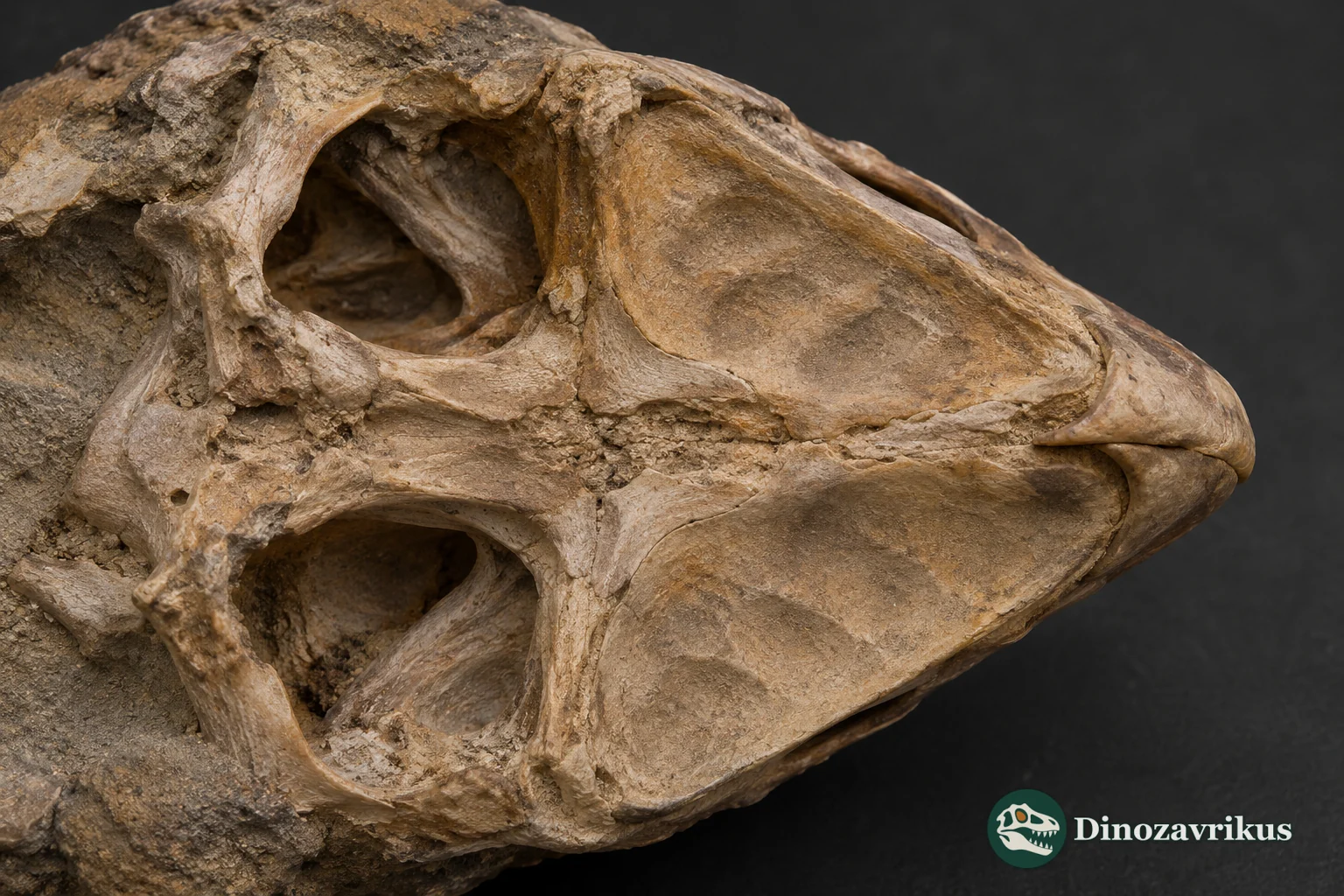
The chewing surface lacks the deep pits seen in comparable Bothremys skulls. This is useful for identifying skulls, although it gives little direct evidence of diet.
A fragment belonging to FMNH PR 247 carries deep pits. The specimen was moved to Bothremys, which left the identity of some similar shells unresolved.
A name based on a single skull
Eugene Gaffney, Haiyan Tong and Peter Meylan described Chedighaii hutchisoni in 2006. The type skull, KUVP 14765, comes from the Kirtland Formation in New Mexico. The genus name comes from the Navajo word for turtle. The species name honours the palaeontologist Howard Hutchison.
The feature that separates two genera
The two genera differ most clearly where the upper jaw formed the chewing surface. In Chedighaii it is flat, while diagnostic skulls of Bothremys have deep pits. That difference identifies structures involved in feeding, without revealing exactly what the turtles ate.
Palatal shape can also be compared across bothremydids. The European Polysternon has paired triangular surfaces that widen to the rear. Such features can be useful when the shell is missing.
When similar shells tell a different story
FMNH PR 247 from the Mooreville Chalk of Alabama was once assigned to Chedighaii barberi. A fragment of the maxilla and jugal among its remaining skull pieces showed deep pits. The authors of the reassessment consequently treated the specimen as Bothremys.
Another fossil, ALAB PV 2001.2, includes both skull and shell. Its skull supports assignment to Chedighaii, though the authors left its species open. They also found the generic placement of the shell originally named Podocnemis barberi unresolved.
Frequently asked questions
Which part of the type specimen was found?
KUVP 14765 is a skull from the Kirtland Formation.
Where does the name Chedighaii come from?
It is derived from the Navajo word for turtle.
Why was an Alabama specimen reassigned?
A newly identified part of the skull showed deep pits diagnostic of Bothremys.
Can the genus be recognised from a shell alone?
Some bothremydid shells are difficult to tell apart. Finding skull and shell together allows a more complete comparison.