

Cherninia was a large Middle Triassic amphibian in the capitosaur group. An unusually broad, elongated snout links species from India and Zambia. Isolated bones from the Indian species also reveal parts of the skeleton beyond the skull.
Quick facts
| Group | Temnospondyls, capitosaurs |
|---|---|
| Age | Middle Triassic |
| Region | Africa (Zambia), Asia (India) |
| Type species | Cherninia denwai |
| Scientific name | Cherninia |
| Diet | Exact prey is unknown |
What can the fossils tell us?
The Indian type skull ISI A 54 and the Zambian skull BP/1/4223 document two species. A mandible and postcranial bones are also known from India.
A long, broad snout links the skulls. The microstructure of Indian limb bones was interpreted as evidence that the animal spent substantial time in water.
Feeding strategies remain hypotheses. The incomplete skeletons limit estimates of total length.
Two skulls from separate continents
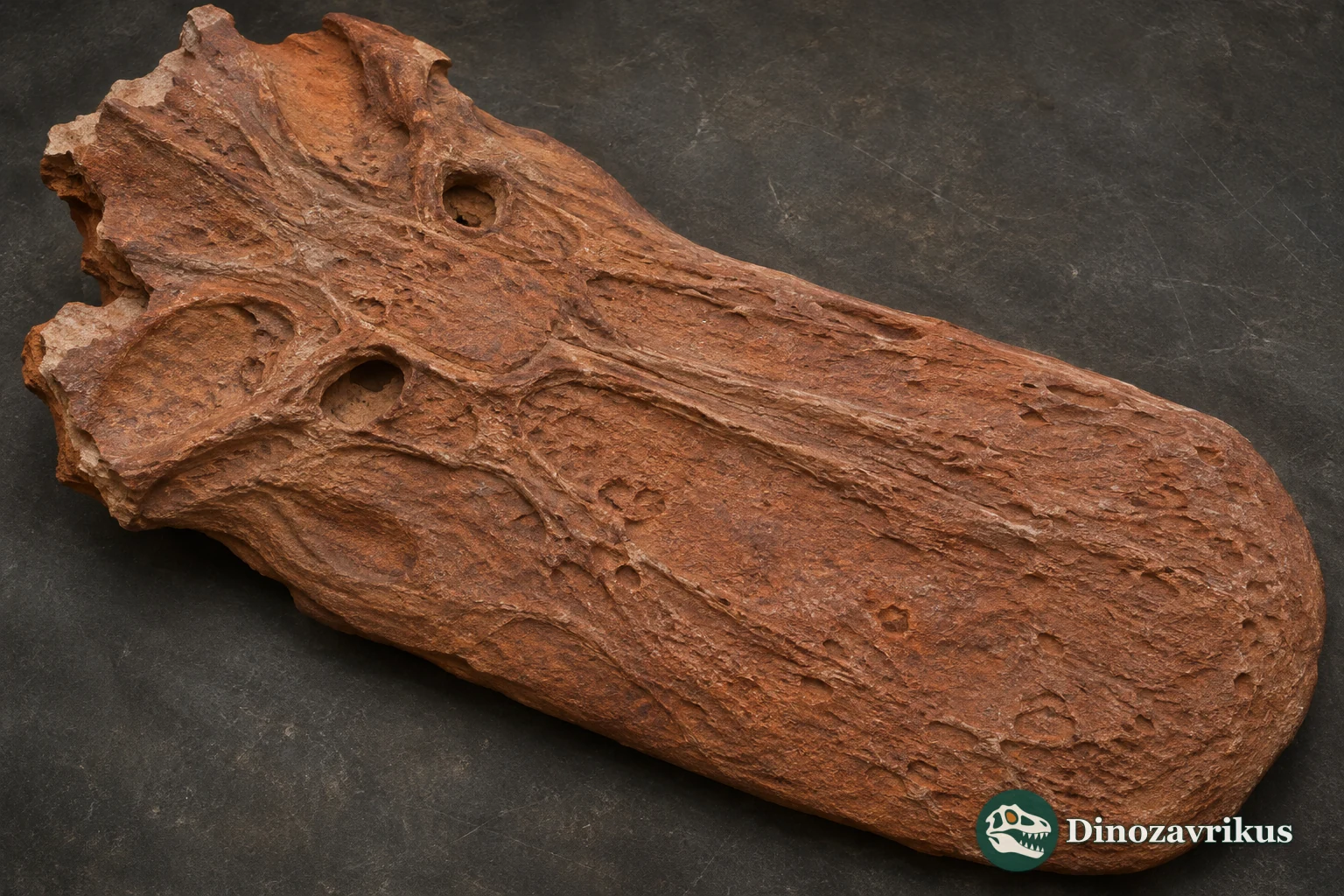
ISI A 54, the nearly complete skull from the Denwa Formation of the Satpura basin, was named Parotosuchus denwai in 1998. The Zambian skull BP/1/4223 from the Ntawere Formation in the Luangwa Valley was also formerly assigned to Parotosuchus. Ross Damiani established Cherninia in 2001. The name honours Samira Chernin, who helped describe the Zambian species.
Snout, eyes and skull openings
In both species the broad front of the skull extends well ahead of the eyes. The eye sockets are in the back half of the skull roof and are raised slightly above it. The details of the notches behind the eyes, the bones at the back of the skull and the openings in the palate help distinguish the two species. The 2024 study of Indian material retained both C. denwai and C. megarhina as distinct.
What the Indian bones add
Denwa fossils include a separate mandible, ISI A 208, nearly 96 cm long, as well as vertebrae, ribs and parts of the limb girdles. The jaw gives a direct measurement of one bone. It leaves the animal’s total length open to estimation. The internal structure of the limb bones differs from that of Paracyclotosaurus, another capitosaur from the same formation. The histology study linked these differences to contrasting ways of living in water.
How it might have caught prey
Damiani proposed that the Zambian species could have swept its head sideways, since pushing the broad snout forwards would meet resistance from the water. For the Indian species, limb anatomy prompted a different emphasis on feeding near the bottom. These are interpretations of bones from different species. The available fossils leave the identities of their prey unknown.
Frequently asked questions
Which species is the type?
Cherninia denwai from India. It is based on skull ISI A 54 from the Denwa Formation.
Has Cherninia been found in Africa?
Yes. Cherninia megarhina is known from a skull found in the Luangwa Valley of Zambia.
Which bones were studied under a microscope?
Researchers examined the internal structure of isolated limb bones assigned to the Indian species from the Denwa Formation.
Do we know its total body length?
Individual bones can be measured. For example, the Indian mandible ISI A 208 is about 96 cm long. Overall body length can only be estimated.