

Paracyclotosaurus was a large Middle Triassic amphibian. The Australian type species is unusually well documented for a capitosaur: the skull and jaw are accompanied by vertebrae, ribs and limb bones from the same individual. The skeleton provides an estimated body length of about two metres.
Quick facts
| Group | Temnospondyls, capitosaurs |
|---|---|
| Age | Middle Triassic, Anisian |
| Region | Australia, Sydney. Asia, India. Africa, South Africa. |
| Type species | Paracyclotosaurus davidi |
| Scientific name | Paracyclotosaurus |
| Diet | Exact prey is unknown |
What can the fossils tell us?
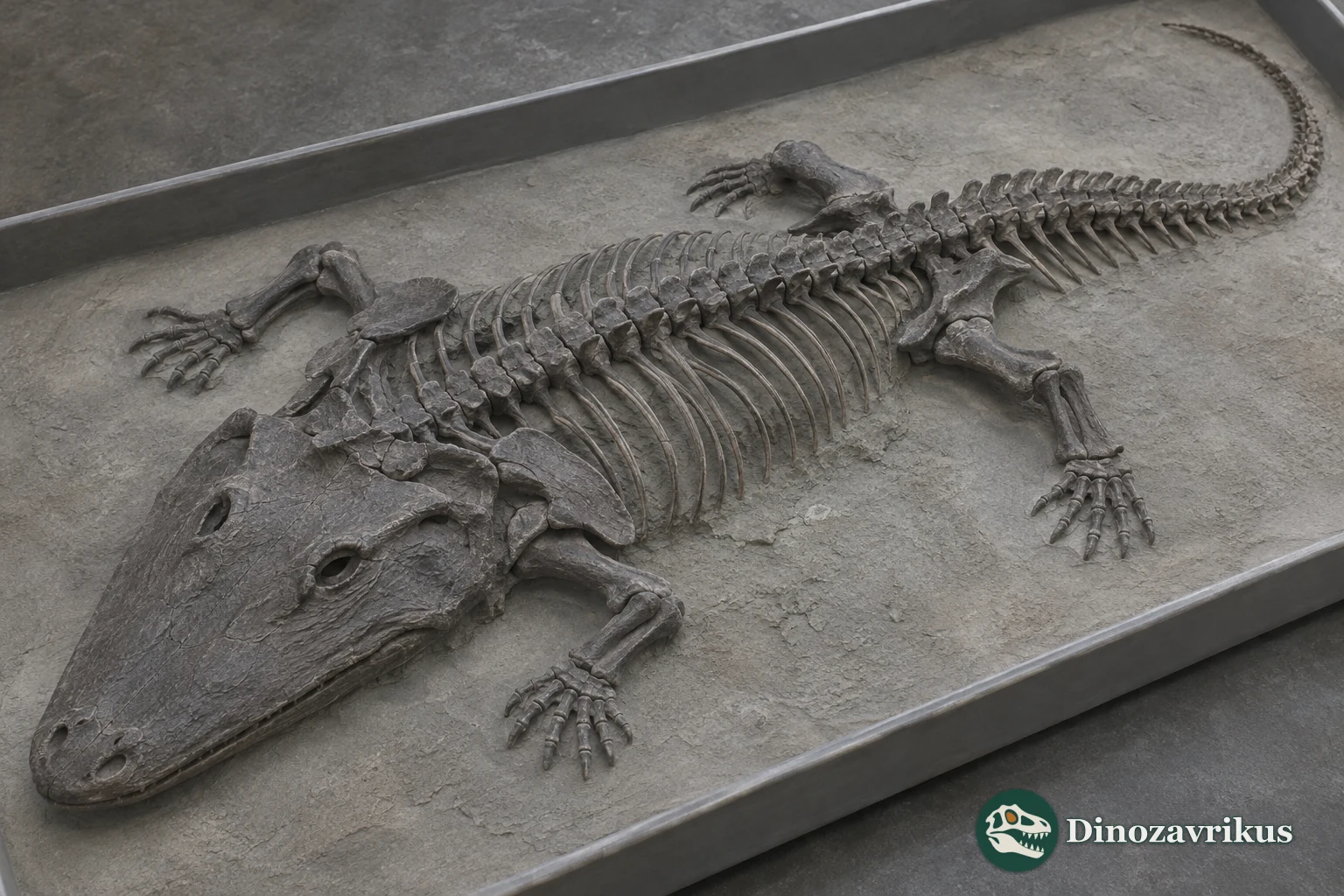
Ironstone concretions preserve the impressions of an articulated skull, a lower jaw and much of the skeleton. They also record traces of skin and scales.
Dimensions of the Australian skeleton and comparative estimates put its length at around 2.1 metres. The estimate applies to this specimen.
Middle Triassic rocks of the Sydney Basin preserve traces left by swimming tetrapods. The tracks cannot be assigned securely to Paracyclotosaurus.
A skeleton in a Sydney brick pit
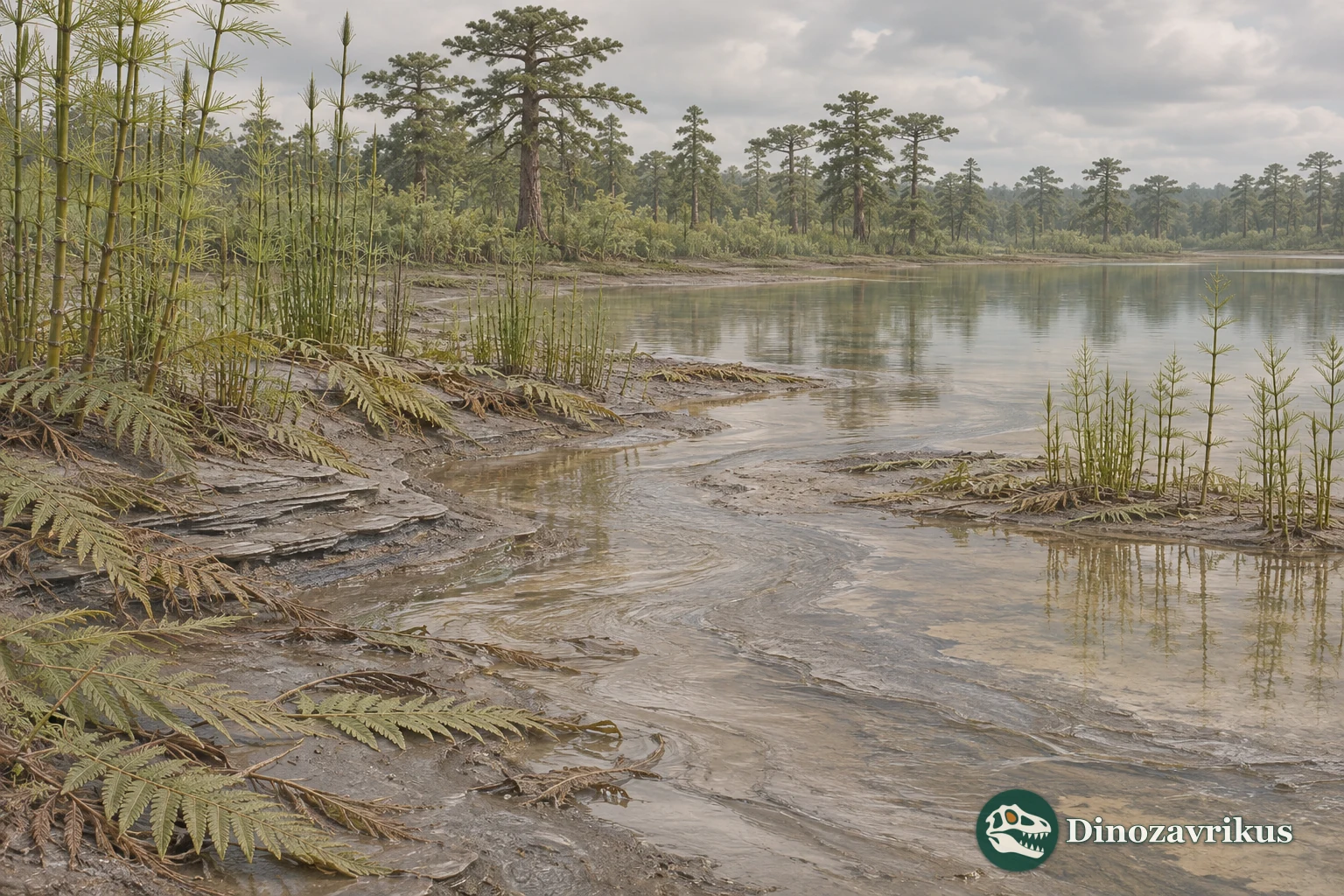
The type comes from the St Peters Brick Pit, now within metropolitan Sydney in New South Wales, where it was discovered in 1910. D. M. S. Watson named the genus and species in 1958. The original paper described the beds as Upper Triassic. More recent work places the Rouse Hill Siltstone Member of the Ashfield Shale in the Middle Triassic, probably in the middle of the Anisian.
What survived in the ironstone
The original bones of NHMUK PV R6000 were fragile. Their outlines remained in the hard rock, allowing preparations to preserve the shapes of the skull, jaw and many of the postcranial bones as casts. Parts of the skin and traces of small scale-like structures survived as well. The Australian Museum holds casts of parts of the type, including the skull and lower jaw.
The shape of the animal
The long, flattened skull has a broad outline and upward-facing eyes. Measurement of its roughly 58 cm skull and the bones behind it constrains the proportions of the reconstructed body, about 2.1 m long in a comparative estimate. A natural mould also preserves the head of the capitosaur Odenwaldia. The associated limbs and trunk make the Australian material particularly informative.
Other fossils assigned to the genus
The genus has also been used for the skull of P. crookshanki from the Denwa Formation of India and part of the skull of P. morganorum from the Karoo Basin of South Africa. A comparison of capitosaurs emphasized the resemblance between these specimens and the Australian type. The available skeleton gives the proportions of the Australian animal, while comparisons with the other species rely mainly on their heads.
Frequently asked questions
When did the Australian species live?
The St Peters type horizon is Middle Triassic, probably middle Anisian.
How large was the Australian individual?
A comparative estimate puts it at about 2.1 m. The skull measurement used in that study is 58.4 cm.
Why are casts important for the type material?
The ironstone retained the shapes of bones whose original material was in poor condition. Casts made from those impressions preserve anatomy for study.
What is known about its skin?
The ironstone preserves traces of skin and small scale-like structures. Those impressions do not establish the animal's original colour.