

Chinlestegophis jenkinsi was a small temnospondyl from Late Triassic Colorado. Two partial specimens provide enough overlapping material to reconstruct most of the skull. One came from the sediment filling a fossil burrow.
Quick facts
| Group | Temnospondyls, stereospondyls |
|---|---|
| Age | Late Triassic, Norian |
| Region | North America (Colorado, United States) |
| Type species | Chinlestegophis jenkinsi |
| Scientific name | Chinlestegophis |
| Diet | Exact prey is unknown |
What can the fossils tell us?
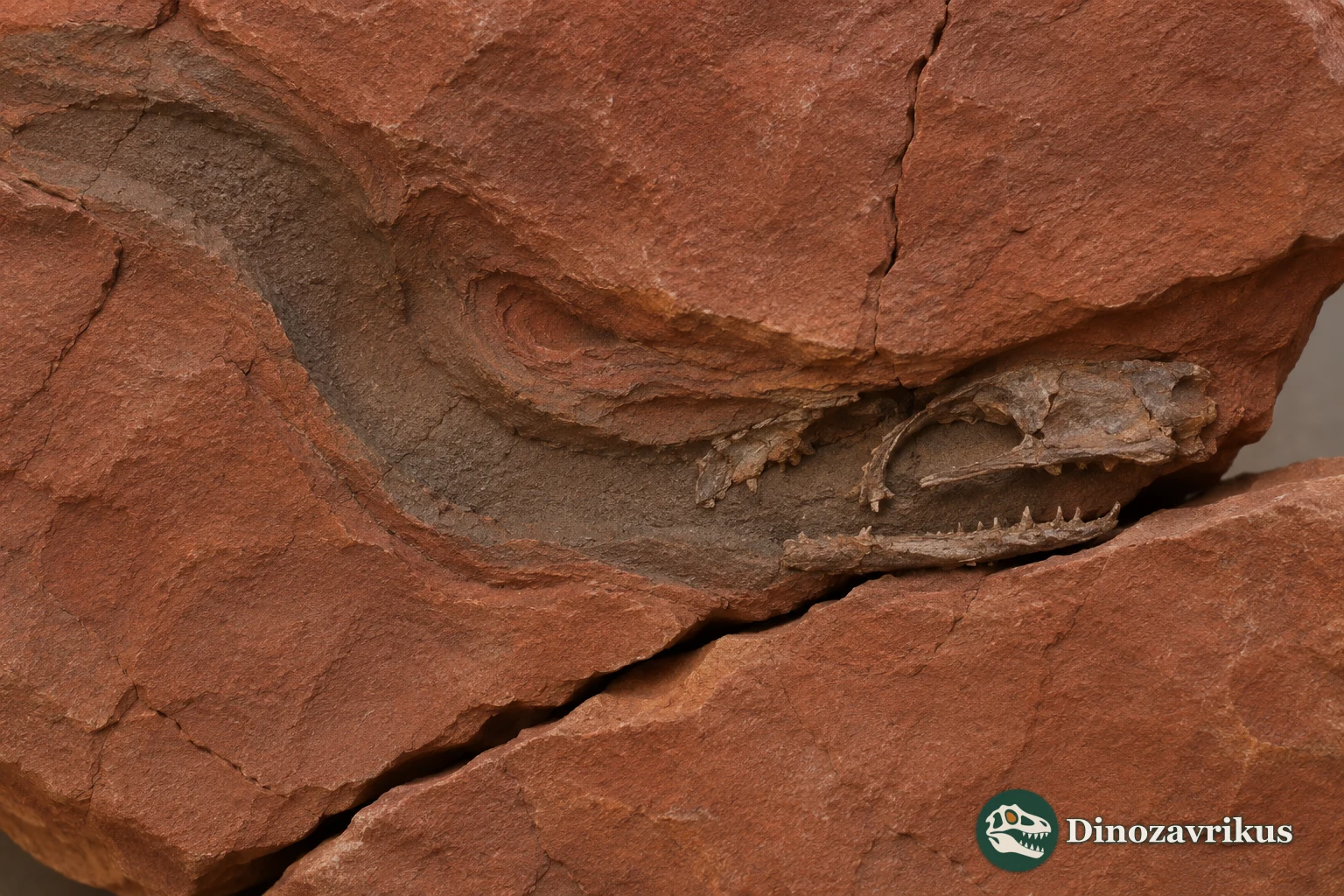
DMNH 56658 preserves part of the skull, a lower jaw and disarticulated postcranial bones. DMNH 39033 records the front of the skull and part of the jaw in a burrow fill.
CT scanning revealed details of the skull. Comparisons with caecilians centred on the lower jaw, eye sockets and structures around the ear.
The burrow fill cannot identify the animal that dug the tunnel. Neither specimen gives a reliable total body length or shows the full extent of the limbs.
Two finds in the Chinle Formation
Bryan Small discovered DMNH 39033 in Eagle County in 1997. Two years later he found the future holotype, DMNH 56658, at Main Elk Creek in Garfield County. Jason Pardo, Small and Adam Huttenlocker established the species in 2017. Both finds came from red siltstone in the Chinle Formation. The reconstructed skull, based on both specimens, is under 3 cm long.
What the skull shares with other amphibians
The eye sockets are small and face sideways, and the lower jaw has two rows of teeth. The combination prompted comparison with caecilians. The same study also found similarities to brachyopoids, Triassic temnospondyls that include Bathignathus. The researchers interpreted a prominent notch at the back of the skull as evidence of an ear unlike the one in living caecilians.
How the relationship was reassessed
In 2023, Ben Kligman and colleagues described Funcusvermis from the Chinle Formation of Arizona. Their analysis placed that genus near living caecilians and interpreted the similarities in Chinlestegophis as independent developments. A 2024 reanalysis led by David Marjanović revised character coding and taxon sampling. It continued to place Chinlestegophis among stereospondyls and found little support for placing it on the caecilian stem.
Bones in a burrow
One specimen was preserved in the fill of a fossil tunnel. This association raises the possibility of habitual sheltering or burrowing. The bones alone leave the original maker of the tunnel unresolved.
Frequently asked questions
What does the name mean?
The genus name combines a reference to the Chinle Formation with Greek words for roof and serpent. The species honours palaeontologist Farish Jenkins.
How long was the skull?
The original description reconstructed a skull less than 3 cm long from the two known specimens.
Was Chinlestegophis a caecilian ancestor?
The original study proposed a close relationship to caecilians. Later studies did not find stable support for that placement.
Did it dig burrows?
One specimen was found inside a fossil burrow fill. The evidence leaves open whether the animal dug the tunnel, used an existing one or was buried in it later.