

Chubutinectes carmeloi was a long-necked marine plesiosaur from the latest Cretaceous of Patagonia. Its single known specimen preserves much of the skeleton behind the head, including vertebrae, girdles and flipper bones, but no skull. That unusual balance of evidence makes its body anatomy informative while leaving the shape of its own jaws and teeth unknown.
Quick facts
| Type species | Chubutinectes carmeloi |
|---|---|
| Group | Elasmosaurid plesiosaur |
| Age | Late Maastrichtian, latest Cretaceous |
| Formation | La Colonia Formation |
| Locality | Puesto Los Colorados, Somún Curá plateau, Chubut, Argentina |
| Holotype | MPEF-PV 5232, the only described specimen |
| Known material | Vertebrae, ribs, shoulder and pelvic girdles, limbs and gastroliths; no skull |
| Size | Approximately 8 m total length in researchers' estimate, not a direct whole-body measurement |
Evidence guide
MPEF-PV 5232 preserves a substantial postcranial skeleton. Its missing skull means that head shape and teeth must not be presented as observed features of this individual.
The original description identifies details of the humerus, hind limb and accessory ossifications in the flippers. These characters support diagnosis but do not measure swimming speed.
Calcareous nannofossils including Micula prinsii and M. murus support a late Maastrichtian horizon younger than approximately 67.3 million years. This dates the layer, not the individual bone directly.
Associated microfossil assemblages are consistent with warm inner-shelf waters and restricted circulation. They do not identify the animal's full range or prey.
Carmelo Muñoz and the discovery
In 2009 local resident Carmelo Muñoz found bones in central Chubut Province and alerted specialists. Later collecting recovered much of the preserved skeleton. The species epithet carmeloi honours the discoverer; the genus combines the province name with a Greek word for swimmer. José P. O'Gorman, Ana Paula Carignano, Lydia Calvo-Marcilese and Juan Pablo Pérez Panera published the description in 2023.
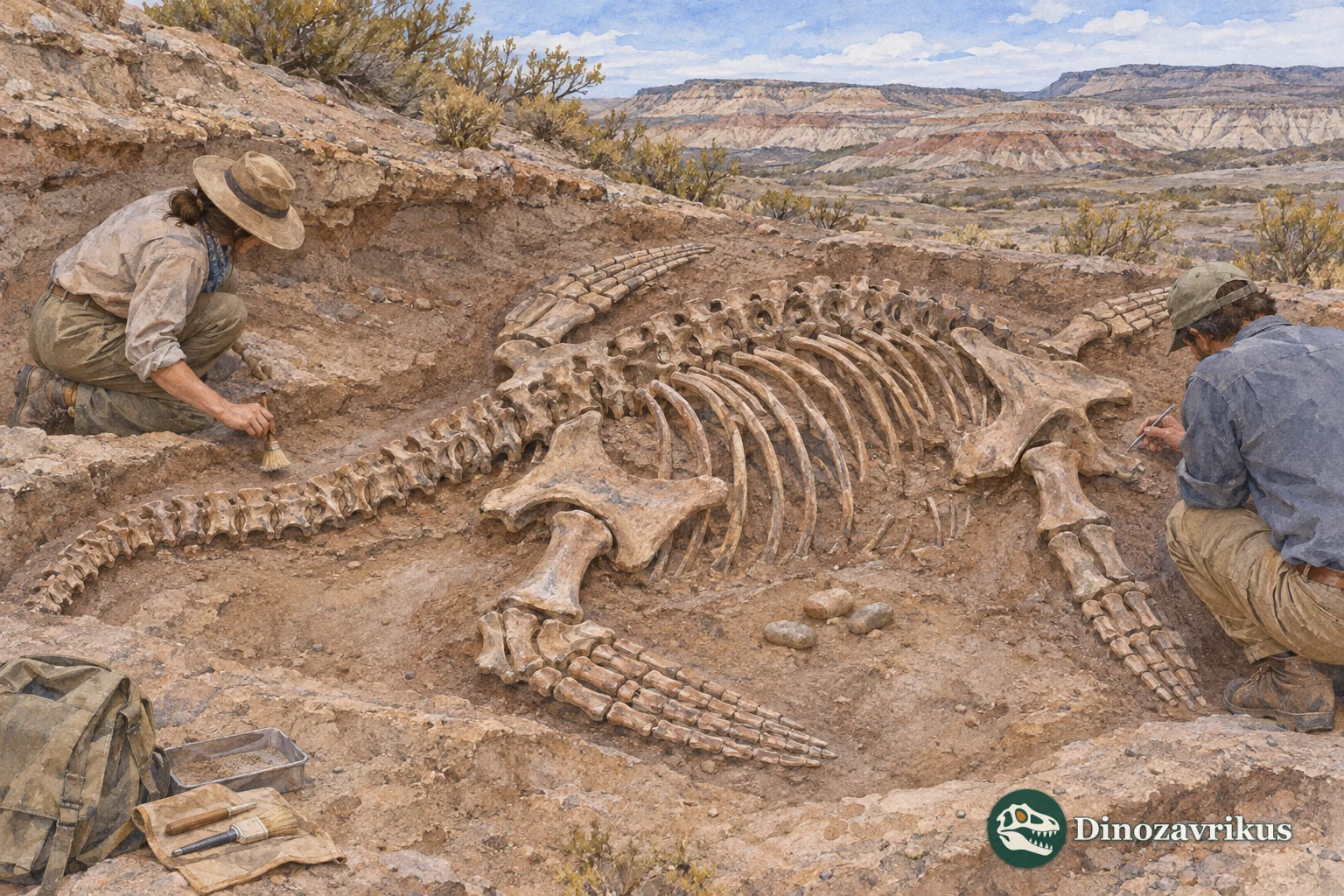
The holotype MPEF-PV 5232 came from Puesto Los Colorados on the Somún Curá plateau. It comprises cervical, pectoral, dorsal, sacral and caudal vertebrae, ribs, shoulder and pelvic elements, and limb bones. Gastroliths were also reported near the body. Their presence is direct evidence, although a particular digestive or ballast function for this individual is harder to demonstrate.
The illustrative fossil scene below shows the kinds of elements recovered. It is not an excavation photograph or a measured layout of MPEF-PV 5232; its absence of a skull reflects the documented missing region.
What the flippers and vertebrae show
The original authors diagnosed Chubutinectes from a combination of anatomical characters. Middle cervical centra are longer than high, bear a lateral keel and have bilobate articular faces. Some vertebrae near the neck-to-trunk transition show comparable bilobate surfaces. The coracoids form a closed, heart-shaped opening and have long anterior processes.
On the forelimb, the back of the humerus expands into an accessory facet. Accessory ossifications were also documented between neighbouring bones in the flippers. Together with pelvic features, these details distinguish the fossil from other elasmosaurids. None directly records stroke frequency, cruising speed or how the animal held its neck in life.
No skull was found. Tooth shape, jaw proportions and sensory anatomy therefore cannot be described for this species from its own fossil. The broader long-necked outline in artwork comes from comparison with relatives. Kawanectes provides a useful comparison from the La Colonia Formation, but its skull or body proportions cannot simply be assigned to Chubutinectes.
The last Cretaceous sea
The fossil-bearing La Colonia rocks at Puesto Los Colorados are Late Maastrichtian. The describing team examined associated microfossils; calcareous nannofossils Micula prinsii and M. murus point to a horizon younger than roughly 67.3 million years. This is a stratigraphic conclusion from organisms in the sediment, not a radiometric date measured on the bone.
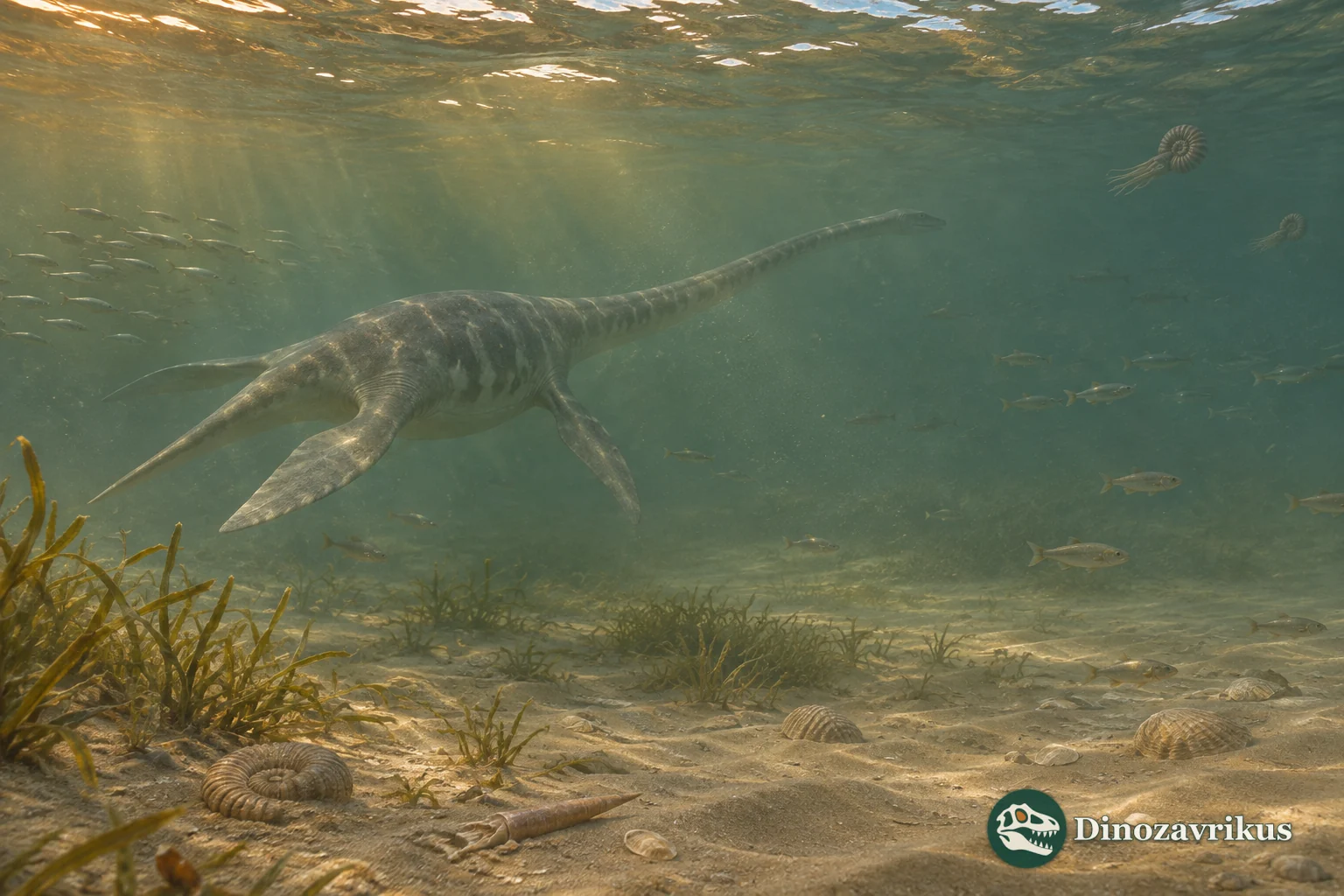
The micro- and nannofossil assemblages indicate a warm, shallow inner-shelf marine setting with restricted circulation. A burial site need not mark the species' entire range or typical depth. Another southern elasmosaurid, Aristonectes, illustrates the diversity of Late Cretaceous forms without implying identical feeding habits or direct ancestry.
Size and classification
Researchers quoted by CONICET estimated an animal about 8 m long and roughly 2 tonnes in mass, with a trunk around 2 m long. Total length and mass reconstruct missing regions; they are not direct snout-to-tail measurements of a complete articulated fossil. The absent skull and incomplete neck matter especially to the final estimate.
The initial phylogenetic analysis recovered Chubutinectes within the elasmosaurid clade Weddellonectia. This placement follows the characters and sample used in that analysis and may be revised. It is not evidence that a particular later species descended directly from Chubutinectes. Brancasaurus, from much older Early Cretaceous rocks in Europe, has a different preservation history and cannot fill missing Patagonian skull details.
The limits of an animal portrait
The vertebrae, girdles and flipper elements document a marine plesiosaur body. The skull, stomach contents, skin colour and detailed hunting behaviour remain unknown. Gastroliths do not identify a prey species. Any complete head or patterned skin in the illustrations is a comparative and artistic choice rather than a fossil observation.
The habitat image is likewise an interpretation of a shallow sea supported by the sedimentary and microfossil evidence. Its particular plants, swimming pose and other animals are not an inventory of organisms found alongside the holotype.
Frequently asked questions
Where was Chubutinectes found?
Carmelo Muñoz found the first bones in 2009 at Puesto Los Colorados on the Somún Curá plateau in Chubut Province, Argentina. The horizon belongs to the La Colonia Formation.
Is its skull known?
No. MPEF-PV 5232 preserves much of the skeleton behind the head, including vertebrae, girdles and flipper bones, but no skull.
How was its age established?
Calcareous nannofossils in associated sediment, including Micula prinsii and M. murus, support a latest Maastrichtian age younger than roughly 67.3 million years.
Was Chubutinectes exactly eight metres long?
About 8 m is a researchers' estimate of the entire animal, reconstructed from an incomplete skeleton. It is not a direct measurement of a complete specimen.