

Brancasaurus brancai is an Early Cretaceous plesiosaur named from a historically near-complete skeleton at a former clay pit near Gronau, northwestern Germany. The fossil was found during brickworks excavations in July 1910 and described by Theodor Wegner in 1914. Excavation damage and later wartime and postwar losses make its original drawings and the surviving bones different kinds of evidence.
Quick facts
| Type species | Brancasaurus brancai |
|---|---|
| Group | Plesiosaur; placement relative to elasmosaurids and leptocleidids debated |
| Age | Late Berriasian, Early Cretaceous |
| Formation | Isterberg Formation, upper Bückeberg Group |
| Locality | Gerdemann & Co. clay pit near Gronau, Germany |
| Holotype | GPMM A3.B4 |
| Known material | Originally nearly complete skeleton; some bones later lost |
| Measurement | Historic mounted skeleton 3.26 m; not exact live-animal length |
Evidence guide
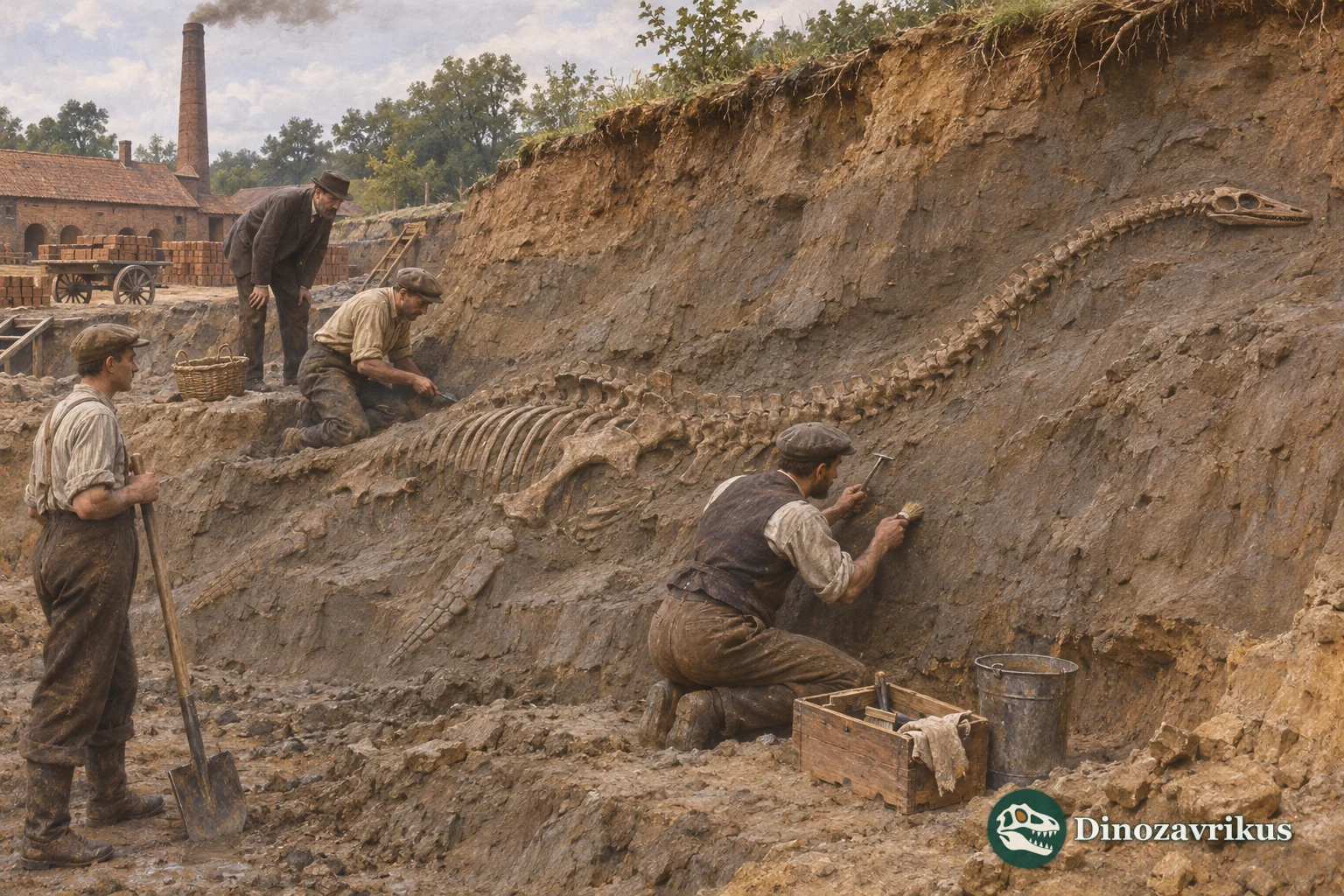
GPMM A3.B4 was uncovered at a brickworks clay pit near Gronau. Workers damaged and displaced elements before Wegner recovered the remaining bones.
Damage during and after World War II removed substantial cranial and other information. Some early observations survive only in Wegner's figures and text.
The fossil comes from the Isterberg Formation in the upper Bückeberg Group. The historic German Wealden label does not make these rocks the same age as the English Wealden.
A 2016 reappraisal interpreted Gronausaurus wegneri as a junior synonym and discussed unstable placement relative to elasmosaurids and leptocleidids.
Discovery and the first reconstruction
The holotype GPMM A3.B4 was found in July 1910 at the Gerdemann & Co. brickworks clay pit near Gronau in North Rhine-Westphalia. Workers exposed and broke parts of the fossil with pickaxes. Theodor Wegner of the University of Münster visited days later and recovered remaining elements that had become disarticulated and, in places, fragmented.
Wegner published the species in 1914, together with illustrations of a more complete specimen than survives today. The mounted skeleton was assembled from excavated bones and restoration work. Its display position does not show an untouched animal at the moment of burial. The species name honours the German geologist Wilhelm von Branca.
A second skeleton from the same clay pit was discovered in 1912, from a higher layer. It was later named Gronausaurus wegneri. The 2016 reappraisal interpreted its differences as compatible with growth-related variation and treated that name as a junior synonym of Brancasaurus brancai. This is a taxonomic argument, not direct proof that the two individuals were identical.
A specimen changed by damage
The original holotype included a skull and substantial postcranial skeleton, including vertebrae, ribs, girdles and paddle bones. This level of preservation makes it unusually informative among European Early Cretaceous plesiosaurs. Yet excavation damage, old restoration and losses during and after World War II changed what can now be examined.
The 2016 study inspected the surviving material and compared it with Wegner's drawings and descriptions. Some cranial elements documented in 1914 are now missing. Details known only from the older record cannot be verified again on those lost bones. Their present absence is not evidence that the living animal lacked them.
Wegner measured a maximum length of 3.26 m for the assembled skeleton. That is a historic specimen measurement, not an exact length of the live animal including soft tissue. Unfused neurocentral sutures indicate immaturity, but aspects of the limb and pelvic bones suggest the holotype was not an early juvenile. A subadult interpretation is therefore more plausible.
Late Berriasian lake and sea connections
The holotype came from the Isterberg Formation in the upper Bückeberg Group and is assigned to the Late Berriasian, near the start of the Cretaceous. Older texts used the term German Wealden for similar facies. That historical label does not make the German sequence the same age as the English Wealden.
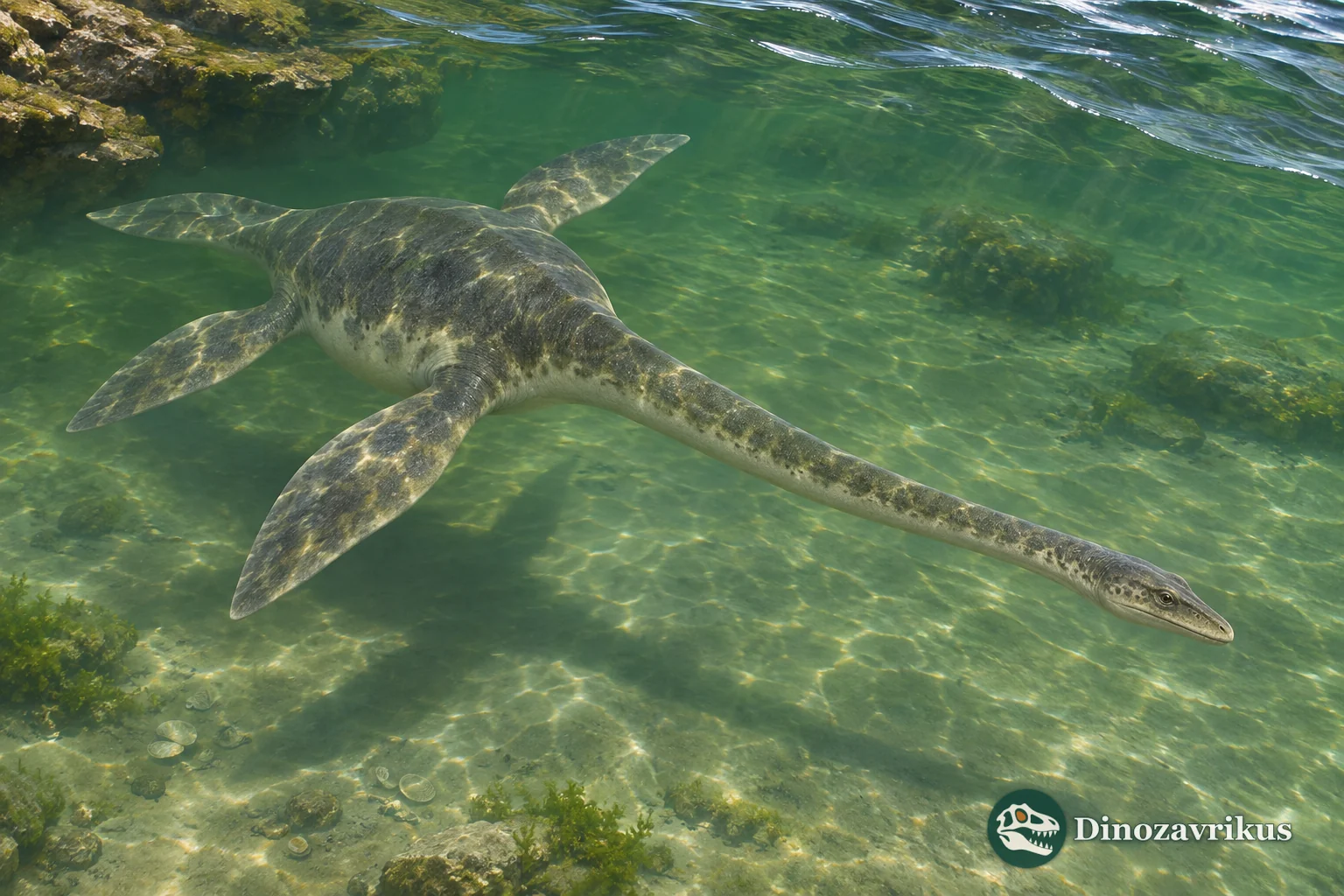
The Bückeberg succession formed in a large lake basin fed by rivers, with a western connection to the Boreal Sea. Sediments indicate predominantly limnic to brackish conditions and episodes of marine influence. A plesiosaur in this system should not automatically be depicted as living in a continuously open ocean. The exact salinity or route used by one individual is not recoverable.
Older Arminisaurus and Avalonnectes came from different Early Jurassic marine deposits. Their fossils help compare plesiosaur diversity across places and time, but do not document direct ancestry for Brancasaurus.
Size, maturity and missing biology
The historical mount reached 3.26 m, but its original burial was disrupted and some missing material had to be positioned during preparation. This figure is useful for describing the mounted fossil, while a precise live-animal length or mass would require assumptions about anatomy and soft tissues.
A long neck and four paddles show the broad plesiosaur body plan. They do not specify swimming speed, a stroke cycle or an exact feeding habitat. No reported stomach contents establish a species-specific prey list. Skin colour, social behaviour and reproductive biology remain unknown.
Classification under review
Wegner compared the animal with elasmosaurids but also described differences in skull proportions, teeth, neck and vertebrae. Later studies considered leptocleidid affinities. The 2016 reappraisal showed that some proposed distinguishing characters are weakened by damaged or lost bones and by variation as an animal grows.
Different phylogenetic analyses have recovered different placements. Stating one family as settled would conceal the uncertainty in the evidence. Comparisons with a later plesiosaur such as Morenosaurus illustrate the group's diversity, but cannot restore the lost parts of the Gronau holotype.
Frequently asked questions
Where was Brancasaurus found?
The holotype GPMM A3.B4 was discovered in July 1910 at the Gerdemann & Co. brickworks clay pit near Gronau, Germany.
Why do illustrations of the holotype differ?
The bones were damaged during extraction, and additional material was lost during and after World War II. Wegner's 1914 figures preserve details no longer fully testable on the present specimen.
How old is the fossil?
Its Isterberg Formation horizon belongs to the Late Berriasian of the Early Cretaceous. The holotype itself was probably subadult rather than an early juvenile.
Was Brancasaurus an elasmosaurid or a leptocleidid?
Its exact placement remains debated. Both affinities have been proposed, and a 2016 revision stressed the limits of the damaged historic material.