

Arminisaurus schuberti is a plesiosaur from the Upper Pliensbachian of northwestern Germany. Its name is anchored to an incomplete, disarticulated skeleton from the Beukenhorst II clay pit near Bielefeld. Parts of the jaw, neck, shoulder girdle and limbs help distinguish it from other early plesiosaurs, while the missing bones limit estimates of its full length and biology.
Quick facts
| Type species | Arminisaurus schuberti |
|---|---|
| Group | Plesiosaur; recovered as an early pliosaurid in a 2017 analysis |
| Age | Upper Pliensbachian, Lower Jurassic |
| Formation | Amaltheenton Formation; Amaltheus margaritatus Zone |
| Locality | Beukenhorst II, Jöllenbeck, Bielefeld, Germany |
| Holotype | ES/jl 36052, an incomplete skeleton |
| Known material | About 90 bones plus numerous small fragments |
| Body length | Roughly 3–4 m in a preliminary reconstruction |
Evidence guide
ES/jl 36052 includes about 90 individual bones and many fragments from the skull, axial skeleton, girdles and limbs. It is not a complete, articulated skeleton.
The published diagnosis describes the mandible, cervical vertebrae and scapula. These preserved features distinguish the taxon; the complete body outline is reconstructed.
The specimen comes from the Amaltheenton Formation and the Amaltheus margaritatus Zone. This is a biostratigraphic assignment of the host bed, not a direct date on the bone.
The placement follows a comparison of anatomical characters in a phylogenetic matrix. It is a research inference, not proof that Arminisaurus was a direct ancestor of another genus.
A find from the Beukenhorst II clay pit
Lothar Schulz found the fossil material in the early 1980s at Beukenhorst II, a clay pit in the Jöllenbeck district of Bielefeld. After preparation and study, the remains were transferred to the city's natural history museum in 2015 by Siegfried Schubert. The specimen is catalogued as ES/jl 36052.
Sven Sachs and Benjamin Kear named the genus and species in a paper published online in 2017 and in the journal's 2018 issue. The genus name refers to Arminius, also known as Hermann, and the region's history. The species name honours Schubert. Neither name is evidence about the animal's appearance or behaviour.
The fossil is an incomplete and disarticulated skeleton. A count of roughly 90 bones and many smaller fragments conveys the amount of material, but should not be mistaken for 90 complete elements or a percentage that can be converted directly into body length.
What the bones show
The material includes parts of the skull and lower jaw, vertebrae and ribs, shoulder and pelvic girdles, and limb elements. The bones do not form one continuous, fully articulated skeleton, so their anatomical positions are reconstructed from shape and comparison.
The diagnosis uses a combination of traits. The jaw has a notch behind its joint surface; the cervical vertebral centra are broader than long and deeply concave at their ends, with lateral processes; the scapula also has a distinctive form. No single silhouette or isolated feature supplies the full taxonomic argument.
Other Pliensbachian cervical vertebrae from nearby German localities were described in a 2024 study. Some resemble Arminisaurus, but the authors could not confidently assign them to the genus. Similarity and geographic proximity make them useful comparisons, not secure referrals.
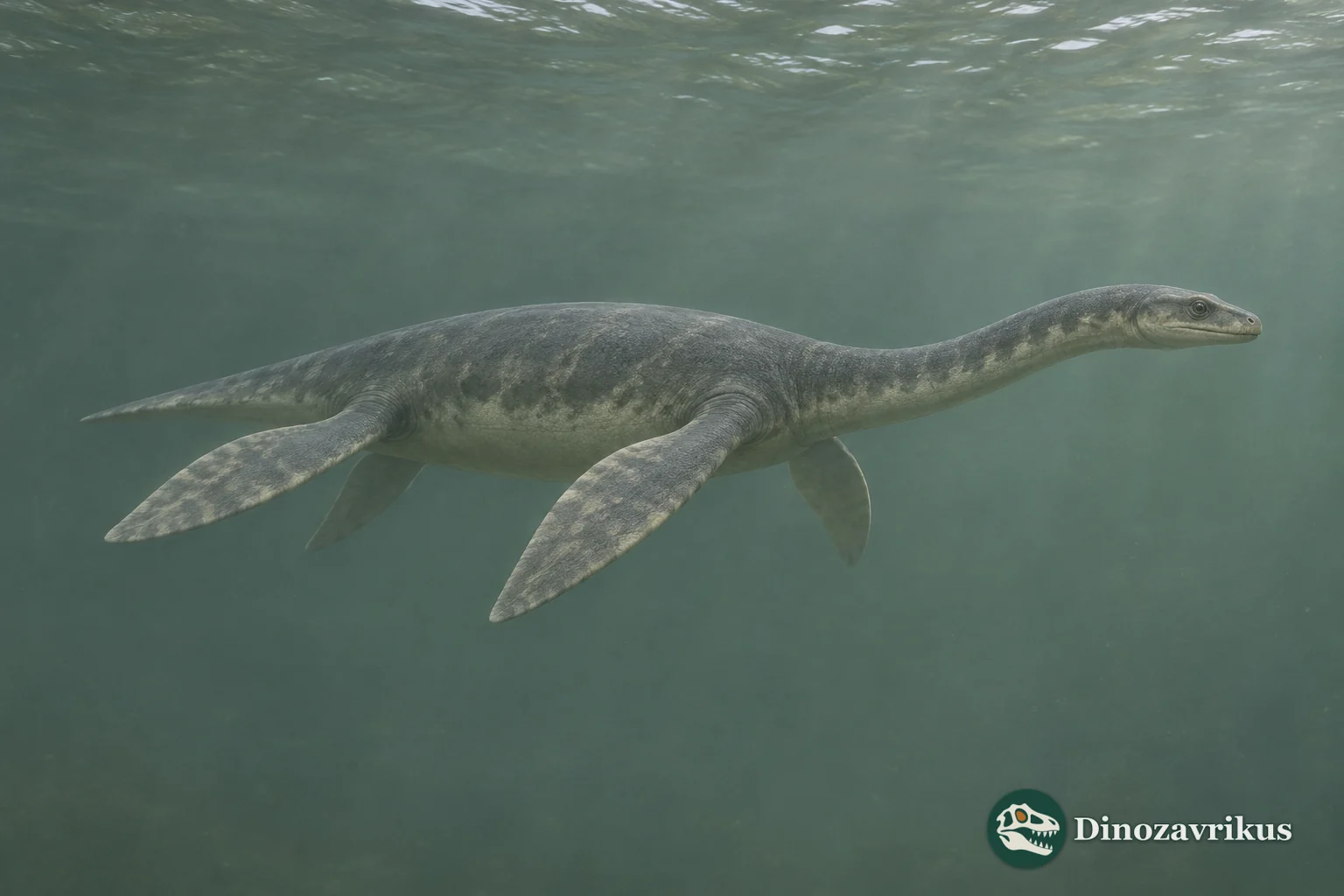
Age and marine setting
The holotype comes from the Amaltheenton Formation and is assigned to the Upper Pliensbachian, within the Amaltheus margaritatus ammonite Zone. A more specific placement has been associated with the Amaltheus subnodosus Subzone. The age comes from the host strata and their ammonites rather than a direct measurement of the fossil.
The clay records a marine setting, but one plesiosaur skeleton cannot establish the exact depth, local water conditions or route followed by the animal. The early Jurassic forms Anningasaura and Thalassiodracon offer useful comparisons, each with a different specimen and geological context.
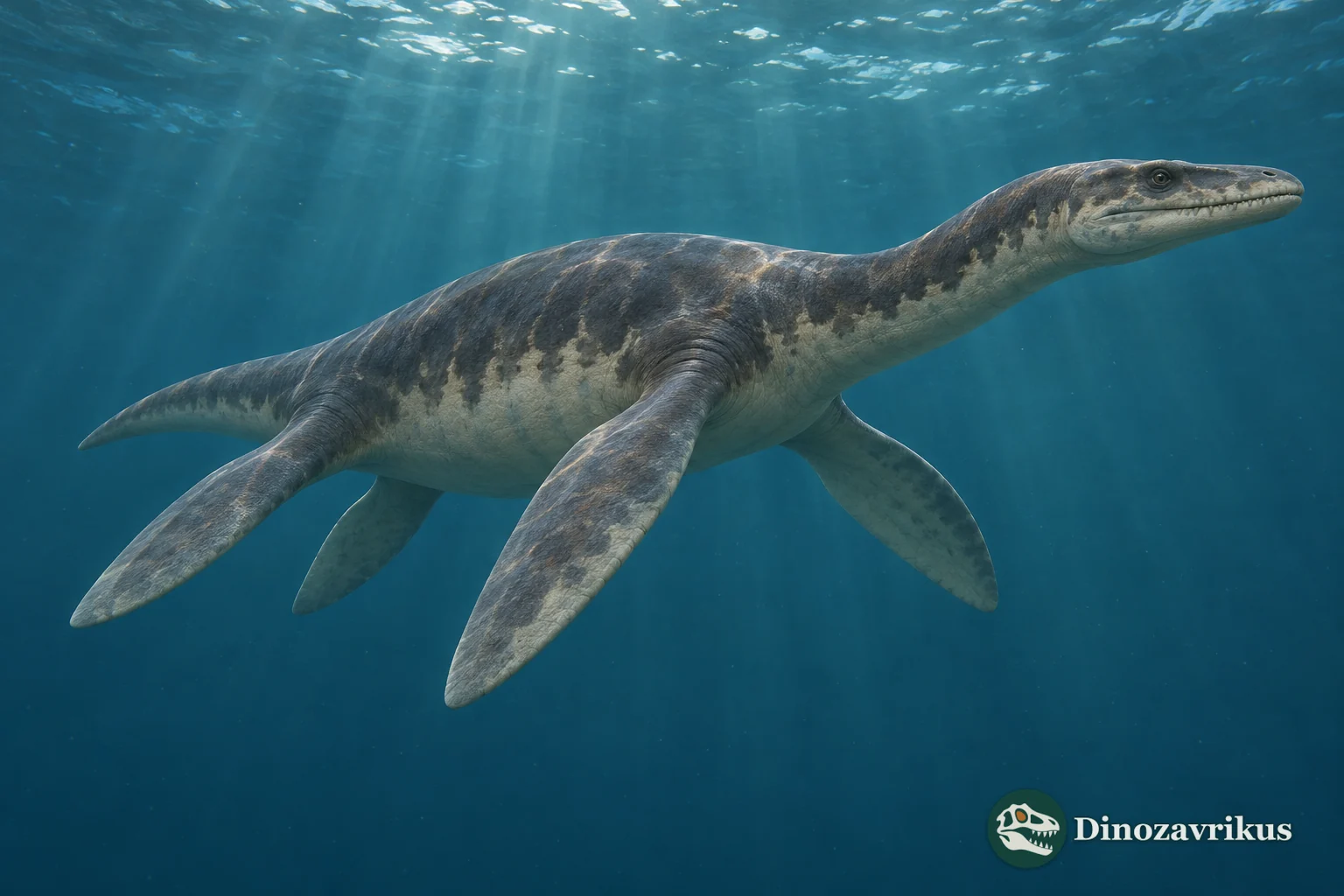
Size, movement and preservation
A total length of roughly 3–4 m is a broad reconstruction from incomplete material. The preserved skeleton does not run continuously from the snout to the tail, so missing regions must be restored by comparison. The estimate is a guide to scale, not a direct measurement of ES/jl 36052.
The limb bones show a four-paddle plesiosaur body plan, but they do not reveal an exact stroke pattern, maximum speed or manoeuvring ability. No stomach contents, associated prey or other direct evidence establishes a species-specific diet. Colour and soft-tissue outlines are also unknown.
Iron sulphides in some bones can oxidise and damage fossil material after excavation. A conservation account discusses controlled storage for this specimen. That mineral decay is a preservation issue, not evidence of an injury suffered in life.
Classification and its limits
Sachs and Kear's 2017 phylogenetic analysis recovered Arminisaurus as an early-diverging member of Pliosauridae. The result came from a coded comparison of jaws, vertebrae, shoulder bones and other characters. It describes a position on a research tree, not a documented ancestor–descendant sequence.
The incomplete record leaves several questions open. It does not provide a secure mass, growth curve, reproductive history or pathology for the genus. Comparisons with later plesiosaurs, including Morenosaurus, help explain anatomical diversity across the group, but do not fill in missing bones or establish direct ancestry.
Frequently asked questions
Where was Arminisaurus found?
Lothar Schulz found the fossils at the Beukenhorst II clay pit in Jöllenbeck, now part of Bielefeld, Germany. The remains came from marine clay of the Amaltheenton Formation.
What does the holotype preserve?
ES/jl 36052 is an incomplete skeleton with about 90 bones and many smaller fragments, including parts of the skull and jaw, spine, ribs, girdles and limbs.
How long was Arminisaurus?
A rough estimate of about 3–4 m has been reconstructed from the incomplete skeleton. The length of a complete animal was not directly measured.
Was it the direct ancestor of later plesiosaurs?
There is no evidence for direct ancestry. A 2017 phylogenetic analysis placed Arminisaurus among early pliosaurids based on shared skeletal characters.