

Avalonnectes arturi was named from Lower Jurassic plesiosaur remains found at Street in Somerset, England. The holotype preserves the back of the skull and parts of the skeleton, including incomplete vertebral rows and limbs. A published measurement of about 735 mm refers only to the trunk region, so it cannot be reported as the animal's total length.
Quick facts
| Type species | Avalonnectes arturi |
|---|---|
| Group | Plesiosaur; recovered among early rhomaleosaurids in a 2012 analysis |
| Age | Hettangian, Early Jurassic |
| Formation | Blue Lias Formation, Pre-planorbis Beds |
| Locality | Street, Somerset, England |
| Holotype | NHMUK 14550, partial skull and postcranial skeleton |
| Known material | Posterior skull, incomplete vertebral rows and limb bones |
| Measured region | Trunk about 735 mm; total body length unknown |
Evidence guide
NHMUK 14550 includes the posterior skull and an incomplete postcranial skeleton. The front of the skull and many skeletal regions are missing; some cranial elements are crushed or displaced.
Twenty-three cervical vertebrae are preserved, with a total of 26–28 inferred. Eighteen dorsals, four sacrals and 16 proximal-to-middle caudals are reported for the holotype.
The measurement is not a nose-to-tail length. The fossil record does not support a precise total body length for Avalonnectes.
This placement comes from comparative anatomical analysis around the Triassic–Jurassic boundary. It does not demonstrate that Avalonnectes was a direct ancestor of later forms.
A plesiosaur from Street
Benson, Evans and Druckenmiller named Avalonnectes arturi in 2012 while examining the diversity of plesiosaurs near the Triassic–Jurassic boundary. The holotype, NHMUK 14550, combines a posterior portion of the skull with an incomplete skeleton behind it.
A second partial postcranial skeleton from Street was referred to the genus in the same study and is held under an uncatalogued AGT field number. It is a separate specimen. Counts or features from that referred material should not be silently added to the holotype description.
The name Avalonnectes refers to the Avalon region around Glastonbury and Street, joined to a Greek-derived word for swimmer. The species name honours Arthur Cruickshank and also alludes to the Arthurian legend. The etymology is not a claim about a measured swimming style.
Skull and vertebral evidence
Only the back of the skull is preserved, and parts are crushed or displaced. The fossil therefore does not preserve a complete snout or a full tooth row. It can support comparisons of the preserved skull region, but cannot establish the exact shape of the entire head or a specific prey list.
The holotype contains 23 cervical vertebrae. The original study estimated a total of about 26–28, while the atlas and axis are absent. Eighteen dorsal vertebrae, four sacrals and 16 proximal-to-middle caudals were also reported. These are partial counts, not a complete vertebral column.
Some limb bones remain partly articulated. They provide evidence for a four-paddle plesiosaur skeleton, but not a direct reading of swimming speed or the exact movement of each flipper.
Age and the Street fauna
The Street material is assigned to the Blue Lias Formation and the Pre-planorbis Beds of the Hettangian, the earliest stage of the Jurassic. This age follows the stratigraphic placement of the fossil-bearing beds, not direct radiometric dating of the bones.
Street has yielded several marine reptiles used in studies of early Jurassic diversity. Their presence in the same broad area does not show that every species occupied the same habitat or fed on the same animals. Anningasaura and Thalassiodracon provide comparisons with other early plesiosaurs, while German Arminisaurus comes from a separate marine basin.
A measurement, not a total length
The published length of about 735 mm applies to a trunk region of the holotype. It excludes the missing front of the skull, incomplete neck and tail, as well as the animal's soft-tissue outline. It should not be restated as the total length of Avalonnectes.
A whole-body estimate would have to restore missing regions by comparison with other plesiosaurs. The result would depend on which analogues and proportions were chosen. Because the primary material does not provide a secure full-length estimate, this overview reports the preserved measurement and leaves total length unresolved.
Relationships and what remains unknown
The 2012 phylogenetic analysis placed Avalonnectes among early-diverging rhomaleosaurids. That result reflects a coded comparison of anatomical characters. A branch in a phylogenetic tree describes inferred relationships; it does not mean that the named taxon is a direct ancestor of a later genus.
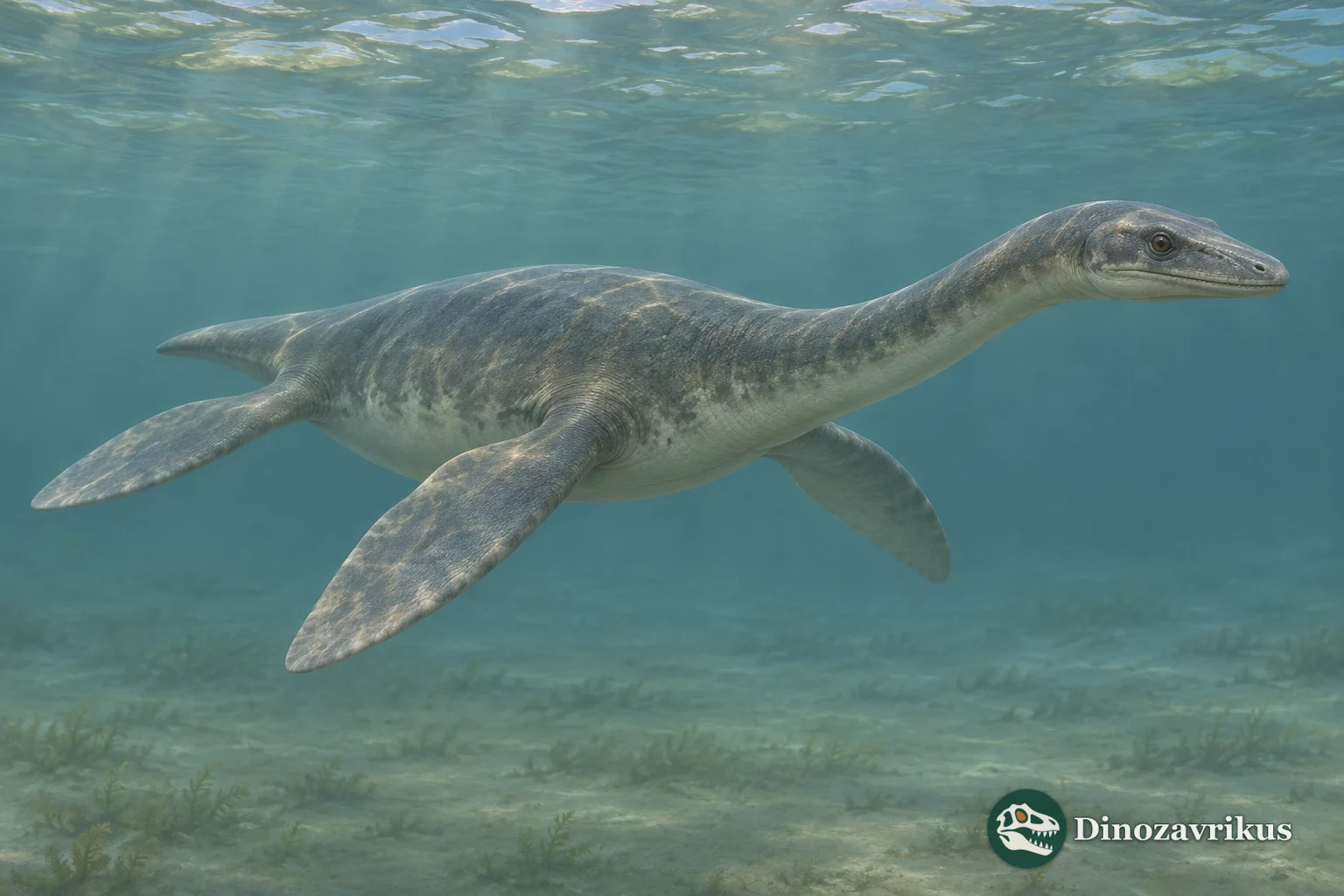
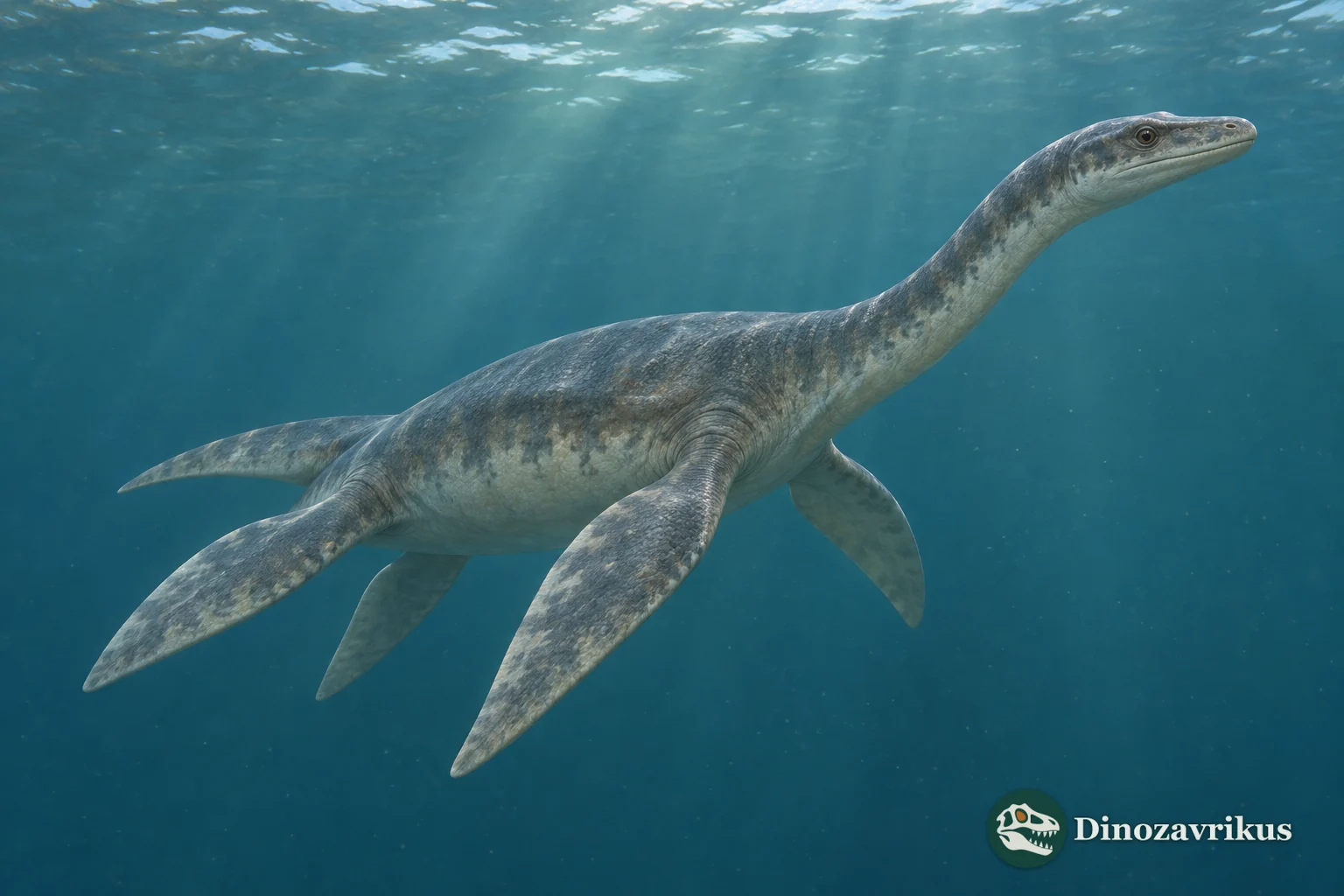
The fossil does not preserve stomach contents or an associated prey item that would establish its diet. Colour, soft tissues, social behaviour, growth and reproductive biology are also unknown. The article illustrations are palaeoart, not images of NHMUK 14550 or a specific Street excavation.
Frequently asked questions
Where was Avalonnectes found?
The holotype NHMUK 14550 is from Street, Somerset, England, in marine rocks assigned to the Blue Lias Formation.
What parts of its skeleton are known?
The fossil preserves the rear of the skull, incomplete vertebral rows and parts of the limbs. The front of the skull and many parts of the spine are missing.
How long was Avalonnectes?
About 735 mm is a measurement of a trunk region, not the entire animal. The published material does not establish a reliable total length.
Was Avalonnectes an ancestor of later plesiosaurs?
No direct ancestor relationship is demonstrated. The 2012 analysis placed it among early rhomaleosaurids by comparing skeletal characters.