

Colpodontosaurus was a Late Cretaceous lizard from North America. The teeth in its type specimen are broken at the tips, exposing unusually thin walls. That feature and the shape of the jaw help palaeontologists compare fragmentary finds.
Quick facts
| Group | Anguimorphs (Anguimorpha) |
|---|---|
| Age | Late Cretaceous, Maastrichtian |
| Region | North America, United States |
| Type species | Colpodontosaurus cracens |
| Scientific name | Colpodontosaurus |
| Diet | Diet unknown |
What can the fossils tell us?
The type specimen, UCMP 46608, was found in the Lance Formation at Lull Quarry. The front of the bone and the ends of its teeth are broken.
Features of the jaw and teeth support an anguimorph identification. More of the skull would help test its position within the group.
A dentary from West Bijou resembles Colpodontosaurus, but the published identification is provisional.
The type specimen from the Lance Formation
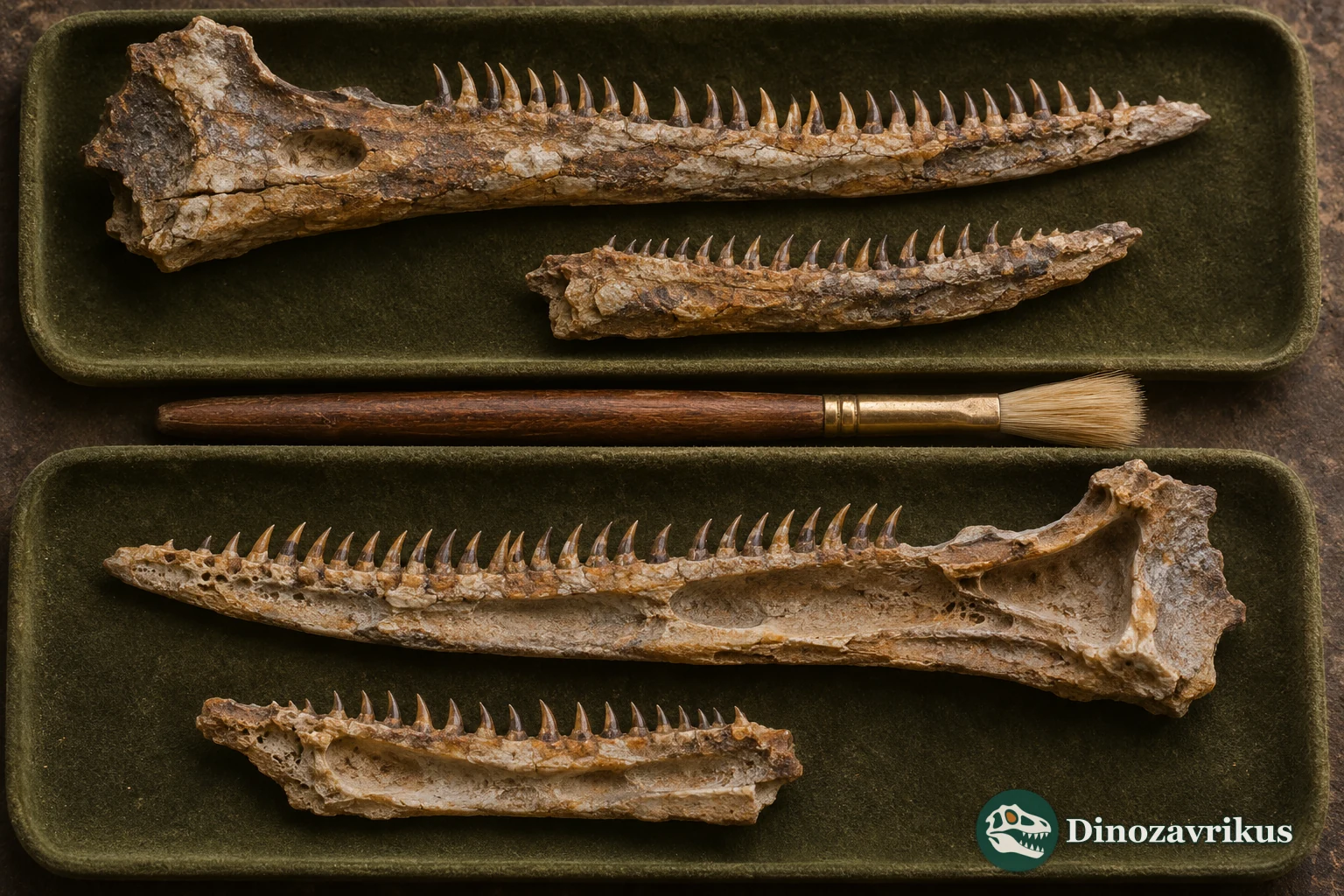
Richard Estes described Colpodontosaurus cracens in 1964. The holotype, UCMP 46608, is a left dentary with the front end missing. None of its remaining teeth has a complete tip. It came from the Maastrichtian Lance Formation at Lull Quarry in eastern Wyoming. Isolated upper and lower jaw fragments have also been referred to the species.
What is distinctive about the teeth
The breaks show that the tooth walls are very thin. This distinguishes them from the teeth of some fossil lizards with similarly shaped jaws. Jaw anatomy is also important for identifying the anguimorph Dorsetisaurus, for which more skeletal elements are known. No comparable set of skeletal remains is available for Colpodontosaurus.
Beyond the type locality
Estes and colleagues identified a specimen from McCone County in Montana, now held at Harvard’s Museum of Comparative Zoology. A dentary from the latest Maastrichtian site of West Bijou in Colorado, DMNH EPV.107966, was compared with the same species. The abbreviation cf. in that identification indicates resemblance without a firm identification.
Frequently asked questions
Where was the type specimen found?
It comes from Lull Quarry in eastern Wyoming, in the Maastrichtian Lance Formation.
Which part of the jaw survives in the holotype?
The holotype preserves the left dentary with its front end missing and its tooth tips broken.
Was Colpodontosaurus a monitor lizard?
It is regarded as an anguimorph and has been compared with varanoids. The fossils do not establish membership in the living monitor genus.
What did Colpodontosaurus eat?
The surviving jaw fragments do not establish its diet.