

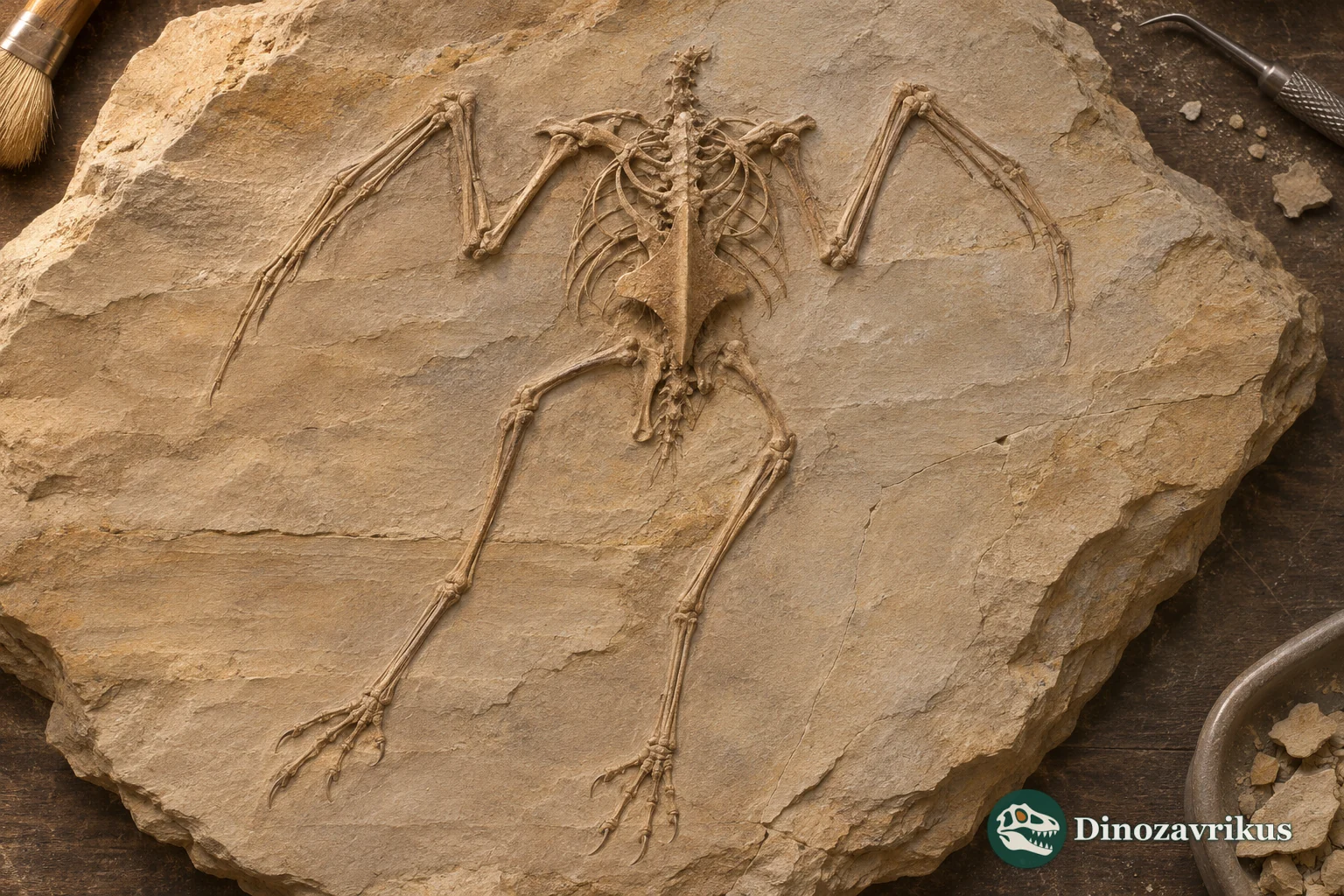
Concornis was an Early Cretaceous enantiornithine from the Las Hoyas wetland in Spain. Its type specimen preserves much of the skeleton from the shoulders to the feet. The wing and breastbone became easier to interpret after more of the limestone was removed.
Quick facts
| Group | Enantiornithines (Enantiornithes) |
|---|---|
| Age | Early Cretaceous (Barremian) |
| Region | Europe (Cuenca, Spain) |
| Diet | No direct evidence |
| Type species | Concornis lacustris |
| Holotype | MUPA-LH-2814, skeleton lacking the skull and most of the neck |
| Locality | Las Hoyas |
| Humerus length | About 33 mm in the holotype |
What can the fossils tell us?
The shoulders, wings and legs can be examined in the type specimen. The skull and most of the neck are missing.
Large claws survive at the ends of the wing digits. The keel occupies the rear half of the breastbone.
MUPA-LH-33333 is similar in size but differs in the shape of the coracoid and breastbone. Its relationship to Concornis is unresolved.
What preparation exposed
José Luis Sanz and Ángela Buscalioni described the species in 1992. Three years later, they and Luis Chiappe published a new account after additional preparation. Most of the skeleton behind the neck is present. The rear of the breastbone has deep notches and a keel that stops well short of the front margin.
The wing bones have proportions close to those of many living birds, while their digits retain large claws. The hindlimbs are slender and elongated. The humerus measures about 33 mm and the tibiotarsus measures about 35 mm in the type specimen.
Its place among the birds of Las Hoyas
The redescription placed Concornis among the enantiornithines using details of the vertebrae, sternum and limbs. It also proposed a close relationship to the group that includes Avisaurus based on the tarsometatarsus. Later analyses kept Concornis among the enantiornithines and recovered it outside Avisauridae.
The Las Hoyas deposits preserve several other small birds. Specimen MUPA-LH-33333 retains parts of the wing feathers and soft tissues. A 2023 study found similarities to Concornis in size and some bones, along with differences in the coracoid and breastbone. The authors left the separate fossil without a species assignment.
Frequently asked questions
Where were the bones found?
They came from the Early Cretaceous limestone of Las Hoyas in Cuenca, Spain.
Does the fossil preserve the head?
The skull and most of the neck are missing. The shoulders, breastbone and much of both pairs of limbs are preserved.
What can be seen in the wing?
The wing bears large claws. The relative lengths of its bones resemble those of many modern birds.
What did Concornis eat?
The type specimen offers no direct evidence of its diet. The burial site records the wetland in which the bones accumulated.