

The type species of Corrugatagnostus has grooved cheeks, yet a species from the Montagne Noire in France has smooth ones. Its assignment to the genus is based on the grooves along the middle of the head and the shape of the tail axis.
Quick facts
| Group | Agnostida |
|---|---|
| Period | Ordovician |
| Genus established | Kobayashi, 1939 |
| Type species | Corrugatagnostus morea |
| French locality | Southern Montagne Noire |
| French holotype | Head shield R 64863 |
What can the fossils tell us?
Two head shields and four tail shields came from the Setso Shale Member.
A low elongate node sits just forward of the glabellar midpoint. The two transverse grooves are subdued.
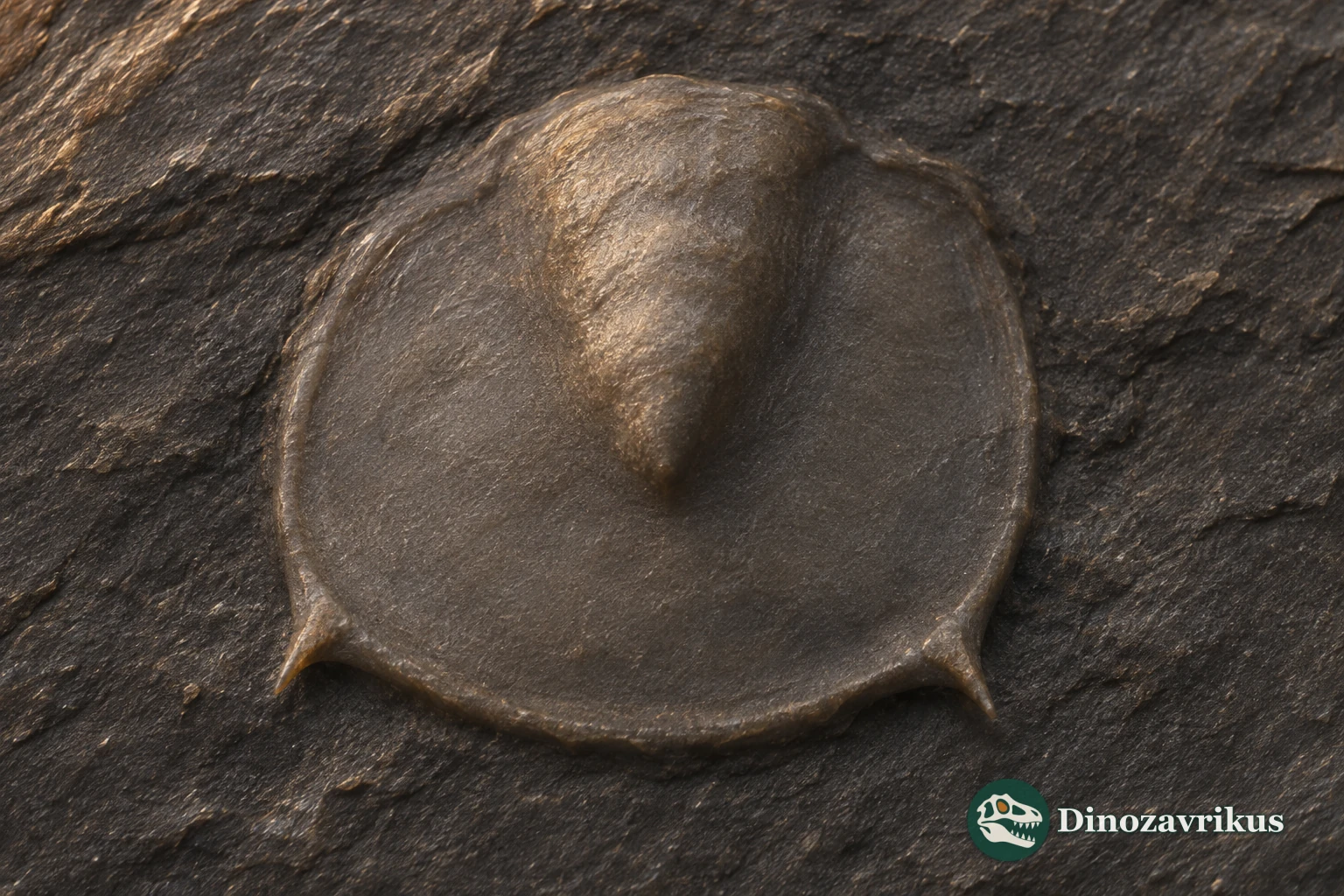
The axis narrows toward the rear. The tail margin carries a pair of posterolateral spines.
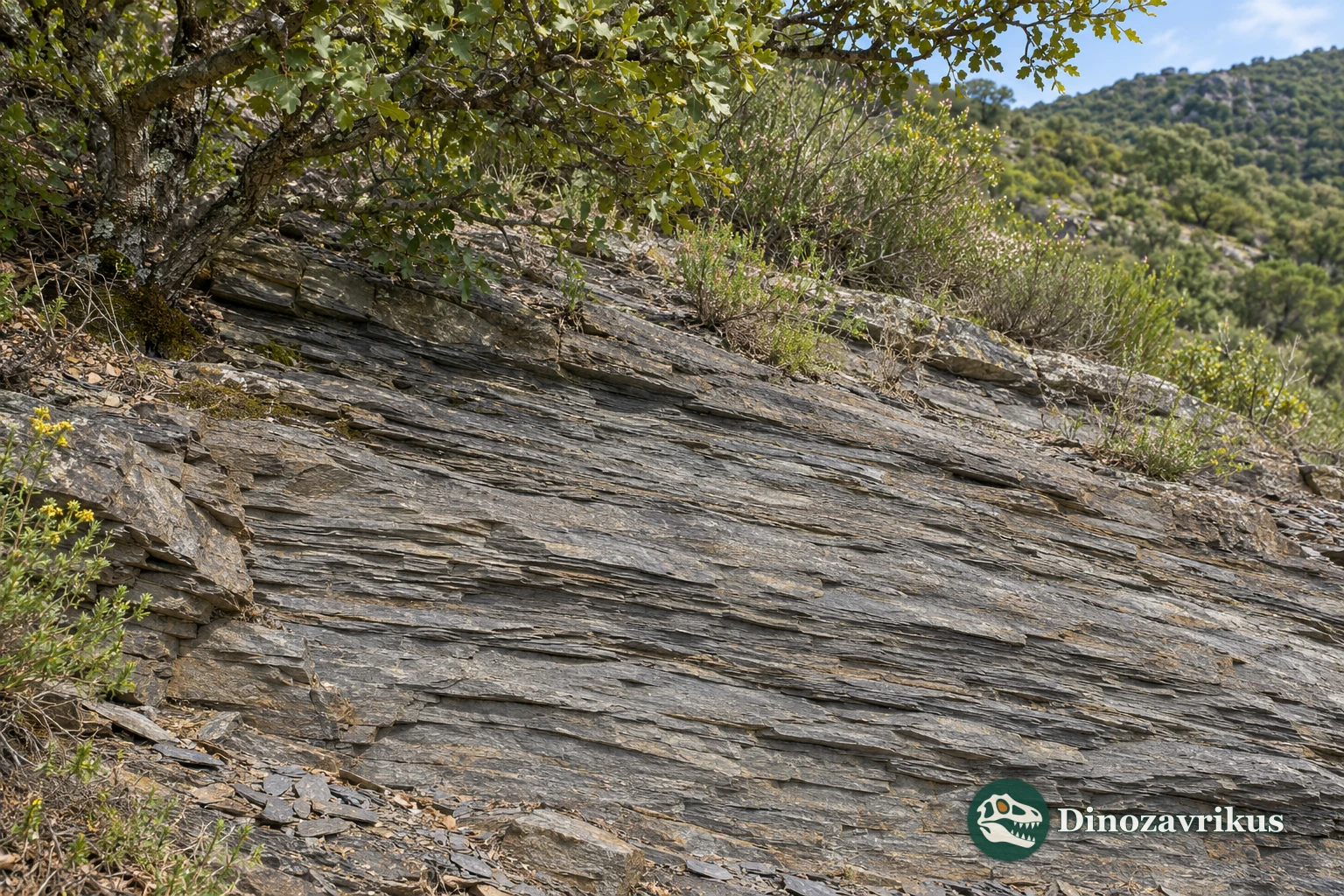
Shield fossils from the Setso shale
Teiichi Kobayashi established the genus in 1939 with Agnostus morea as its type species. John Salter had described that species in 1864 from Ordovician rocks in Bohemia. It has also been reported from Britain and Belgium.
The Early Ordovician Setso Shale Member of the La Maurerie Formation yielded two head shields and four tail shields of C. coulobresensis. The species takes its name from Coulobres hill near Cessenon in southern France. The holotype head shield, R 64863, measures 2.1 mm long and 2.2 mm wide. The four tail shields range from 1.9 to 2.5 mm in length.
Distinguishing the French species
The glabella, the raised central part of the head, takes up roughly two-thirds of the shield’s length. An elongate node lies just in front of its midpoint. One transverse groove forms a shallow chevron, and the groove behind it is lower still. The cheeks on either side are smooth.
The raised axis occupies roughly half the length of the tail shield and tapers to a rounded or slightly pointed rear end. A pair of short spines flanks the rear margin.
Comparisons with related forms
The authors who described the French material followed a broad definition of Corrugatagnostus that treats Segmentagnostus as a junior synonym. Some glabellar grooves are similarly faint in the British C. stubblefieldi. The French species has a more transverse groove and a differently shaped rear part of the tail axis.
Early Ordovician beds elsewhere in the same massif also yielded pygidia of Leiagnostus. The central relief is far more subdued in those shields.
Frequently asked questions
What part of the shell is the French holotype?
It is a 2.1 mm head shield catalogued as R 64863.
How did the French species get its name?
It was named after Coulobres hill near Cessenon in southern France.
Did all species of the genus have grooved cheeks?
The Montagne Noire species is one example with smooth cheeks.
How much of the French tail shield does its axis occupy?
The short axis takes up about 50–55% of the length of the shield.