

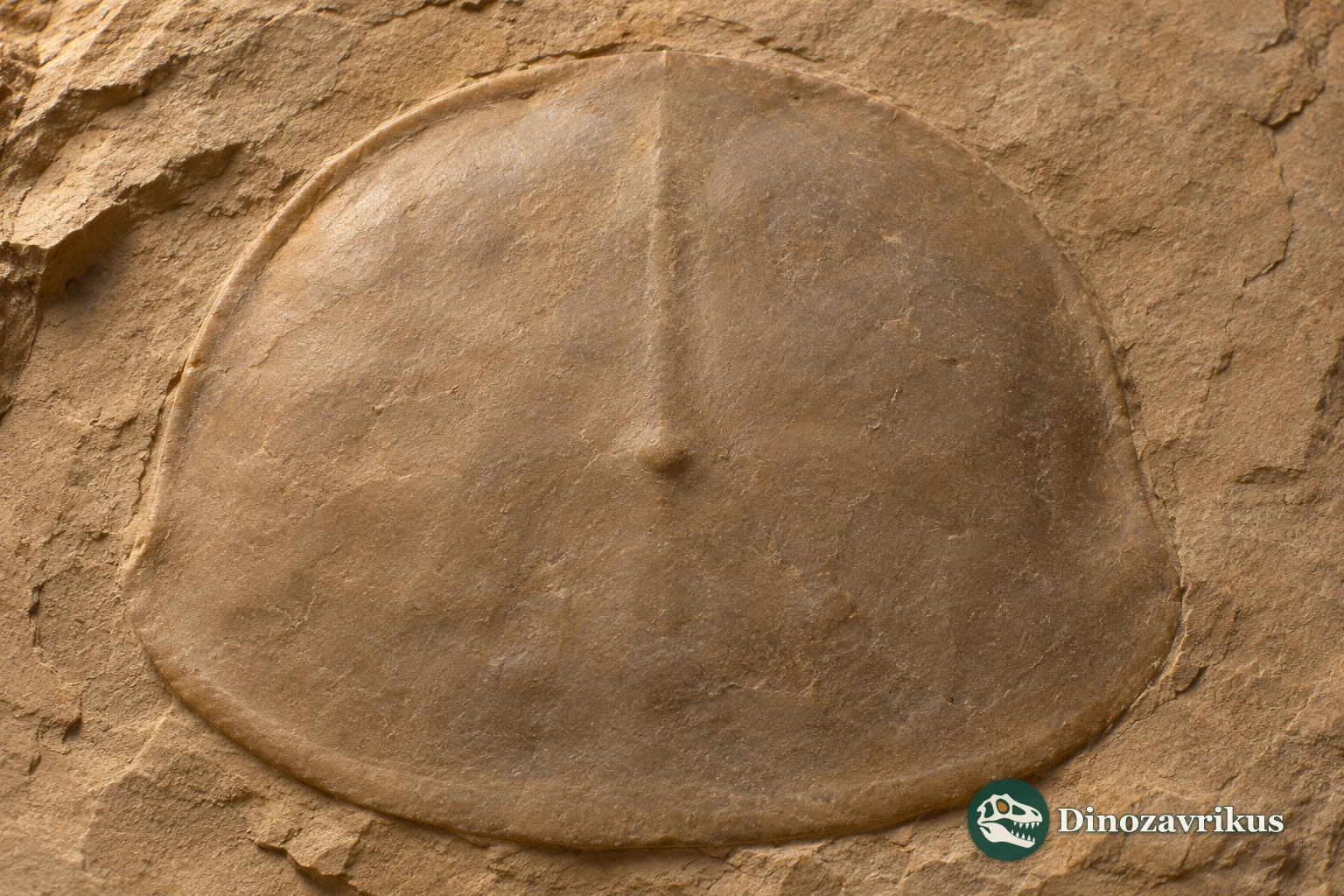
Leiagnostus has convex shields with unusually subdued grooves. The head of its Ordovician type species is almost featureless, while Late Cambrian fossils from Tasmania still show a faint outline of the axis. Articulated shells provide a means of comparing the head and tail directly.
Quick facts
| Group | Agnostida |
|---|---|
| Age of the material discussed | Late Cambrian and Early Ordovician |
| Type species | Leiagnostus erraticus |
| Genus established | Otto Jaekel, 1909 |
| Type find | Enrolled shell in a glacial erratic, Berlin |
| Tasmanian material | Complete shells and detached shields |
What can the fossils tell us?
The cephalon is vaulted and almost featureless. The boulder’s findspot is better established than its original horizon.
Well-preserved shields show a faint axis and a node on its second segment.
The French material was assigned using the smooth surface, the rim and the furrow separating them.
The type fossil in a transported boulder
Otto Jaekel established Leiagnostus in 1909 with L. erraticus as its type species. The enrolled holotype was found in a limestone glacial erratic in Berlin’s Neukölln district. The boulder had been moved by ice. A later revision suggested that it most probably originated in Ordovician strata in Baltoscandia.
The type specimen has an oval, strongly convex cephalon. Its outer surface lacks visible lobes, furrows and a median node. The head and tail are preserved together in the enrolled shell.
A Late Cambrian species from Tasmania
Siltstone west of Birch Inlet yielded three complete specimens of L. inletensis, together with detached shields. Holotype UT92572 is an internal mould of a complete shell. Subtle depressions and swellings outline the tail axis, and a node stands out on its second segment.
The axial relief on both shields is stronger than in the type species, and the pygidium lacks marginal spines. The same late Cambrian succession yielded Trilobagnostus. Comparisons of the broader local fauna helped correlate the beds with sections in South China.

A French series of small tails
Three imperfect pygidia assigned to L. miqueli measure 1.9–2.2 mm long. They came from lower Tremadocian strata in the southern Montagne Noire. One is strongly distorted across its width. The identification rests on a combination of the otherwise smooth surface, a clearly marked furrow and a wide convex rim.
Frequently asked questions
Where was the type species found?
In a glacial erratic of limestone found in Neukölln, Berlin.
What is preserved in the Tasmanian holotype?
UT92572 is an internal mould of a complete shell.
Did L. inletensis have spines on its tail margin?
No marginal tail spines are present in the described fossils.
How large are the French tail shields of L. miqueli?
The three reported pygidia measure 1.9 to 2.2 mm long.