

A fragment from a Florida clay bed preserved the ankle end of a small songbird’s shin. Pierce Brodkorb compared it with the legs of living oropendolas and named a new genus, Cremaster. He also recognised two separate bones from the same quarry as possible material of the bird.
Quick facts
| Family | New World blackbirds (Icteridae) |
|---|---|
| Age | Late Pleistocene in the museum catalogue |
| Locality | Alachua County, Florida |
| Holotype | UF/PB 1663, lower end of left tibiotarsus |
| Described | Pierce Brodkorb, 1959 |
| Type species | Cremaster tytthus |
| Measured size | Referred humerus 27.1 mm long |
What can the fossils tell us?
The distal tibiotarsus preserves enough of the joint to compare it with living New World blackbirds. The fragment gives no secure estimate of standing height.
The right humerus and right femur were assigned separately to the species. Their association with the type individual remains unknown.
Arredondo and Haile preserve the local faunas around Cremaster. The deposits give context for the bones. The bird’s nest remains unknown.
Discovery and type specimen
Brodkorb collected the holotype on 6 May 1956 at Pit 2, Arredondo, southwest of Gainesville in Alachua County. It preserves the lower end of the left tibiotarsus, the principal bone of the avian shin. The Florida Museum of Natural History holds it as UF/PB 1663.
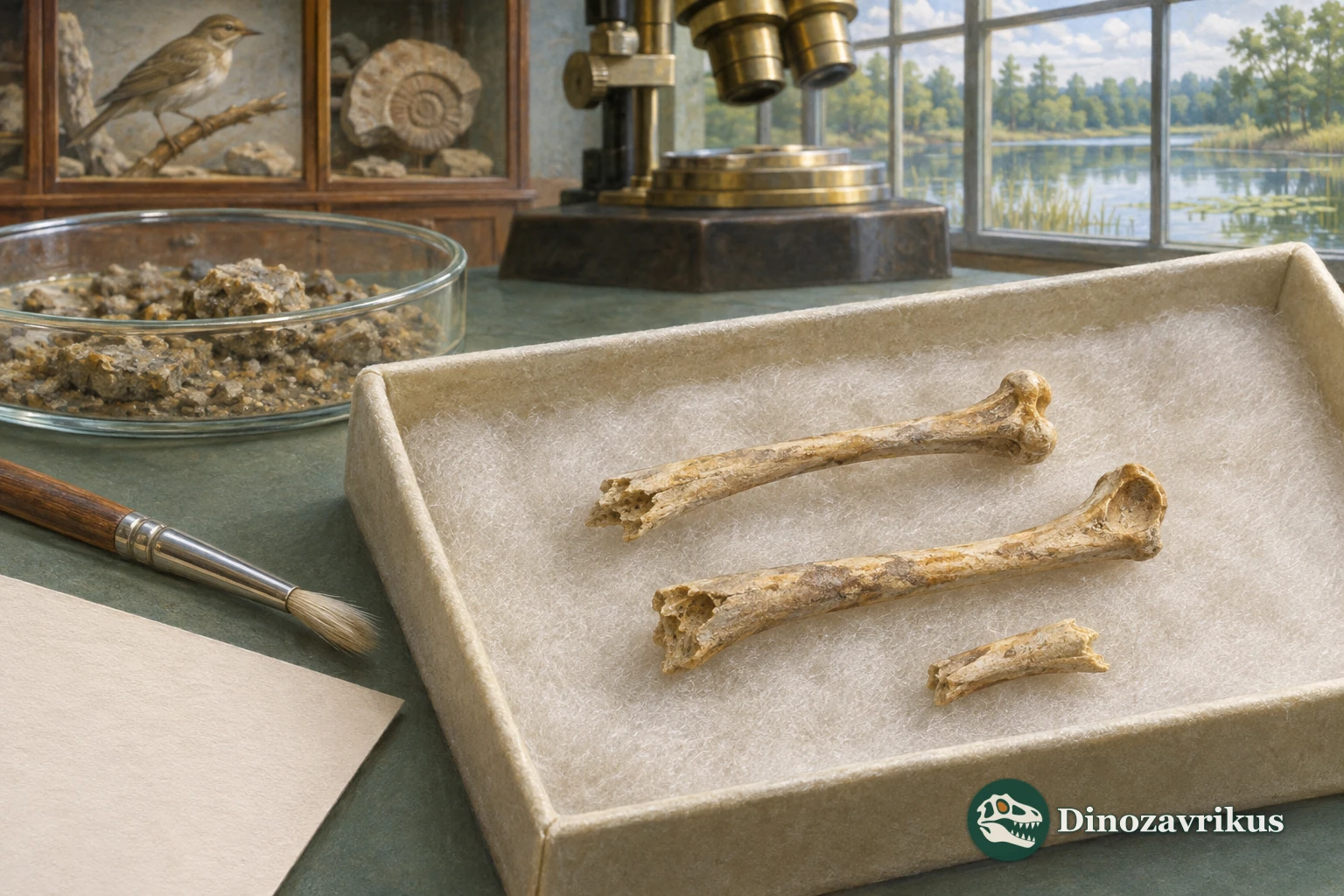
The 1959 description also assigned a right humerus (no. 1664) and a right femur (no. 1694) from the same pit. Brodkorb measured the humerus at 27.1 mm. The three bones are separate finds. Material attributed to the bird has yet to yield a skull or plumage.
What resembles an oropendola?
The stout lower shaft, a transverse bony bridge over a tendon canal and a deep hollow between the joint surfaces are features Brodkorb used to distinguish Cremaster. He found the closest resemblance to the crested oropendola, listed in his paper as Ostinops decumanus. The fossil is smaller in the bones compared and differs in the shape of the ankle.
The genus name alludes to a hanging object, such as a basket. That was a suggestion about behaviour based on the hanging nests of living relatives. No nest, egg or direct record of the diet is known for the fossil bird.
A second Florida locality
Brodkorb interpreted the Arredondo clay as a freshwater marsh deposit with scrub close by. The museum lists the type as Late Pleistocene. Cremaster has also been reported from Haile 11B in the same county, where another extinct New World blackbird, Pandanaris, was present. The known sites do not establish a precise extinction date.
Frequently asked questions
Was Cremaster a type of songbird?
Yes. Its shin led Brodkorb to place it with the New World blackbirds and to compare it closely with oropendolas and caciques.
What is the holotype?
It is the lower end of the left tibiotarsus, UF/PB 1663, held by the Florida Museum of Natural History.
Where did Cremaster live?
Its fossils have been reported from Arredondo and Haile 11B in what is now Alachua County, northern Florida.
Did it weave hanging nests?
That is a suggestion based on living relatives. No preserved nest has been identified as belonging to Cremaster.