

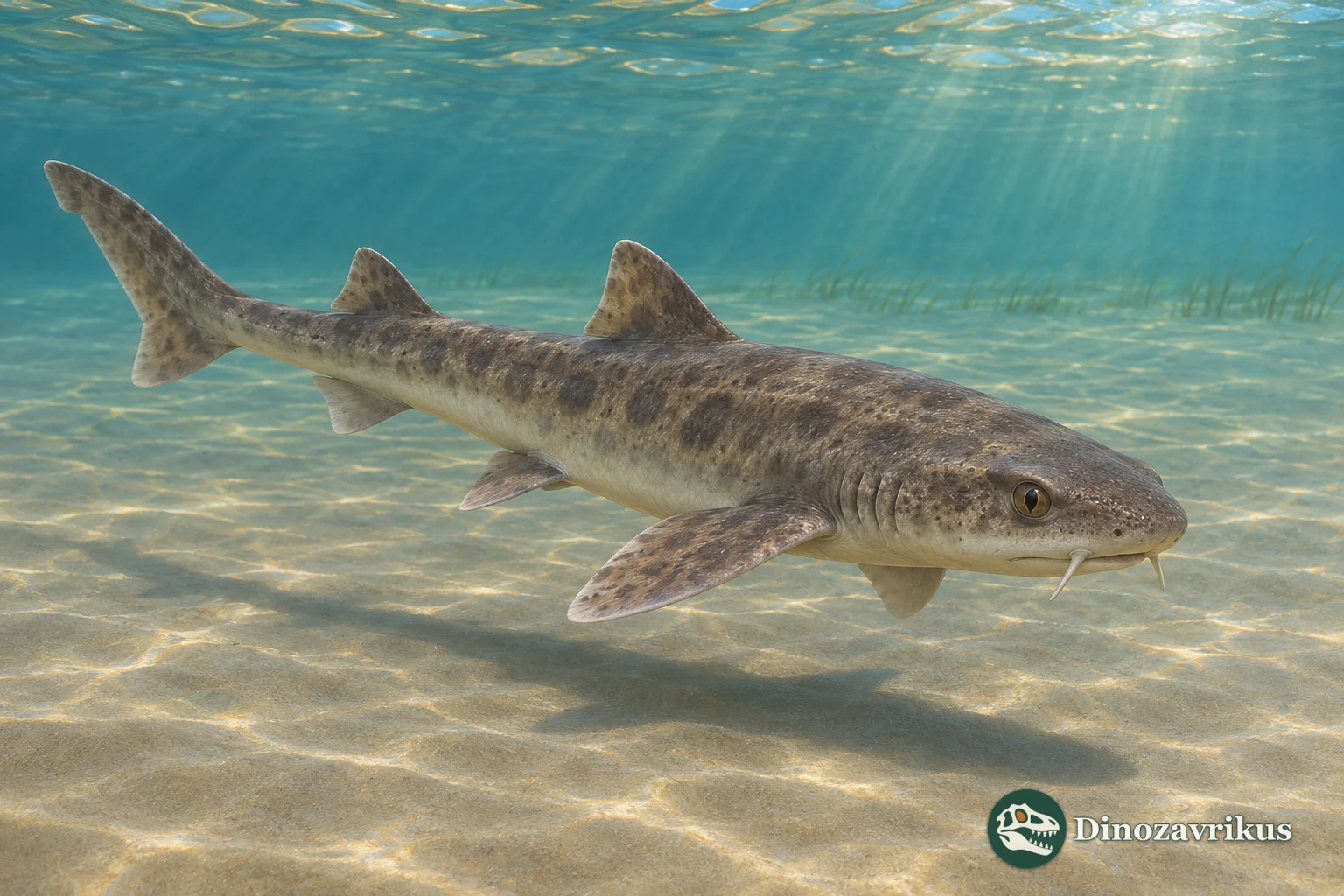
Cretascyliorhinus is an extinct shark genus recognised from small isolated teeth in Cretaceous rocks. Its central cusp, paired side cusplets, enamel folds and expanded root provide characters for comparing specimens. No associated skeleton establishes the animal's overall appearance, length or precise ecology, so any image of the shark must remain an explicitly generic artistic analogy.
Quick facts
| Type species | Cretascyliorhinus destombesi, first described as Scyliorhinus destombesi |
|---|---|
| Genus established | Charles Underwood and Simon Mitchell, 1999 |
| Classification | Carcharhiniformes; precise position among catsharks remains uncertain |
| Known material | Isolated teeth with one pair of lateral cusplets |
| Main localities | Wissant in France and several horizons in eastern England |
| Tooth size | About 0.7–1.3 mm in examples figured from England; body length unknown |
| Reported range | Early Albian to Campanian, with some later referrals tentative |
What can the fossils tell us?
The teeth show a short robust principal cusp, a single pair of lateral cusplets, longitudinal enamel folds and a flared root. They do not show a complete jaw or the body's proportions.
The type species comes from Upper Albian Wissant. British samples include Albian and lower Cenomanian teeth; a wider range to the Campanian depends on specimens referred tentatively as cf. or aff.
The genus is associated with catshark relatives in Carcharhiniformes, but the original revisers could not confidently place it in a living Scyliorhinidae subfamily. Isolated teeth limit the available character set.
A new genus for a previously named species
Henri Cappetta described Scyliorhinus destombesi in 1977 from Upper Albian deposits at Wissant in northern France. In 1999, Charles Underwood and Simon Mitchell compared that species with teeth from Albian and Cenomanian sections in eastern England and erected Cretascyliorhinus. The French species became its type species. The name refers to the genus's common occurrence in Cretaceous rocks.
This was a change in how isolated fossils were classified, not the discovery of a complete shark. Another tooth-based genus, Palaeorhincodon, illustrates the same limit: dental characters can be informative even when the rest of the animal is absent.
A crown with cusplets and enamel folds
Typical teeth have a short, stout central cusp flanked by one well-developed pair of smaller cusplets. Straight longitudinal folds commonly cross the labial face and may divide near the crown base. The crown projects over a compact root whose flared lobes give its basal outline a heart-like shape. The details vary, and small teeth may show weaker ornament.
Underwood and Mitchell reported 36 teeth in their studied material, with preservation ranging from good to poor. Their figured lateral tooth measured about 1.3 mm high and an anterior tooth about 0.7 mm. These are measurements of particular crowns, not a body-length estimate. A tooth from an anterior row may also differ from one farther back in the jaw.
Albian records and a tentative wider range
The type species is based on Upper Albian material from Wissant. The English collection includes teeth from the Speeton Clay and Hunstanton Formation near Speeton and South Ferriby, ranging through Albian horizons and into the lower Lower Cenomanian. These specimens are tied to named beds and formations; their age comes from the stratigraphic context, not from the tooth's shape.
Underwood and Mitchell gave a broader Lower Albian to Campanian range by including teeth previously called Scyliorhinus cf. destombesi and S. aff. destombesi. Those labels mark a comparison or an apparent relationship, not an equally secure identification. The Campanian end of the range should therefore be treated more cautiously than the Albian type material.
A placement that remains incomplete
The crown and root resemble those of catshark relatives, leading researchers to associate the genus with Scyliorhinidae within Carcharhiniformes. The 1999 authors noted that it could not be confidently accommodated in any subfamily of living catsharks and may represent an extinct branch. Later lists may use a family placement, but the fossil material itself still consists of teeth.
No known tooth establishes the animal's total length, fin shape, colour, swimming speed or exact prey. The image in this article is deliberately a generic artistic shark, not a taxon-specific restoration. A complete jaw or associated skeleton would provide evidence that isolated crowns cannot.
Frequently asked questions
When did Cretascyliorhinus live?
The type species is known from Upper Albian deposits. A Lower Albian to Campanian genus range has been proposed by including tentative referrals, so its youngest records are less secure.
What features identify its teeth?
Typical crowns have a short robust main cusp, one pair of lateral cusplets, longitudinal folds and a compact flared root. Wear and breakage can obscure some of these features.
Has a complete skeleton been found?
No associated skeleton is known from the material used to establish the genus. Published descriptions are based on isolated teeth.
How long was the shark?
Its body length is unknown. Some figured teeth measure roughly 0.7–1.3 mm high, but those measurements cannot be converted reliably into total length.