

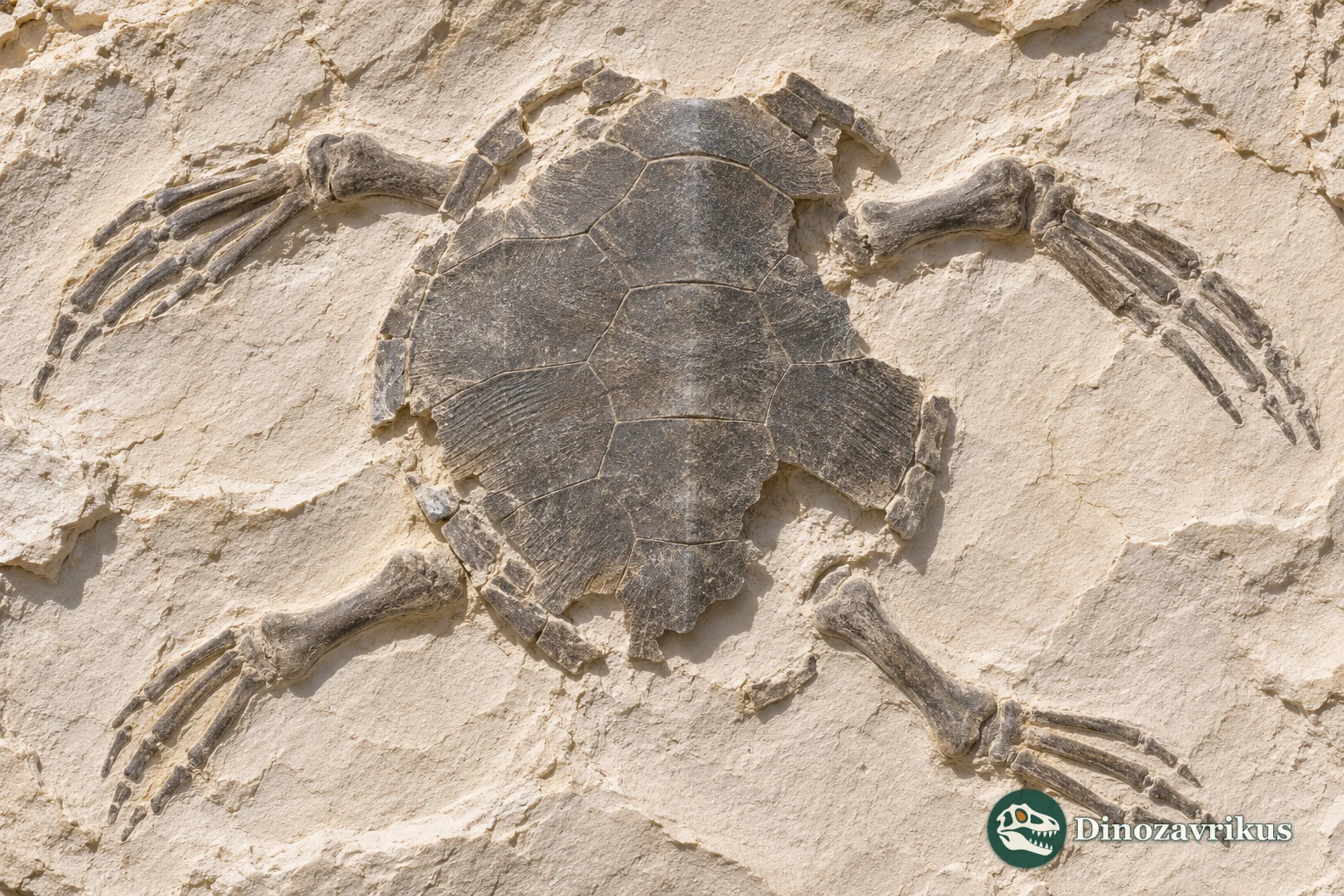
Ctenochelys lived in Late Cretaceous seas. A row of bony crests ran along the centre of its shell, and unusually complete fossils preserve details of the skull and limbs. Comparing juveniles with adults also helped researchers reassess the specimen once used to name Lophochelys.
Quick facts
| Group | Turtles, Ctenochelyidae |
|---|---|
| Age | Late Cretaceous |
| Region | North America: USA. Europe: Germany |
| Type species | Ctenochelys stenoporus |
| Studied skull | RMM 6157, Ctenochelys acris |
| Scientific name | Ctenochelys |
| Diet | No direct evidence |
What can the fossils tell us?
The midline crests incorporate extra ossifications above the shell plates. Fossils preserve those bones, while the overlying soft tissues remain uncertain.
A comparison of younger and older specimens shows that part of the chewing surface expanded during growth. Age therefore matters when comparing skulls.
The type of Lophochelys natatrix is a juvenile from Kansas. A revision treated it as Ctenochelys stenoporus, while other specimens originally called Lophochelys were assigned elsewhere.
A crested turtle with two known species
Oliver Hay named the type species in 1905 as Toxochelys stenoporus. Rainer Zangerl later established Ctenochelys. Its crest combined the carapace bones with separate ossifications that lay above them. The condition also occurs in Peritresius, another member of Ctenochelyidae.
Several specimens from Alabama’s Campanian Mooreville Chalk provided a fuller description of C. acris. The larger skull, RMM 6157, measures 201 millimetres from the front of the snout to the rear of the supraoccipital bone. It is less pointed at the front than the skull of C. stenoporus. The species also differ in the shape of the chewing surfaces and of some rear shell bones.
From Lophochelys to Ctenochelys
George Sternberg collected FMNH PR 220 in January 1949 in the Niobrara Formation of Kansas. The juvenile preserves a plastron, part of the carapace, limb girdle and limb bones, and vertebrae. Zangerl made it the type of Lophochelys natatrix in 1953.
Ren Hirayama reassigned the specimen to C. stenoporus. Subsequent work on Danish material used that interpretation when comparing lower shell bones. Hirayama treated Lophochelys niobrarae as a synonym of Toxochelys latiremis. Reviewing the fossils individually led to different identifications for the two historical names.
Changes with age and the geographical record
An almost complete juvenile C. stenoporus from the Niobrara Formation shows how the skull changed with age. Compared with adults, its chewing surfaces extended less far towards the rear and the midline. Differences around the braincase are consistent with a greater amount of cartilage in the juvenile.
Late Cretaceous material is documented in the United States and has been referred to C. stenoporus in north-western Germany. A partial jaw from Maastricht in the Netherlands resembles the genus, but the available features support only a provisional identification.

Frequently asked questions
What formed the crest on the shell?
Additional small bones sat above the shell plates and contributed to the midline crests.
What became of Lophochelys natatrix?
Its juvenile type specimen was reassigned to Ctenochelys stenoporus. Other fossils once given the genus name have been treated separately.
How does the Alabama species differ?
Ctenochelys acris has a less pointed snout and differences in the chewing surfaces and rear shell bones.
What food did it eat?
The skull gives evidence about the shape of the chewing surfaces. There is no direct evidence of the precise diet.