

Ctenopristis was a sclerorhynchoid ray from Late Cretaceous Morocco. Its narrow, elongated denticles projected from the sides of the rostrum, the flattened extension in front of the mouth. Camille Arambourg pictured these denticles giving the edge of the rostrum the appearance of a comb.
Quick facts
| Family | Sclerorhynchidae |
|---|---|
| Type species | Ctenopristis nougareti |
| Age | Maastrichtian |
| Localities | Moroccan phosphate basins |
| Fossils | Rostral denticles and oral teeth |
| Body length | Undetermined |
What can the fossils tell us?
Arambourg described slender crowns set at about twenty degrees to their bases. The total number of denticles along the rostrum remains unknown.
Samples used in the microstructure study come from Maastrichtian levels labelled C5 and C6.
The layer reached about 80 micrometres at the front cutting edge in one cross-section. Its thickness does not reveal a particular hunting behaviour.
Arambourg’s Moroccan fossils
Camille Arambourg named Ctenopristis nougareti in 1940 using fossils from the Moroccan phosphates. The genus name combines Greek words for a comb and a sea saw. The species honours Nougaret, who worked as a phosphate prospector in Morocco.
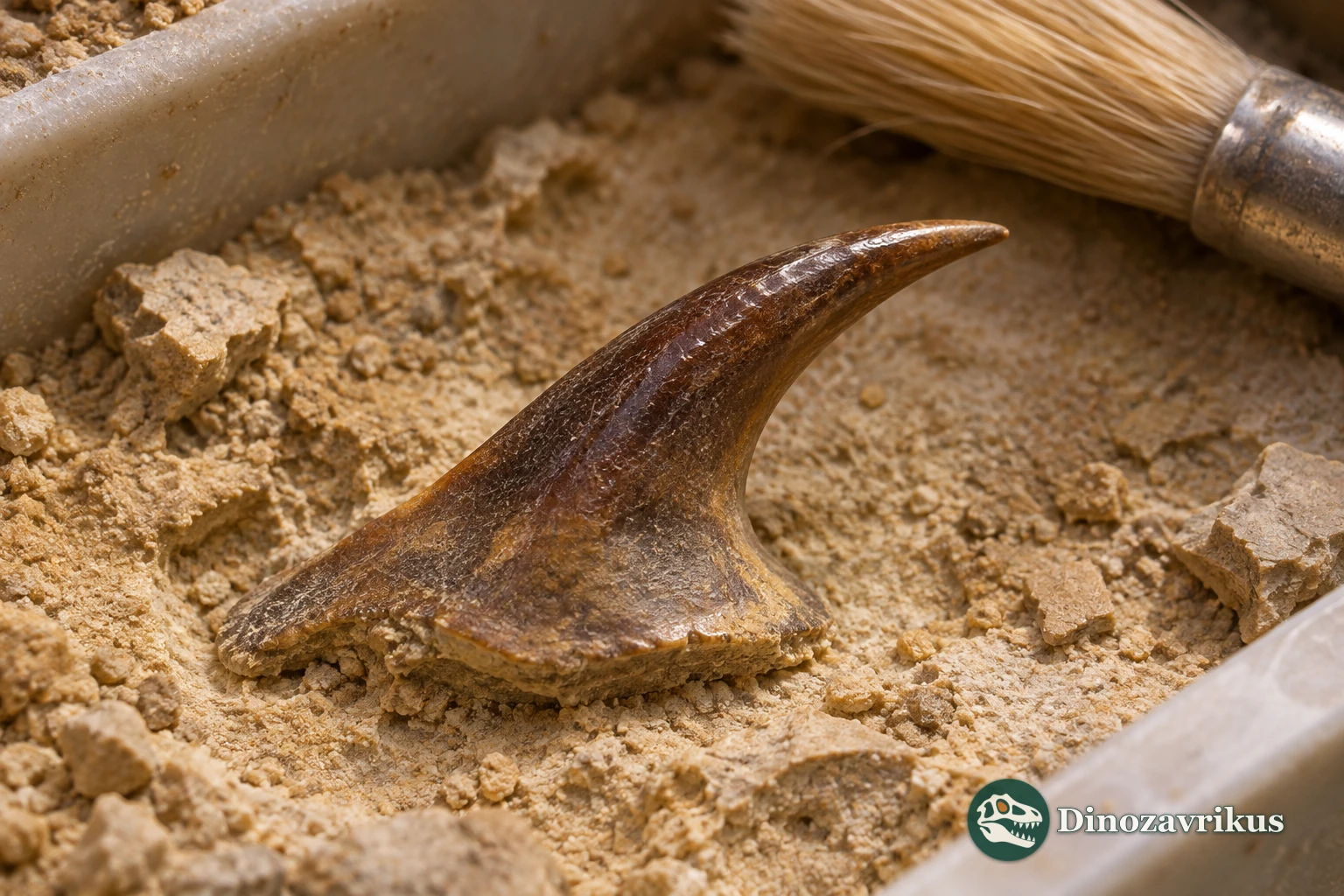
Arambourg estimated that some of the rostral denticles could reach 3–4 cm in length. The crown is about six times as long as it is wide at the base. The compressed, shallow base has a depression underneath with a narrow opening into the pulp canal. That combination of features helped distinguish it from other rays with similarly angled crowns.
A jaw tooth and a rostral denticle
Rostral denticles and oral teeth occupied different parts of the head. The shape of the crown and the attachment at its base help identify a loose denticle. Oral teeth have their own cusp, ridges and cutting edges. Fossils of the related Sclerorhynchus show how denticles could be arranged along a sclerorhynchoid rostrum.
Benguerir in Morocco’s Ganntour Basin preserves loose phosphate beds, marls and hard phosphatic limestone. Recording the layer from which a tooth or denticle came lets researchers compare the occurrence with fossils from other phosphate basins.
A closer look at the cutting edge
In 2026, Endy Chateauneuf-Gautier and Guillaume Guinot examined sections and etched surfaces of teeth and denticles from Benguerir. Their cross-section of denticle BEG.C6-52 showed compact dentine with a thin mineralised coating called enameloid. That coating was about 25–30 micrometres thick in the rear half of the section and reached about 80 micrometres at the front cutting edge.
Some ridges and edges show loosely organised bundles of crystallites. Individual crystallites with no shared orientation also occur on the etched surface. Across the sampled rays, the researchers did not find a clear signal of evolutionary relationships in how these structures were distributed.
Frequently asked questions
Where does the name Ctenopristis come from?
Arambourg named it for the comb-like appearance he inferred from the slender denticles lining the snout.
How did a rostral denticle differ from an oral tooth?
The denticle projected from the edge of the rostrum in front of the mouth. The oral tooth belonged to a row in the jaws.
Where did the sectioned specimens come from?
They came from Maastrichtian phosphate deposits at Benguerir in the Ganntour Basin of Morocco.
How large was Ctenopristis?
Some individual rostral denticles can be measured, but the available material does not establish the length of the ray.