

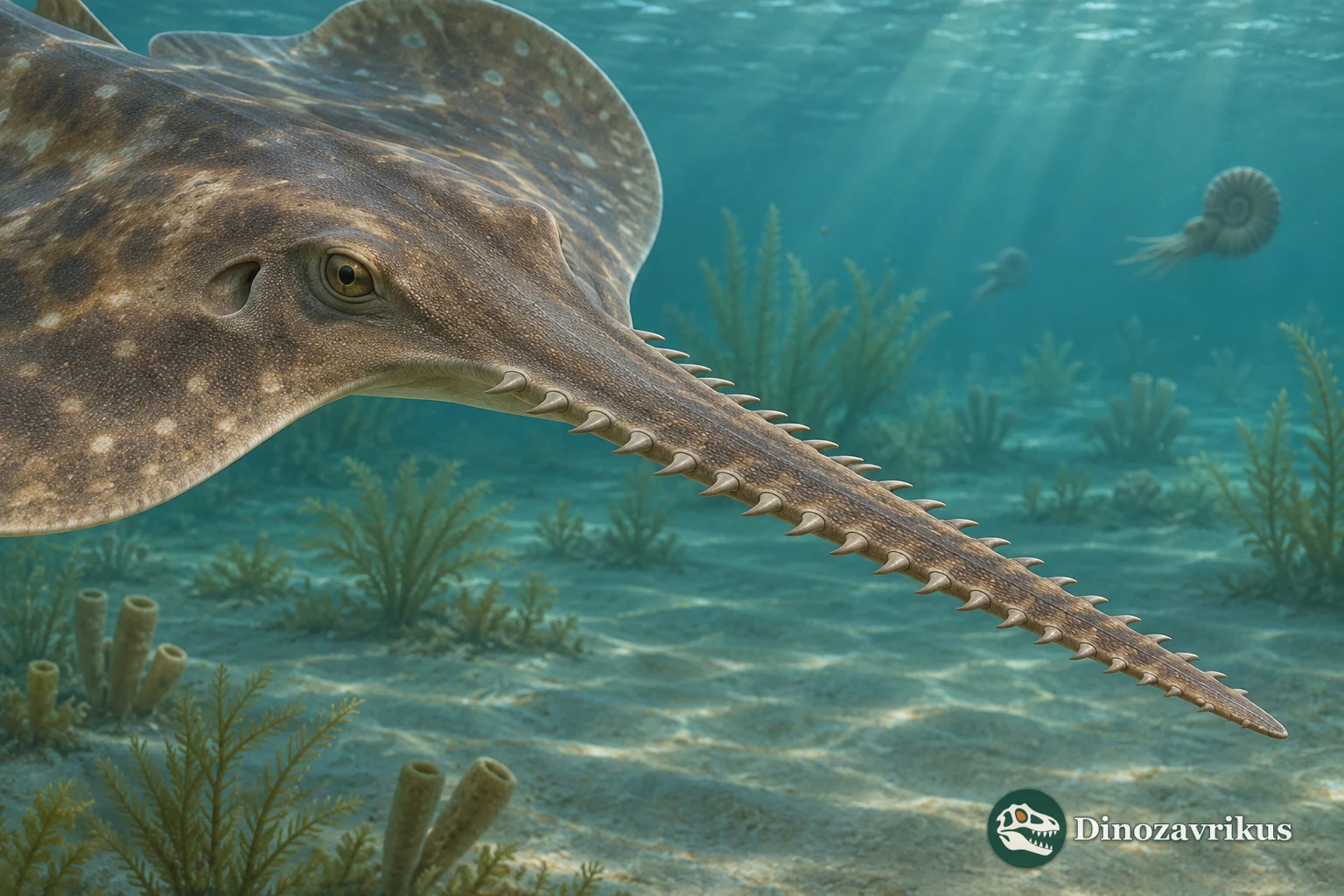
Sclerorhynchus was an extinct ray with an elongated rostrum edged by large tooth-like denticles. Its saw-like outline once made its classification difficult, but a partial head preserves several distinct denticle series and shows that it was a batoid, or ray, rather than a modern sawfish or sawshark.
Quick facts
| Group | Extinct batoid ray in Sclerorhynchoidei, commonly called sawskates |
|---|---|
| Type species | Sclerorhynchus atavus, named by Arthur Smith Woodward in 1889 |
| Known material | Partial head and rostrum with rows of denticles; no complete skeleton |
| Type locality | Sahel Alma, Mount Lebanon; holotype NHMUK PV P 4776 |
| Age | Upper Cretaceous for the type material |
| Total length | Unknown; the holotype preserves only part of the head |
| Rostrum function | Not established directly by the fossil |
What can the fossils tell us?
NHMUK PV P 4776 is an imperfect rostrum from Upper Cretaceous Mount Lebanon. Later work described rostral and lateral head denticles, but the specimen does not supply the ray’s total length or complete silhouette.
The type and referred material show large denticles along the rostral margins and modified denticles on the sides of the head. These are not the ordinary teeth inside the jaws.
Sclerorhynchus is placed among extinct batoid rays called sawskates. Similarities with sawfish and sawsharks reveal convergent features, not direct ancestry.
A puzzling fossil from Mount Lebanon
Arthur Smith Woodward named Sclerorhynchus atavus in 1889 from an imperfect rostrum found in Upper Cretaceous rocks of Mount Lebanon. The holotype, NHMUK PV P 4776, is associated with the fossil locality of Sahel Alma. The specimen entered the literature as a saw-bearing cartilaginous fish, but the fragment did not preserve enough of the animal to settle its relationships.
Woodward noted resemblances to both sawfish and sawsharks and provisionally placed the fossil near living sawfish. That early classification reflects the evidence then available: an unusual rostrum and incomplete anatomy. A later description of the partial head showed that the fossil carried more than one kind of tooth-like dermal structure, providing characters that could be compared directly with different living groups.
The rostrum and its denticles
The long front extension of the head is called a rostrum. In Sclerorhynchus, prominent denticles lined its lateral margins. Additional, modified denticles occurred along the sides of the head. The combination is important: it shows a field of related but distinct skin structures, not simply a row of teeth inserted into the mouth.
Underwood, Smith and Johanson examined the type head and described how the larger rostral denticles appear to rotate into position as they develop. Later CT-based work traced rostral, ventral and lateral cephalic denticle series in the type and referred material. These studies document anatomy and development; they do not show a particular feeding strike or prove how the living animal used its rostrum.
Sawskate, sawfish or sawshark?
The shared saw-like outline is not enough to make Sclerorhynchus a sawfish or a sawshark. Modern sawfish are batoid rays whose rostral teeth sit in deep sockets. Sawsharks belong to a different shark lineage. In the Sclerorhynchus type, the large denticles lie along the rostral margins, and the head also has modified denticles along its sides.
Researchers treat Sclerorhynchus as a fossil batoid within the extinct group Sclerorhynchoidei, often called sawskates. Similar rostra and denticles evolved in more than one cartilaginous fish lineage. This is a case of convergent anatomy: a comparable structure does not demonstrate that one group descended directly from another. Other ancient saw-bearing rays, including Schizorhiza and Onchopristis, preserve their own distinct patterns of evidence.
A name for the group has also changed
Family-level names for sawskates have not been stable. Many publications use Sclerorhynchidae, the name formed from Sclerorhynchus. A 2021 nomenclatural paper argued that Ganopristidae has priority if the type genera Ganopristis and Sclerorhynchus are treated as synonyms. That conclusion concerns the rules for naming a family-level group; it does not change the anatomy of the fossil or make the genus itself disappear.
The wider sawskate record includes several genera and species, and assignments have been revised as rostra and denticles are found in better association. For an individual specimen, the shape and position of its denticles matter more than a familiar common name. A ray such as Brachyrhizodus, known chiefly from oral dental remains, offers a useful contrast with the rostrum-based evidence of sawskates.
Age, habitat and what the fossil cannot show
The type material comes from Upper Cretaceous marine deposits in Lebanon. The age and locality describe the rock and specimen, but a partial head does not reveal the animal’s exact depth, swimming route or ecological role. Other named species assigned to the genus come from separate Cretaceous localities, so the broad range of genus-level records should not be mistaken for one continuous population.
No complete skeleton establishes the total length or body proportions of Sclerorhynchus atavus. A rostrum might have contacted prey or the seafloor, but those are possible functions rather than direct observations. The fossil supports claims about the rostrum, denticles and head anatomy. Colour, soft tissue, swimming style, diet and behaviour remain unknown.
Frequently asked questions
Was Sclerorhynchus a shark?
No. It was a batoid ray in the extinct sawskate group. Its long saw-like rostrum resembles structures in both sawfish and sawsharks, but those similarities do not make the groups identical.
Were the rostral denticles ordinary teeth?
They are interpreted as enlarged dermal denticles along the rostrum, distinct from the teeth inside the jaws. The preserved head shows their positions, not a specific hunting behaviour.
Is a complete skeleton known?
No complete skeleton of the type species is known. Its holotype preserves an incomplete rostrum and partial head, so total body length and full proportions remain uncertain.
Was Sclerorhynchus a direct ancestor of modern sawfish?
There is no evidence for that. Similar saw-like structures developed independently among different cartilaginous fishes, and modern studies classify Sclerorhynchus with extinct rays rather than living sawfish.