

Brachyrhizodus was a Late Cretaceous ray described from dental remains. Its broad, closely set tooth elements could form a crushing surface, but no complete skeleton reveals the animal’s body proportions. The genus also has an unusual history: its name-bearing specimen was first described as Permian, then interpreted as a Cretaceous fossil reworked into older rock.
Quick facts
| Group | Extinct eagle ray (Myliobatidae); its proposed position near mobulid rays has been disputed |
|---|---|
| Type species | Brachyrhizodus wichitaensis Romer, 1942 |
| Main evidence | Isolated teeth and elements of dental plates |
| Age | Late Cretaceous records, chiefly Campanian and Maastrichtian |
| Geography | North America, including Texas and eastern coastal states |
| Body length | Unknown; isolated teeth do not provide a reliable total-length estimate |
| Possible feeding | A crushing surface is plausible; specific prey are not established |
What can the fossils tell us?
Harvard’s Museum of Comparative Zoology catalogues MCZ VP VPF-7197 as the holotype of Brachyrhizodus wichitaensis. Romer described it in 1942 from material regarded as Permian. Later authors interpreted the tooth as Cretaceous and reworked into older deposits.
Fossils include isolated teeth and parts of dental plates. Crown and root form can be compared with other rays, but detached elements rarely preserve their exact position in the mouth or the outline of the complete jaw.
Claeson and colleagues placed Brachyrhizodus as a stem mobuline, sister to Mobula plus Manta. A 2012 study of devilray evolution challenged that interpretation after comparing published figures and additional specimens. Neither hypothesis makes the genus a proven direct ancestor.
A name first linked to Permian rocks
Alfred S. Romer named Brachyrhizodus wichitaensis in 1942. The description connected the specimen with Permian deposits in Texas and treated it as part of an ancient group of crushing-toothed fishes. The species remains the type species, which anchors the scientific use of the genus name. Harvard’s Museum of Comparative Zoology records the name-bearing specimen as MCZ VP VPF-7197.
The rock that encloses a fossil does not always date the animal that produced it. A tooth can be eroded from a younger layer, transported, and deposited again in older sediment. Later work treated the type material of Brachyrhizodus as a Cretaceous ray fossil that had been reworked into Permian strata. That interpretation removed the apparent Paleozoic record and changed the genus from an alleged ancient fish into a late-surviving member of a much younger ray fauna.
What the dental remains preserve
The available material consists chiefly of separate teeth and pieces of dental plates. In many rays, adjacent teeth form a pavement that spreads bite forces across a broad surface. The teeth assigned to Brachyrhizodus have thick crowns and substantial roots, features consistent with a durable contact surface. Their shape can be compared with other fossil and living rays, even when the jaw itself is absent.
Researchers examine crown outline, surface texture, root lobes and the way neighbouring elements could have fitted together. These characters can help distinguish taxa and can be coded in evolutionary analyses. They do not preserve the whole skull, however, and a loose tooth may not reveal whether it came from the front, middle or back of the tooth row. A dental plate fragment carries more positional information than an isolated element, but still falls short of a complete mouth.
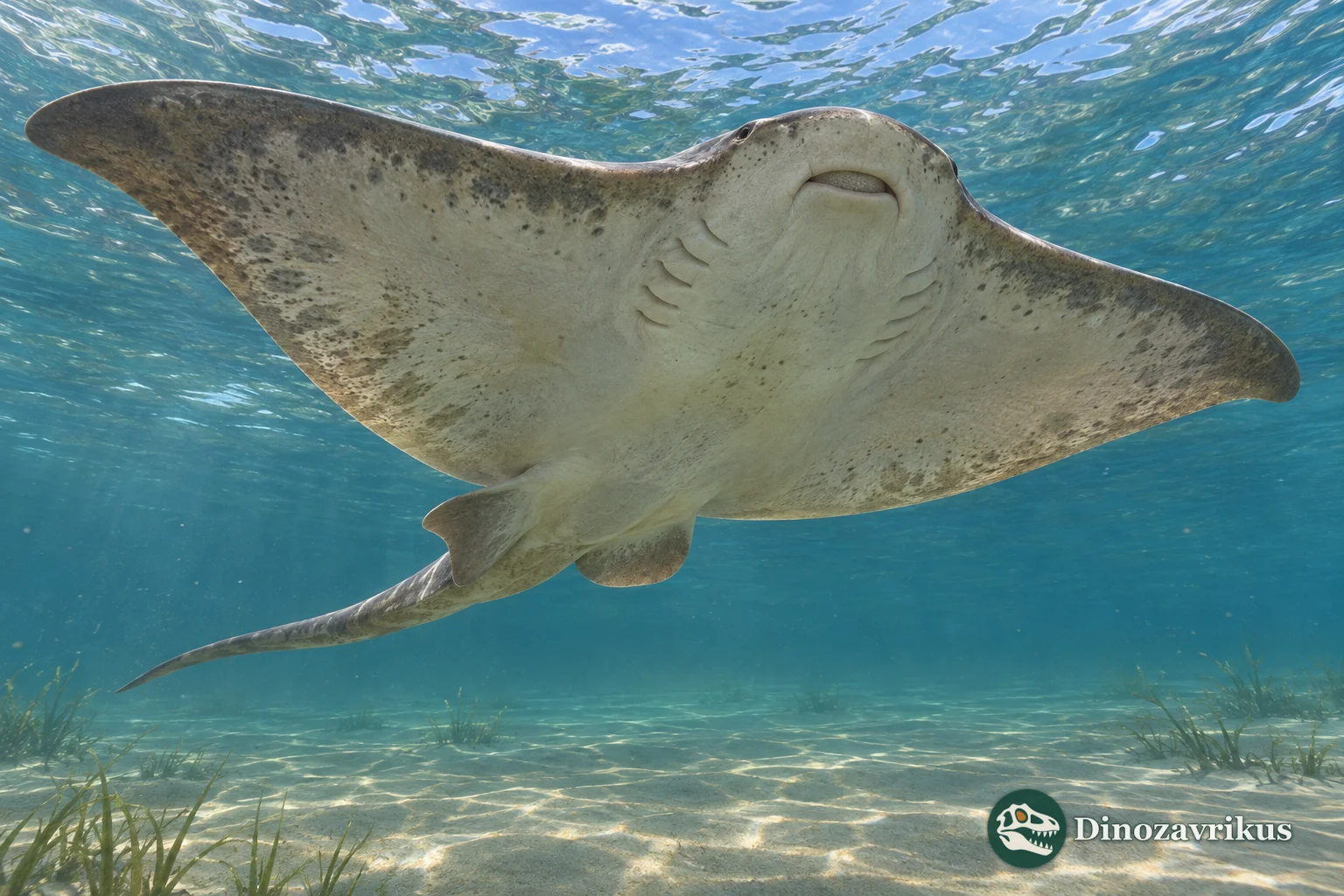
The illustration below is a visual reconstruction, not a drawing of a catalogued specimen. A better-preserved ray such as Schizorhiza shows how associated structures can preserve their arrangement. By contrast, the teeth of the shark Crassescyliorhinus document another kind of feeding apparatus. These comparisons frame the evidence without supplying missing details of Brachyrhizodus itself.
Late Cretaceous records and proposed relationships
Reports assign Brachyrhizodus teeth to Campanian and Maastrichtian deposits in North America, including localities in Texas and along the eastern side of the continent. These are records from separate sites and horizons, not proof that one population occupied a continuous range. Many occurrences consist of detached dental material, so the strength of an identification depends on the characters visible on each specimen and on its geological context.
A phylogenetic study by Claeson and colleagues in 2010 analysed dental and other available characters to test relationships within eagle rays. Their preferred tree placed Brachyrhizodus as a stem mobuline, sister to the clade containing Mobula and Manta. A 2012 study of devilray evolution disputed that placement after examining published figures and additional specimens. This disagreement is a reminder that the result depends on the characters and specimens included in an analysis. Neither tree makes Brachyrhizodus a proven direct ancestor of any living ray.
Diet, body size and what remains unknown
A pavement of robust teeth is compatible with crushing or grinding food. That interpretation is based on dental form and comparison with animals whose feeding is better observed. No stomach contents or prey remains have been reported in direct association with Brachyrhizodus, so a menu of named molluscs or crustaceans would go beyond the evidence. Nor does a tooth surface establish filter feeding, a behaviour associated with some living mobulids.
The animal’s total length is not known. The dimensions of an isolated tooth cannot be converted into body length without a validated relationship between tooth position, tooth size and the body of this genus. The disk outline, fin proportions, skin pattern, colour and swimming style are also uncertain. An artistic image can make a fossil animal easier to imagine, but the defensible reconstruction must distinguish the preserved dental evidence from the unpreserved body.
Frequently asked questions
Did Brachyrhizodus really live in the Permian?
The name-bearing tooth was first described from rocks considered Permian. Later work interpreted it as a younger, Cretaceous fossil that had been reworked into older deposits.
Was it a direct ancestor of manta rays?
No direct ancestry has been demonstrated. A phylogenetic analysis placed it near the stem of mobulid rays, which describes a proposed relationship rather than a direct ancestor-descendant link.
What did Brachyrhizodus eat?
Its dental pavement may have crushed food, but no associated stomach contents or prey identify a particular diet.
How long was the animal?
Its total length is unknown. Isolated teeth cannot provide a dependable body-length estimate for this genus.