

Crassescyliorhinus is an extinct catshark genus established for unusually robust teeth. Its fossil record consists mainly of isolated crowns and roots rather than complete skeletons. The teeth reveal differences between jaw positions and support comparisons with other sharks, but do not securely establish body length, colour or an exact menu.
Quick facts
| Type species | Crassescyliorhinus germanicus, first described as Scyliorhinus germanicus |
|---|---|
| Genus established | Charles Underwood and David Ward, 2008 |
| Classification | Carcharhiniformes, Scyliorhinidae |
| Main evidence | Isolated teeth from Cretaceous and younger deposits |
| Tooth size | Some C. germanicus teeth reach about 3 mm in width |
| Body length | Unknown |
| Diet | A tougher-food specialization has been proposed, not demonstrated |
What can the fossils tell us?
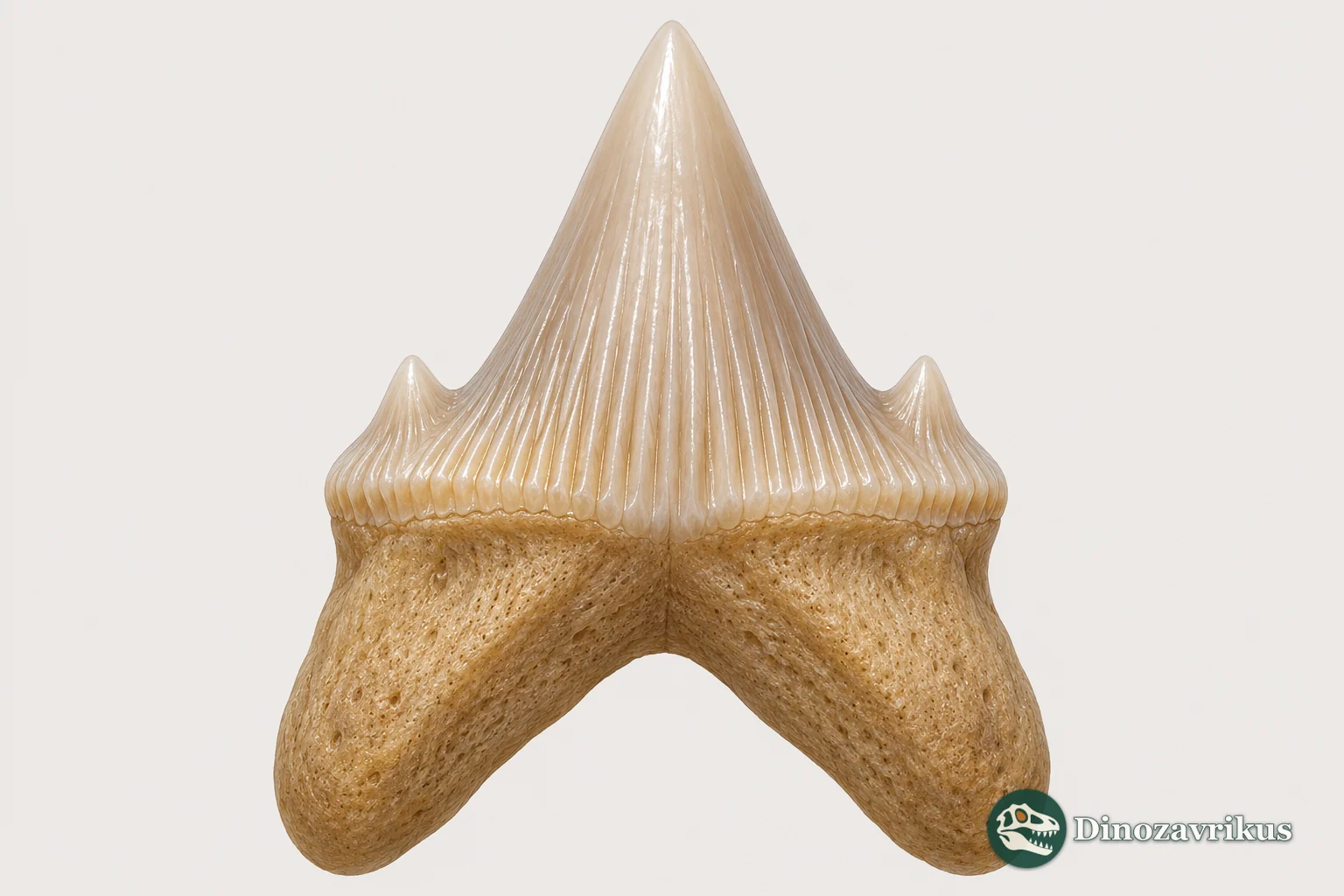
The teeth have a robust conical main cusp, lateral cusplets and strong folds. Anterior teeth differ from lateral and posterior teeth, revealing variation along the same jaw.
Viewed from below, the root is bulky and V-shaped, with flared lobes. An open nutritive groove is absent from most described teeth; wear and preservation affect visible detail.
The type species is known from Maastrichtian strata in Germany. Hundreds of teeth were reported from British Upper Cretaceous phosphatic beds, with Danish early Paleocene material and later genus-level reports from Egypt.
From an older species name to a new genus
In 1982, Claude Herman described Scyliorhinus germanicus from Maastrichtian deposits in northern Germany. Charles Underwood and David Ward compared it with other Late Cretaceous catsharks in 2008 and concluded that its unusually powerful teeth warranted a separate genus. The new combination became Crassescyliorhinus germanicus. The genus name refers to the thick, heavy form of the teeth.
The type species anchors the use of the genus name. Its original material came from the Maastrichtian of Germany. Later researchers reported similar teeth from other layers and regions, but every such sample needs to be assessed against diagnostic features: general stoutness alone does not prove that a tooth belongs to the same species.
Underwood and Ward also proposed transferring Scyliorhinus musteliformis to Crassescyliorhinus, based on dental similarities and a difference in crown height. This is a taxonomic proposal, not a separate skeleton or a directly observed relationship between living animals.
What the teeth show
Teeth of C. germanicus have a massive main cusp, flanked by one or more pairs of short lateral cusplets. Unworn crowns carry strong folds that may form a reticulate pattern near the base. The root is broad, bilobed and V-shaped in basal view; most described teeth lack an open nutritive groove.
The tooth row was not uniform. Anterior teeth are taller, with a more elongated main cusp; lateral and posterior teeth are shorter, and the main cusp can lean towards the corner of the mouth. This variation within one jaw is called heterodonty. The shape of a single tooth therefore depends on both species and position. Breakage and wear can hide the root or crown details used in comparison.
Underwood and Ward studied hundreds of teeth assigned to C. germanicus from British Upper Cretaceous phosphatic beds. The larger sample allowed them to describe variation and jaw positions better than a single specimen would. Yet hundreds of loose teeth do not mean that hundreds of complete sharks were found: the teeth may come from many individuals and accumulate separately.
Geography and age limits
The type material of C. germanicus is Maastrichtian and comes from northern Germany. Teeth of the genus have also been described from Upper Santonian, Campanian and Maastrichtian phosphatic beds in Britain. A study of shark fossils from Stevns Klint in Denmark recorded the type species in both Cretaceous chalk and the early Paleocene layer immediately above the Cretaceous–Palaeogene boundary.
These records broaden the European range beyond the original type locality. Eocene deposits in Egypt have also yielded teeth identified at genus level. That does not necessarily extend the range of C. germanicus: younger teeth can resemble older forms, and their preservation may not support a species-level identification. The later record should be treated separately rather than as proof that one unchanged population persisted across the entire interval.
Phosphatic localities often preserve many detached teeth. They are useful for documenting marine assemblages and comparing fine details, but may combine animals and horizons. Provenance and diagnostic characters matter more than the mere fact that teeth occur together in a collection.
Feeding and the limits of reconstruction
The massive crowns and roots led researchers studying the Danish assemblage to suggest a specialization for tougher food. This is a functional interpretation of tooth form, not the result of stomach-content analysis. No directly associated prey remains establish a specific menu, so particular molluscs, crustaceans or other prey should not be stated as fact.
An isolated tooth width cannot provide total body length by itself. Equations based on living sharks depend on the comparison species and tooth position, and no robust model for the whole length of Crassescyliorhinus is established. Fin proportions, skin pattern and colour are also unknown.
The cover image is a generalized catshark-like animal, not a species portrait. It provides a visual reference to the broader family, while the fossil evidence remains restricted mainly to teeth. Another tooth-known shark, Restesia, has very small crowns and a different diagnostic pattern. Comparing it with Palaeorhincodon shows how fossil shark profiles can describe dental anatomy without turning a broad outline into an exact reconstruction.
Frequently asked questions
Why was Crassescyliorhinus separated from Scyliorhinus?
The 2008 revision emphasized a combination of very robust teeth, a large conical main cusp, short lateral cusplets and a heavy V-shaped root.
Is a complete skeleton known?
The described record is based mainly on isolated teeth. A complete skeleton or associated jaws establishing the full body and dental arrangement has not been reported.
How large was the shark?
Its total length is unknown. Some teeth of C. germanicus reach about 3 millimetres in width, which cannot be reliably converted into shark length.
What did it eat?
Robust teeth prompted a suggestion that it could process tougher food, but no direct food remains establish a particular diet.