

Restesia is a genus of extinct carpet-shark relatives known only from tiny isolated teeth. Its type species was first described under another genus name, and two later studies added further species from different Late Cretaceous deposits in the United States. Tooth anatomy can distinguish some forms, but no jaw or skeleton establishes the shark's body shape, total length or exact diet.
Quick facts
| Type species | Restesia americana (Estes, 1964), first named Squatirhina americana |
|---|---|
| Genus established | Todd Cook, Michael Newbrey, Donald Brinkman and James Kirkland, 2014 |
| Classification | Orectolobiformes, Orectolobidae |
| Type locality | Lance Formation, Wyoming, USA |
| Known material | Small isolated teeth, up to about 2 mm |
| Named species | R. americana, R. monocuspilatus and R. corricki |
| Known interval | Early Campanian to Maastrichtian |
| Body size and diet | Not established by the known teeth |
What can the fossils tell us?
The teeth show a central cusp, sloping shoulders, a crown apron and a heart-shaped root outline. They do not establish body length, a complete jaw or a precise diet.
R. americana has rounded, non-cusped shoulders; R. monocuspilatus has one lateral cusplet on one side; R. corricki usually has two on one shoulder and may have three. These compare crowns, not complete jaws.
Restesia teeth occur in the Lance and Hell Creek formations and at the lower Campanian Lowerverse site in Texas. The deposits include fluvial or freshwater and brackish intertidal settings, which do not by themselves prove a fixed salinity tolerance.
A species described under another genus
Richard Estes described Squatirhina americana in 1964 from the Lance Formation of Wyoming. Later comparisons showed that its tooth-character combination did not fit Squatirhina. Todd Cook, Michael Newbrey, Donald Brinkman and James Kirkland established Restesia in 2014 for those fossils. They named the genus in honour of Estes, the author of the original species description.
The type species is the already named R. americana. Its type locality is UC locality V-5620 in the Maastrichtian Lance Formation. Later teeth assigned to the same species from Montana helped document variation and compare it with teeth from related genera. The fossils are isolated finds, not pieces of one articulated skeleton.
What a tooth can reveal
The 2014 description records a central cusp with oblique, rounded shoulders, an apron near the base of the crown and a heart-shaped outline on the root's basal face. Anterior teeth are more symmetrical and have a taller, needle-like central cusp. Lateral teeth are shorter, more asymmetrical and have a wider apron. A 2020 revision gives a maximum crown length of roughly 2 mm for the genus.
At this scale, a broken or worn tooth can lose important features. The 2014 study compared many such fossils from the Hell Creek Formation and Bug Creek Anthills. Other tooth-only sharks, including Palaeorhincodon, show why crown details are useful for taxonomy while remaining poor evidence for a whole-body portrait.
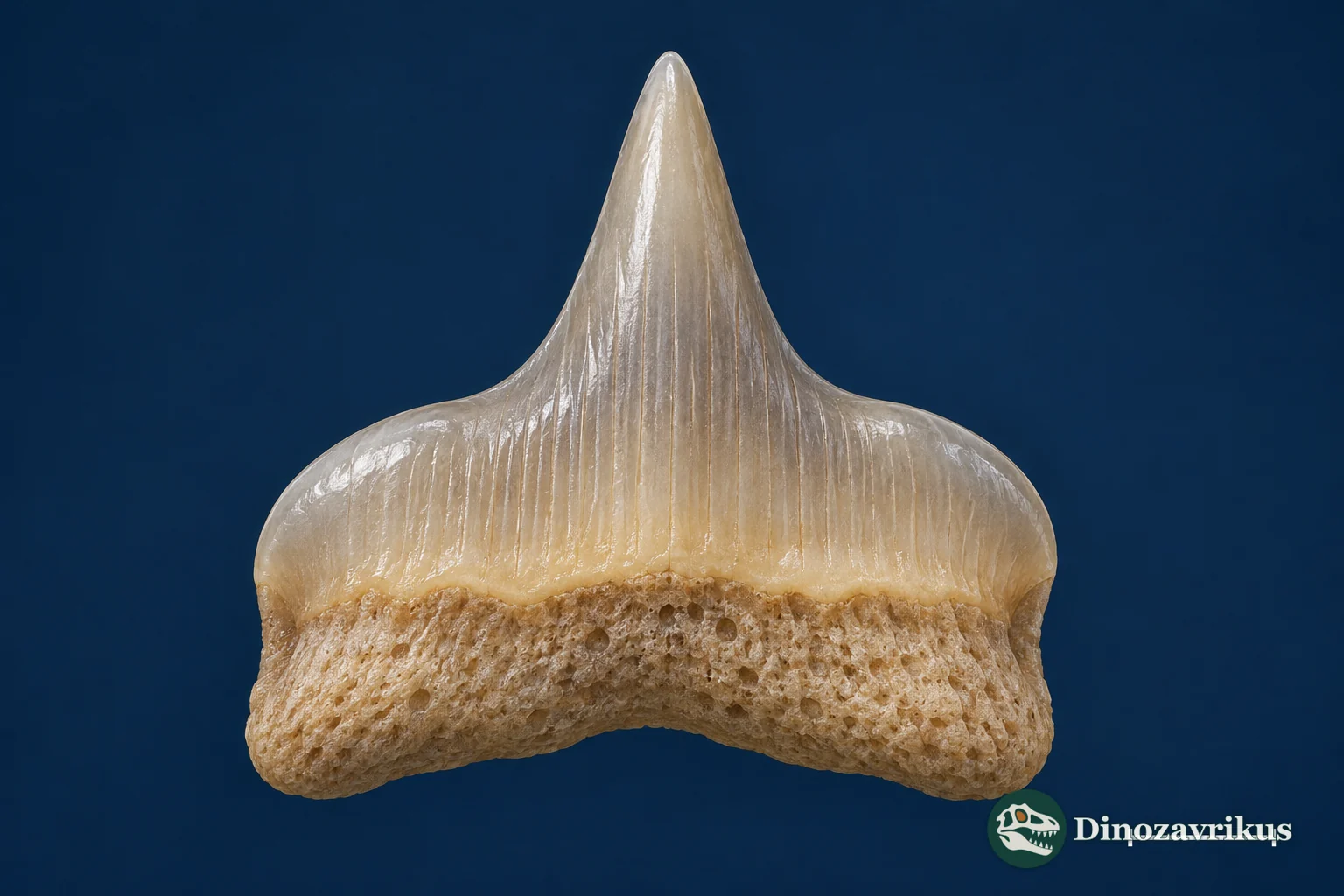
Three species, distinguished by small differences
Cook and colleagues recognised one species in 2014. In 2020, Bradley Wynd, David DeMar and Gregory Wilson described R. monocuspilatus from upper Hell Creek beds in Montana. Its crown has a single lateral cusplet on one side of the central cusp. In the type species, the central cusp is bordered instead by rounded shoulders without such a cusplet.
Steven Wick and Thomas Lehman named R. corricki in 2025 from the lower Campanian Aguja Formation in West Texas. It has a more erect central cusp and cusplets along one shoulder, usually two and sometimes as many as three. These differences distinguish described tooth morphologies; they do not demonstrate that researchers have found the full tooth rows or skeletons of all three species.
From Campanian Texas to Maastrichtian Wyoming
The type locality of R. americana is in Wyoming, and later examples of the species were reported from the lower and upper Hell Creek Formation and Bug Creek Anthills in Montana. R. monocuspilatus is also from the upper Hell Creek Formation. The 2025 species R. corricki comes from the lower Campanian Lowerverse microfossil site in the Abajo Shale Member of the Aguja Formation, Texas.
Together these published occurrences place the genus from the early Campanian through the Maastrichtian. That is a genus-level interval; it does not mean every species lived through the entire span. Hell Creek samples represent freshwater and river deposits, whereas Lowerverse was interpreted as a brackish intertidal setting. The depositional environment describes where the teeth were buried, not a complete account of each shark's movements or salinity tolerance.
A classification based on teeth
Researchers place Restesia in Orectolobiformes and Orectolobidae using tooth morphology. The fossils currently do not include a secure skull, jaw or postcranial skeleton that could test the placement with a broad set of anatomical characters. The family assignment is therefore a taxonomic interpretation based chiefly on the evidence that is actually preserved.
No tooth measurement can be converted into a reliable body length without a well-supported comparison. The fossils do not establish colour, fin shape, swimming speed, social behaviour or prey. A cover image can make the article more vivid, but it must be read as an explicitly generic artistic impression rather than a portrait of the named genus.
Frequently asked questions
How many Restesia species have been named?
Three species had been named by 2025: Restesia americana, R. monocuspilatus and R. corricki. Their crowns differ in cusp and shoulder morphology.
Where was the type species found?
R. americana was first described from the Lance Formation of Wyoming. Later teeth assigned to the species come from the Hell Creek Formation and Bug Creek Anthills in Montana.
How large was Restesia?
Its body length is unknown. The teeth are tiny, with the 2020 revision giving a maximum crown length of roughly 2 mm; that measurement cannot be scaled directly into the shark's length.
Do freshwater fossils prove it was a freshwater shark?
No. Some teeth came from freshwater or fluvial deposits and others from a brackish intertidal setting. Those deposits record where fossils were buried, not the full salinity range of the living animals.