

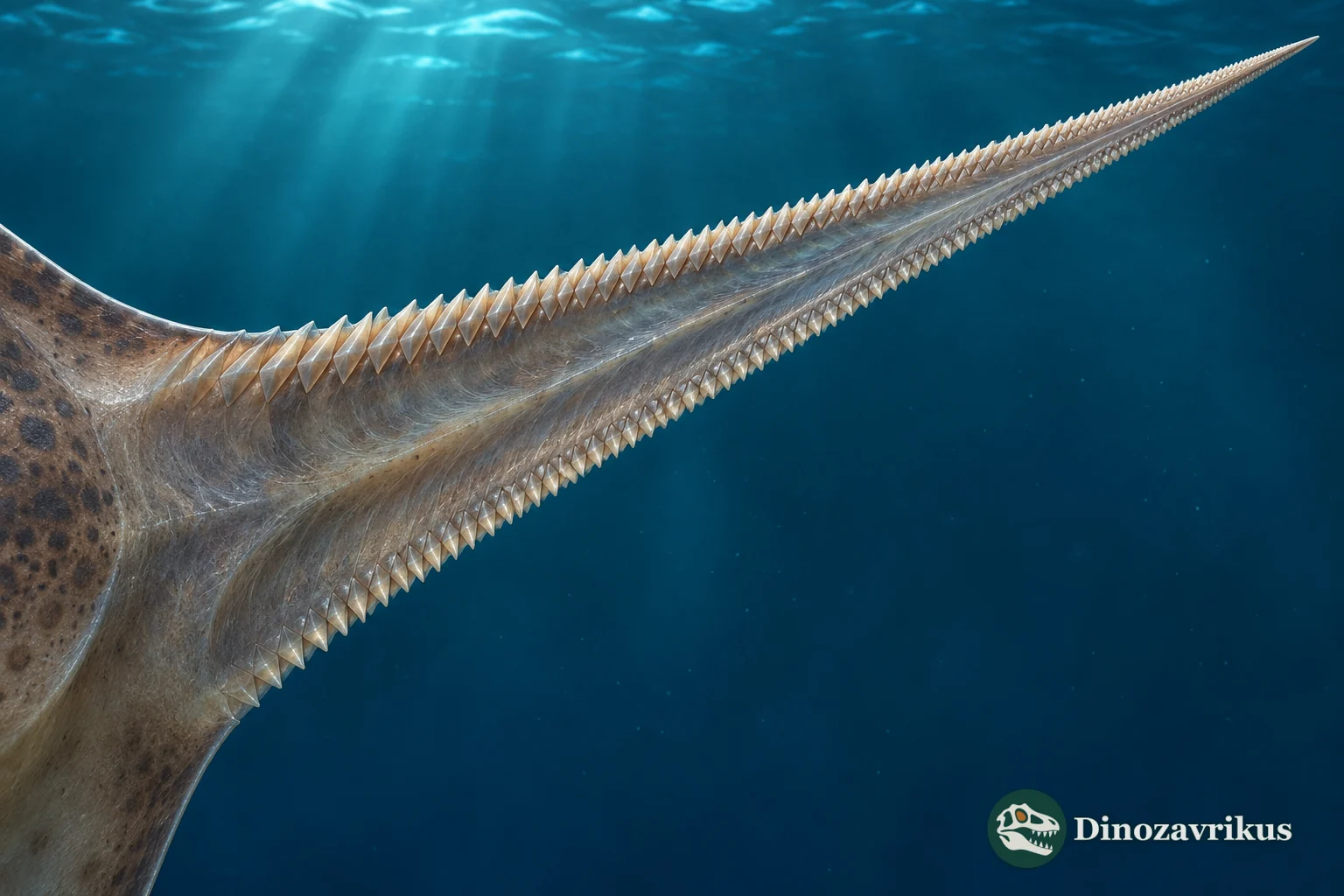
Schizorhiza was a Late Cretaceous ray with a long rostrum bearing large teeth along its sides. Some fossils preserve this unusual structure almost completely, but no complete skeleton establishes the animal’s body proportions. The rostrum is direct evidence; the full swimming animal remains an informed reconstruction.
Quick facts
| Group | Extinct saw-bearing rays, Sclerorhynchoidei |
|---|---|
| Known material | Rostra, rostral teeth and a few associated elements |
| Age | Late Cretaceous; Campanian and Maastrichtian records |
| Geography | North Africa, the Middle East and the Americas |
| Measured rostrum | One Mexican specimen exceeds 50 cm |
| Total body length | Unknown |
| Possible prey | Fish have been proposed from rostrum form; direct evidence is lacking |
What can the fossils tell us?
Described specimens include fragments and near-complete rostra with lateral tooth rows. Some exceed half a metre, but this measurement cannot be converted into total body length without a reliable proportional model.
Articulated fossils preserve tightly arranged teeth and their roots. CT scans and thin sections show ordered growth and rotation of tooth elements; this documents development, not a particular hunting act.
The genus is assigned to Sclerorhynchoidei. Family-level proposals differ, and the absence of a complete cranium limits tests of those relationships.
The name and the changing fossil record
Ernst Weiler introduced the genus Schizorhiza in 1930. Early North African fossils were mainly isolated rostral teeth, detached from the structure that gave them their position. Later finds preserved teeth in place and allowed researchers to study their shape and arrangement as a connected system.
In 2002, James Kirkland and Martha Carolina Aguillón-Martínez described material from the Difunta Group in the Mexican state of Coahuila. Their paper discussed a large rostrum from the Cerro del Pueblo Formation and its late Campanian setting. One reported specimen preserves more than 50 centimetres of rostrum. That is a measurement of the surviving front of the head, not an estimate of the ray’s total length.
In 2015, researchers examined articulated fragments and near-complete rostra from Cretaceous phosphorites in Morocco. They combined computed tomography, volume rendering and histological sections. The methods exposed the tooth bases and development sequence within the rostrum, not just the visible outline of each tooth.
How the saw-like rostrum was built
The rostrum was an extension of the head, not a separate horn. Teeth were arranged along its sides to form the working edges. Mexican material shows large teeth with expanded roots; Moroccan specimens reveal alternating positions and a dense battery of root structures. An isolated tooth carries less positional information than one preserved in a rostrum.
The 2015 study identified successive tooth development with ordered rotations of roughly a quarter turn. This is unusual among the rostral structures studied in cartilaginous fishes. It describes how the teeth formed; it does not establish how often an individual lost a tooth or how quickly a replacement grew.
Late Cretaceous localities
Fossils assigned to the genus have been reported from several Late Cretaceous localities in Africa and the Middle East, as well as from the Americas. The Mexican material extended the documented record into the late Campanian. The articulated Moroccan rostra come from Maastrichtian phosphatic deposits. These records mark occurrences at particular places and horizons; they do not show that all populations were contemporaneous or equally well sampled.
Assemblages with loose teeth are useful for comparing shapes, but can combine fossils from different animals and beds. Articulated teeth in one rostrum provide stronger evidence about how the elements were positioned. Age and anatomy should therefore be connected to the specimen and its context, rather than transferred automatically to every isolated tooth assigned to the genus.
Classification, feeding and reconstruction
Schizorhiza is placed among the extinct Sclerorhynchoidei, a group of rostrate rays. A saw-like outline does not make every member closely related to every living saw-bearing fish. Researchers have proposed different family-level placements, but rostra without a complete cranium preserve too few characters to resolve every relationship.
Kirkland and Aguillón-Martínez argued that the tooth arrangement may have helped the animal hunt fish. This is a functional hypothesis, not a direct observation: the known fossils do not preserve prey in the mouth, a specific impact trace or stomach contents. Other fossil cartilaginous fishes, such as Palaeorhincodon, are known from a different set of hard parts; comparison is useful, but it cannot establish the diet of Schizorhiza.
The rostrum does not reveal skin colour, fin dimensions, swimming speed or the exact shape of the trunk. An illustration can show a plausible ray carrying the documented structure, provided that the body remains labelled as comparative artistic reconstruction. Another Late Cretaceous fish, Xiphodolamia, illustrates how the fossil record of cartilaginous and bony fishes can preserve very different anatomical evidence.
Frequently asked questions
What was Schizorhiza?
It was a Late Cretaceous ray in the extinct saw-bearing group Sclerorhynchoidei. Its distinctive feature was a long rostrum with rows of large teeth along the sides.
How long was its rostrum?
A Mexican specimen preserves more than 50 centimetres. This is the rostrum length, not the total length of the animal, which is unknown.
How did researchers study the rostral teeth?
A 2015 study used computed tomography and histological sections on articulated Moroccan material to examine tooth bases and their ordered development.
Did it hunt fish with its saw?
The rostrum’s form led researchers to propose fish hunting, but no prey or direct hunting trace has been found. The interpretation remains a hypothesis.