

Cummingella was a marine trilobite known from Carboniferous fossils in Europe. Its broad tail shield has a distinct axial region and ribs spreading to either side. These features are useful when the exoskeleton survives only as separate pieces.
Quick facts
| Group | Trilobita |
|---|---|
| Age of the material described here | Early Carboniferous |
| Type species | Cummingella jonesi |
| Genus established | Frederick Reed, 1942 |
| Type material | Ireland |
| Material | Exoskeletons, pygidia and head fragments |
What can the fossils tell us?
The species was originally described under a different genus. The ruling fixed which species carries the generic name.
Its shape remains useful despite the break. The study also described a fragment of a free cheek.
Both shields are convex and nearly semicircular. The comparison is tentative.
How the type species was fixed
Frederick Reed established the genus in 1942. His original indication of the type concerned the name Entomolithus (Oniscites) derbiensis, whose application in earlier literature had been inconsistent. Opinion 352 of the International Commission on Zoological Nomenclature fixed Portlock's Irish species Phillipsia jonesii as the type in 1955. Cummingella jonesi is the spelling used in much of the later literature.
The original combination links the naming history to Phillipsia. The Commission's ruling sets which species defines the genus, whereas identifying a detached fossil still depends on its characters.
A tail and a cheek at Holwell
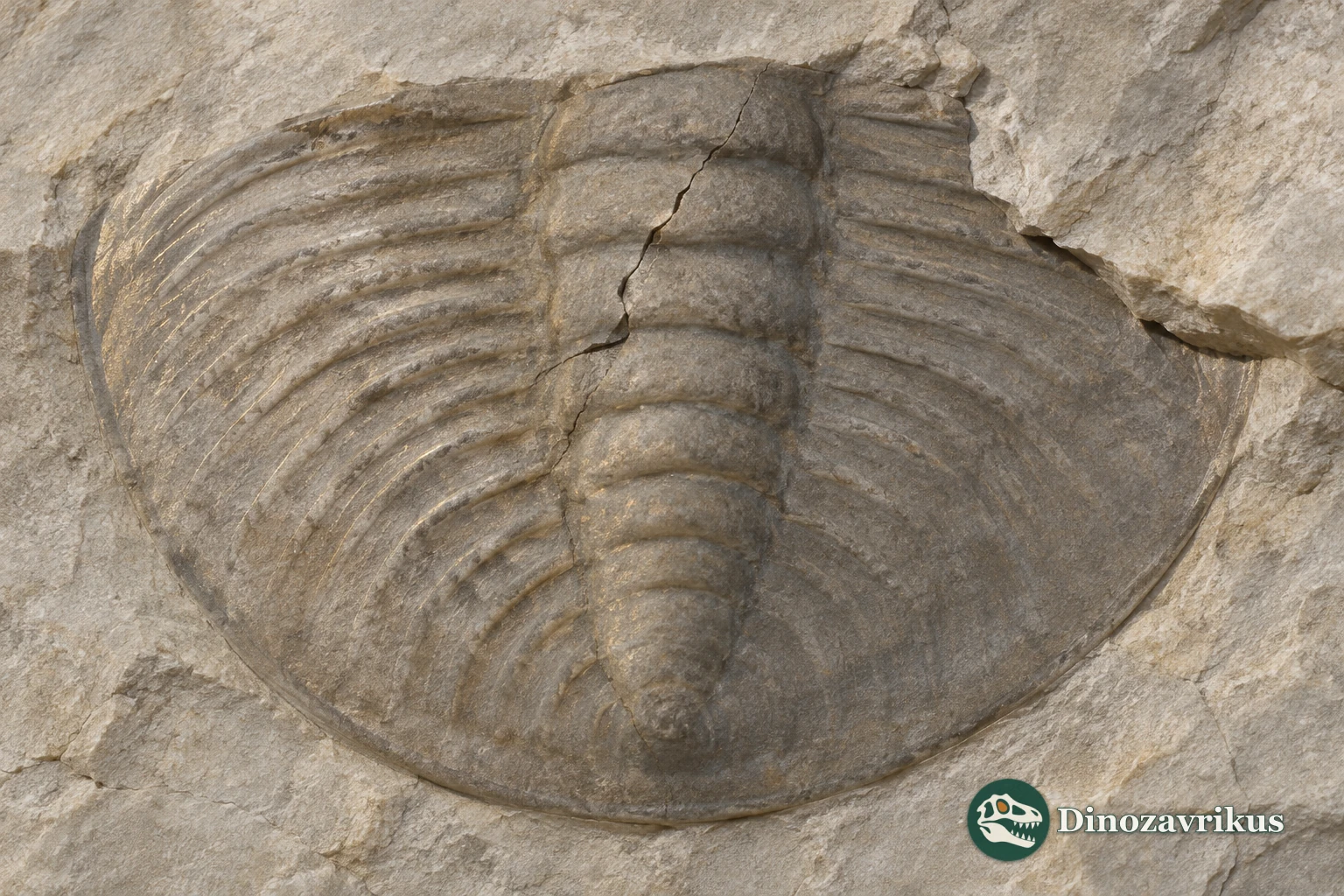
Two specimens from Holwell, England, were assigned to the type species: pygidium BU 21029 and left free cheek fragment BU 21030. The pygidium is broken across the median axis. The proportions of the axis, the lateral ribs and the outline are useful for comparison. The free cheek preserves information from an entirely different part of the shell, near the eye and the side of the head.
Two tail shields from the Moravian Karst
Mokrá Quarry in Czechia yielded two incomplete pygidia on one slab of shale. Their bed belongs to the latest Tournaisian, an early part of the Carboniferous. The shields are convex and nearly semicircular in outline.
The authors described the material as Cummingella cf. auge. The abbreviation signals a comparison with C. auge while leaving the precise species open. The fossils come from a well-defined interval even though the damaged shields cannot give an equally firm species identification.
Frequently asked questions
When did Cummingella live?
The fossils discussed here are Early Carboniferous, including material from the latest Tournaisian.
Which is the type species?
Cummingella jonesi, originally described as Phillipsia jonesii.
What is preserved at Holwell?
The study describes a broken pygidium and a fragment of the left free cheek.
Why is the Moravian species assignment tentative?
Both shields are incomplete. Their outline and convexity allow comparison with C. auge.