

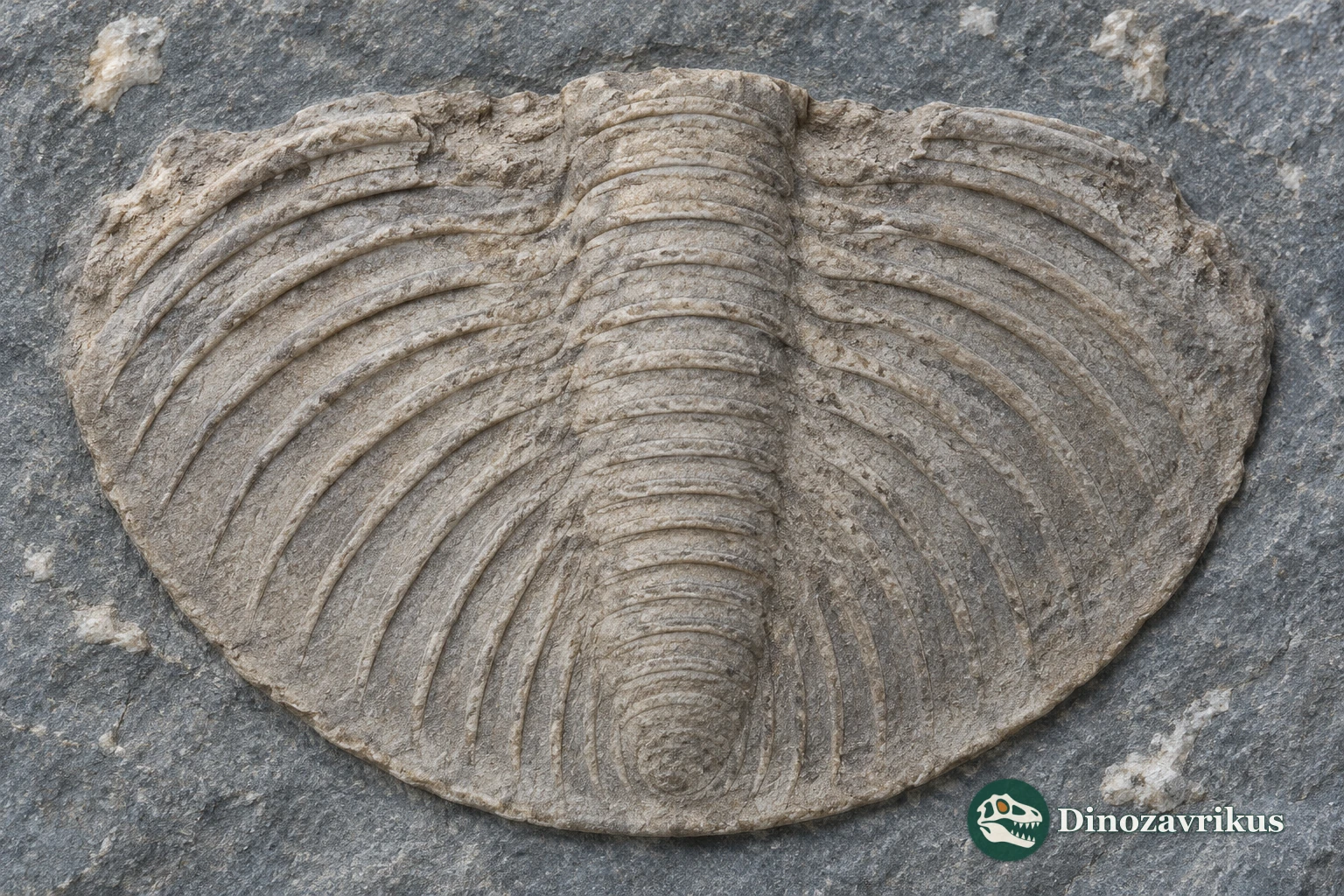
Phillipsia is a trilobite genus best known from Carboniferous fossils. Its tail shield has a ringed axis and lateral ribs. Their counts and profiles help separate species even when the tail is the only surviving part of the shell.
Quick facts
| Group | Trilobita, Phillipsiidae |
|---|---|
| Age of key material | Carboniferous |
| Genus named | Joseph Portlock, 1843 |
| Type species | Phillipsia kellyi |
| Type locality | Ardpodien, County Kildare, Ireland |
| Tail axis of the type species | 17 rings in the published diagnosis |
What can the fossils tell us?
Its Irish specimen allows the head and tail to be compared in the same individual.
In P. gemmulifera a row of tubercles divides each rounded rib into two nearly equal bands.
P. kellyi has 17 axial rings, compared with 13 to 14 in P. holwellensis. Rib shape and border width give additional clues.
An Irish specimen and the genus name
Joseph Portlock established Phillipsia in 1843. The official zoological list records P. kellyi as the type species. Specimen GSM 63045 from Ardpodien in County Kildare serves as a reference for comparisons. It comes from Upper Tournaisian rocks.
Nineteenth-century authors used the name Phillipsia for a much wider range of trilobites. Comparisons of their head and tail shields later moved some to other genera. The former Phillipsia maccoyi, for example, became the type species of Brachymetopus.
Reading the ribs of the tail shield
In P. kellyi the tail shield is narrow and elongate, with a flat border. Its axis has 17 rings and each lateral field has 13 ribs. The rear of each rib forms a steep slope.
John Phillips named the similar P. gemmulifera as Asaphus gemmuliferus in 1836. Its ribs are rounded in cross section. A row of tubercles divides each rib into two nearly equal bands. On the head, the anterior branches of the facial sutures diverge more strongly than in the type species.
Viséan shields from Somerset
Phillipsia holwellensis was described from tail shields in the Clifton Down Limestone at Holwell Quarry in Somerset. Holotype BU 21023₁ comes from Viséan strata. Six other shields were included in the type series, some only partly preserved.
The tail axis has 13 to 14 rings and the lateral fields have 11 to 12 ribs. The posterior ribs curve sharply backward and extend onto a narrow border. This combination distinguishes the Holwell fossils from the more elongated, more strongly ringed shields of the type species.

Frequently asked questions
What is the type species of Phillipsia?
Phillipsia kellyi, named by Joseph Portlock in 1843.
How many axial rings does the tail shield of the type species have?
The published diagnosis counts 17 rings.
How are the ribs of P. gemmulifera distinctive?
They are rounded in cross section and divided by a row of tubercles into nearly equal bands.
Where was P. holwellensis found?
In the Viséan Clifton Down Limestone at Holwell Quarry in Somerset, England.