

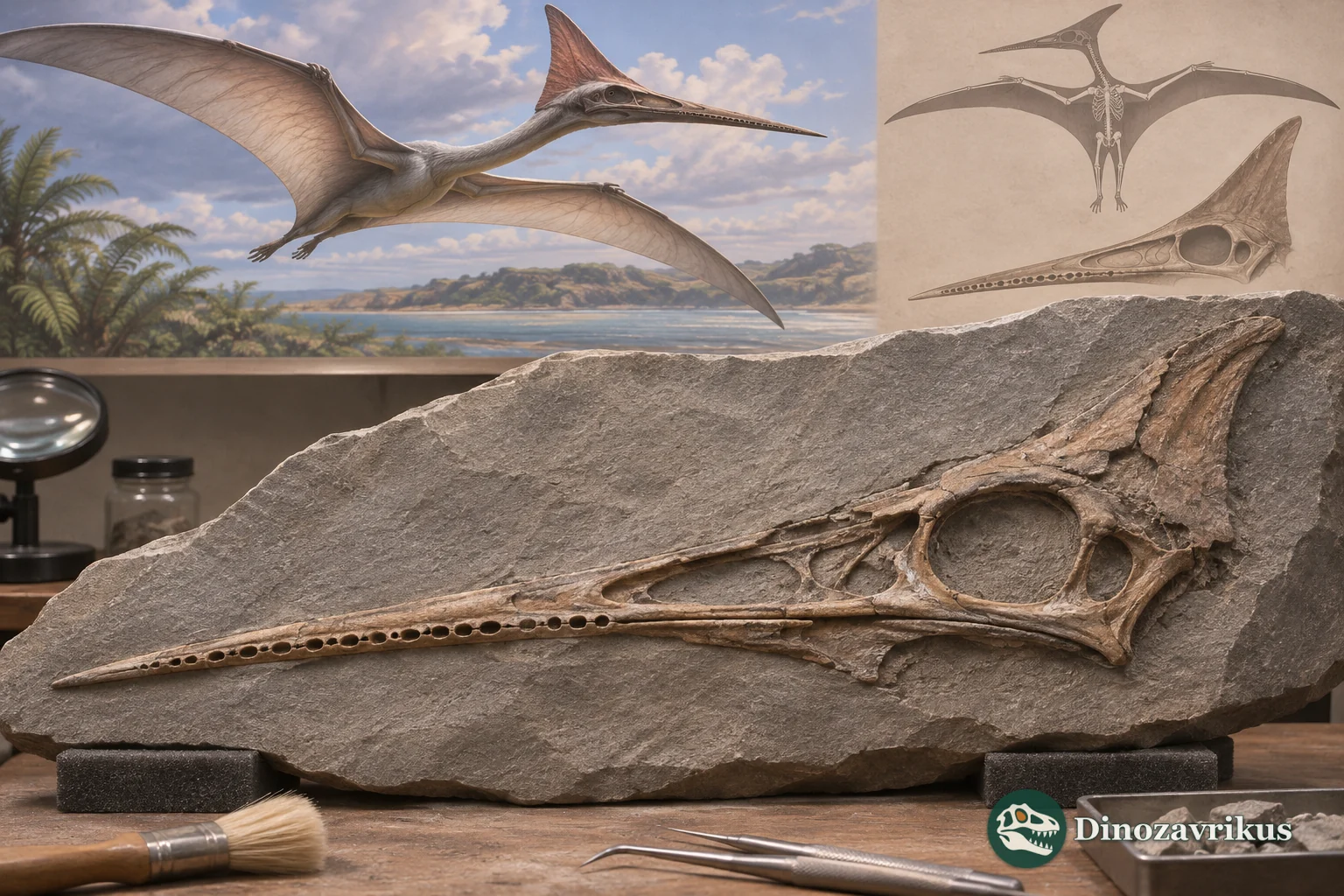
Cuspicephalus scarfi was named from a flattened skull found on the Dorset coast. The long pointed rostrum and partial low bony crest survive, but its teeth, lower jaw, wings and trunk do not. A life image therefore combines direct skull evidence with comparative assumptions.
Quick facts
| Scientific name | Cuspicephalus scarfi, Martill and Etches, 2013 |
|---|---|
| Holotype | MJML K1918, flattened partial skull on mudstone slab |
| Locality | Kimmeridge Bay, Dorset, England |
| Rock unit | Lower Kimmeridge Clay Formation |
| Age | Kimmeridgian, Late Jurassic |
| Skull length | 326 mm in the original measurement table |
| Teeth | Sockets preserved; teeth absent |
What can the fossils tell us?
MJML K1918 preserves a pointed rostrum, parts of the cranial roof and orbit. It lacks a lower jaw and postcranial skeleton.
The authors counted 12–13 alveoli ahead of the nasoantorbital opening. The total number of teeth is inferred because many positions are obscured.
A low bony crest is present, but its rear margin is incomplete. Soft-tissue extension is not preserved.
The skull has been compared with early monofenestratans including Darwinopterus; close relationships cannot be proved from the material alone.
Discovery at Kimmeridge Bay
Fossil collector Steve Etches found the slab on the foreshore at Kimmeridge Bay in December 2009. The dark mudstone belongs to the lower Kimmeridge Clay Formation, within the Aulacostephanus autissiodorensis ammonite zone. Compaction flattened the skull, while marine erosion removed some bone before collection. The holotype is catalogued as MJML K1918.
David Martill and Steve Etches described Cuspicephalus scarfi in a paper released online in 2011 and printed in 2013. The genus name refers to the pointed head; the species honours cartoonist Gerald Scarfe.
A long rostrum and absent teeth
The original description recorded a skull length of 326 mm. The snout is long and slender, and parts of the orbit and nasoantorbital opening remain visible. The authors identified 12–13 tooth sockets in front of the large opening. Their higher estimate for the entire row is an inference across hidden or destroyed positions.
No teeth survive in the skull. A low fibrous bony crest is preserved along part of the snout, although its rear edge is incomplete. The lower jaw is absent. The fossil alone does not establish a precise feeding method.
How it fits among pterosaurs
Martill and Etches placed the animal among monofenestratans and noted similarities to Darwinopterus, without claiming that a close relationship had been proved. A later analysis by Witton and colleagues revisited its relationships. A skull-only taxon remains difficult to place when key body and wing characters are unknown.
Ceoptera presents the opposite preservation pattern, with postcranial remains but no skull. Campylognathoides is another Jurassic pterosaur, yet its fossils cannot fill the missing Cuspicephalus skeleton.
The limit of a reconstruction
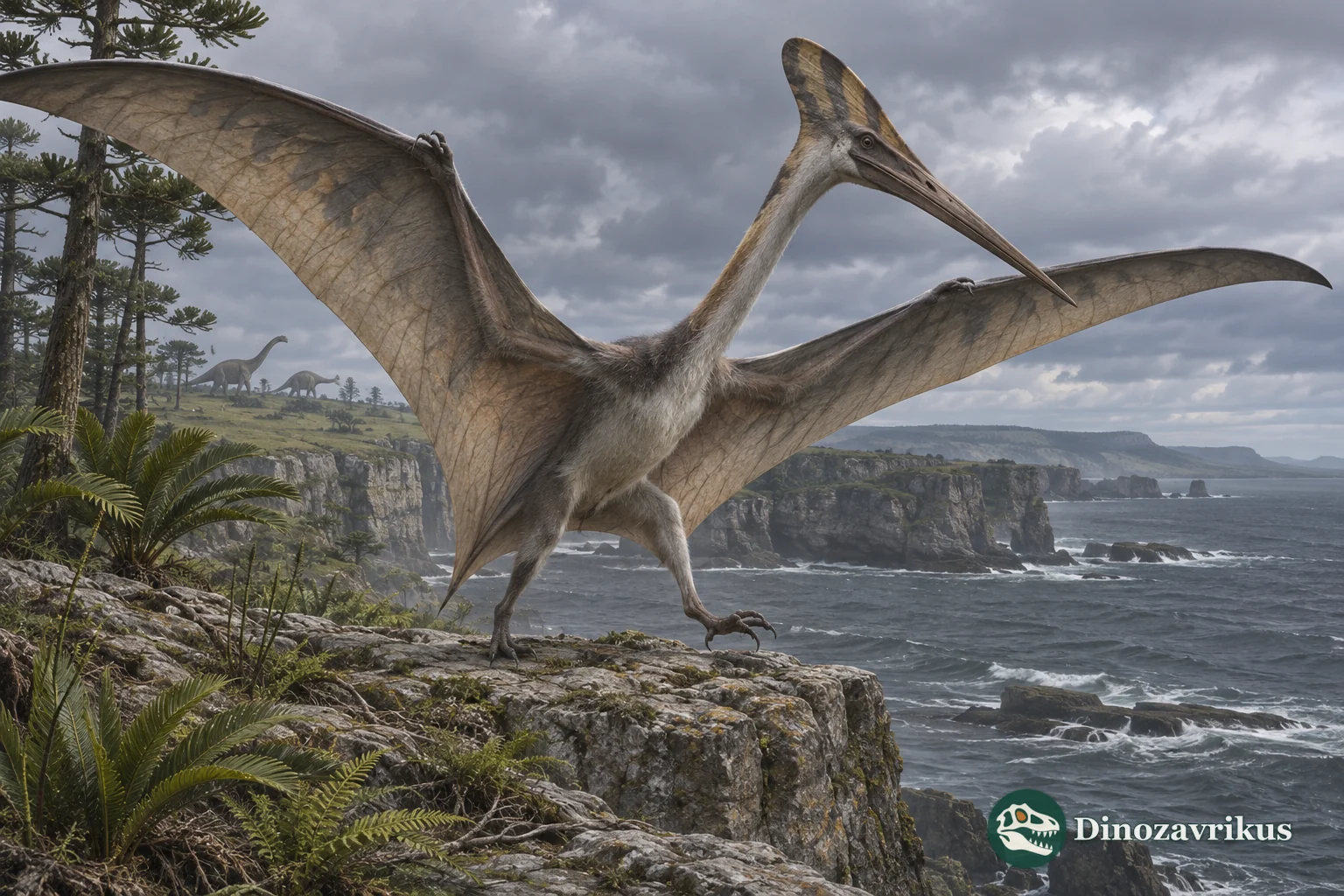
Neither the wingspan nor the colour can be measured from MJML K1918. The coastal life scenes in this article represent an interpretation of a possible animal and setting. The skull supports a long pointed rostrum and a partial bony crest, while the rest would need new fossil evidence.
Frequently asked questions
Who discovered Cuspicephalus?
Steve Etches collected the holotype at Kimmeridge Bay in Dorset in December 2009.
Were its teeth preserved?
No. Tooth sockets can be studied, but the teeth themselves are absent from the type skull.
How long is the skull?
The original measurement table gives 326 mm for the flattened skull; this is not a body length.
Is its wingspan known?
No wing bones accompany the holotype, so a wingspan cannot be measured directly.