

Cuvierichelys is a freshwater turtle recorded across the Late Eocene and Early Oligocene of Europe. Its name is anchored in fossils from the gypsum of Montmartre. A Belgian assemblage later helped distinguish features that vary between individuals from those that separate species.
Quick facts
| Group | Turtles, geoemydids (Geoemydidae) |
|---|---|
| Age | Late Eocene and Early Oligocene |
| Region | Europe (France, Belgium and Spain) |
| Type species | Cuvierichelys parisiensis |
| Type material | Syntype series including MNHN.F.GY1 |
| Scientific name | Cuvierichelys |
| Diet | Exact diet unknown |
What can the fossils tell us?
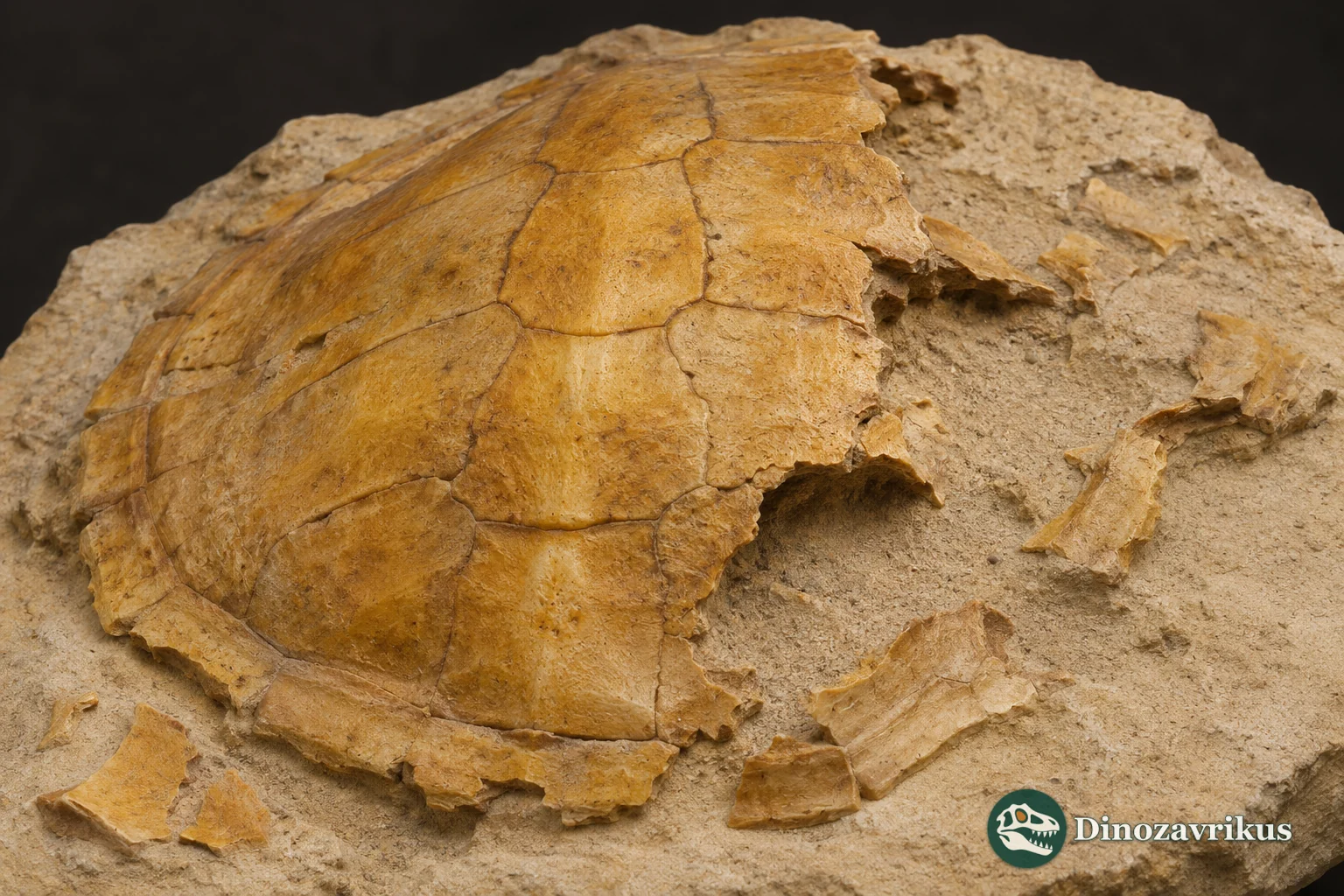
MNHN.F.GY1 is one of several fossils listed as syntypes at the natural history museum in Paris.
The Boutersem bones preserve marks left by the surface scutes. Their placement differs across the assemblage.
The Paris fossils are Late Eocene. The Belgian material comes from Early Oligocene sands of the Borgloon Formation.
The name from Montmartre
John Edward Gray named the Paris species Emys parisiensis in 1831. Sophie Hervet erected Cuvierichelys in 2004, honouring Georges Cuvier. The Muséum national d’Histoire naturelle in Paris lists a syntype series, including MNHN.F.GY1, MNHN.F.GY2 and MNHN.F.GY7.
The shell anatomy places the genus among freshwater geoemydids. Europe’s Eocene turtle record also includes marine lineages such as Eochelone.
A composite picture of the shell
The Boutersem Sand Member of the Borgloon Formation in Belgium yielded pieces from nearly every part of the upper and lower shell. These include bones from multiple individuals. The carapace has a weak or absent centre keel and lacks lateral keels. A deep notch indents the back of the plastron.
Adán Pérez-García, Thierry Smith and Richard Smith compared the grooves left by the scutes across the assemblage in 2016. The throat scutes extend different distances over neighbouring bones. Grooves around the rear of the carapace also vary. A series from one locality made the range of variation easier to evaluate.
Where the authors drew the species boundary
The authors treated C. crassa as a synonym of C. parisiensis, because the shell differences fell within the range observed at Boutersem. They retained the Early Oligocene Spanish species C. iberica, whose carapace bears three longitudinal keels.
The shells record the genus on both sides of the Eocene–Oligocene boundary. They provide no direct evidence of its diet.
Frequently asked questions
Where does the type species come from?
It comes from the Late Eocene gypsum deposits of Montmartre in Paris.
Is MNHN.F.GY1 a holotype?
It is one of several syntypes in the Paris collection.
Why was Cuvierichelys crassa synonymised with C. parisiensis?
The shell differences fit within the estimated variation of C. parisiensis in the Belgian material.
What distinguishes the Spanish species?
Cuvierichelys iberica has three lengthwise keels on the carapace. The type species lacks the lateral pair.