

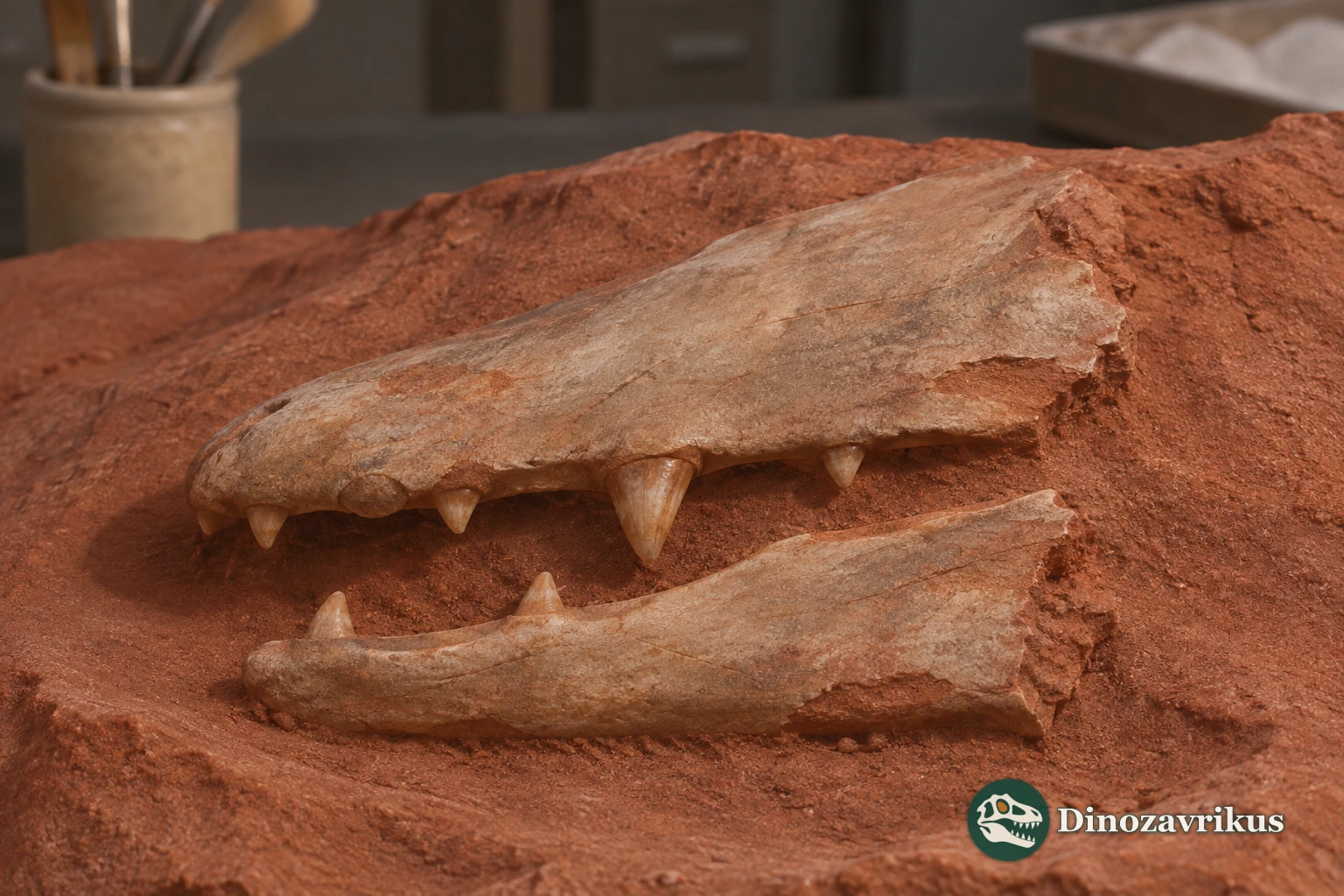
Cynodontosuchus rothi was a Cretaceous crocodyliform from Argentine Patagonia. It was described from the front of the snout and part of a lower jaw. Their small size and relatively smooth bone surfaces have prompted different views of whether the specimen represents a distinct genus or a young animal of another kind.
Quick facts
| Species | Cynodontosuchus rothi |
|---|---|
| Group | Notosuchian of disputed affinities |
| Age | Cretaceous, precise horizon unknown |
| Region | Neuquén, Argentina |
| Principal evidence | Front of the snout and lower jaw |
| Length preserved | Less than 10 cm of the snout |
What can the fossils tell us?
The snout and lower jaw retain evidence about the teeth and palate. Their size does not provide the full skull length or body length.
An association with other fossils from historical collections makes the Late Cretaceous Bajo de la Carpa Formation a possible source. The original bed was not recorded.
A small snout and relatively smooth bone surfaces fit the juvenile interpretation. A series of specimens at different ages is needed to test it.
One specimen from Neuquén
Arthur Smith Woodward described Cynodontosuchus in 1896 in a work on crocodyliforms from the red sandstones of Neuquén. The type, MLP 64-IV-16-25, is held at the Museo de La Plata. It includes the front of the snout and an adjoining piece of lower jaw. The portion of the snout that survives is less than ten centimetres long. It does not provide a total skull measurement.
The precise position of the fossil in the local beds is uncertain. Comparisons with other material described by Woodward suggest the Late Cretaceous Bajo de la Carpa Formation as a possible source.
Teeth, palate and the juvenile hypothesis
The teeth in the premaxilla were less enlarged than in some other baurusuchids. The palate lacks the pronounced rough area along the midline seen in several members of that group. Its relatively smooth bone surfaces could have reflected either anatomy that persisted into adulthood or an early stage of growth.
Felipe Montefeltro and colleagues recovered Cynodontosuchus as an early branch of Baurusuchidae in 2011. They also considered whether the fragment might be a juvenile of Wargosuchus, which came from the Bajo de la Carpa Formation. In Campinasuchus, a more extensive fossil series includes vertebrae and limbs that help researchers recognise a juvenile.
A name with a disputed status
Darlim and colleagues included Cynodontosuchus among baurusuchids in their 2021 analysis. In a 2025 survey André Pinheiro and colleagues listed the name as doubtful among cutting-toothed crocodyliforms. Settling its status requires comparable material that can distinguish juvenile characters from those shared by individuals of the same species.
Frequently asked questions
Is there a complete skeleton of Cynodontosuchus?
The type in the Museo de La Plata preserves parts of the snout and lower jaw. The trunk and limbs are unknown.
How old is the fossil?
It is from Cretaceous rocks of Neuquén. Its suggested origin in the Late Cretaceous Bajo de la Carpa Formation remains indirect.
Was Cynodontosuchus a young Wargosuchus?
That possibility has been raised on the basis of its size and bone sculpturing. More comparable material would be needed to confirm it.
What does the ten-centimetre figure measure?
It refers to the preserved part of the snout. The overall length of the head and body is unknown.